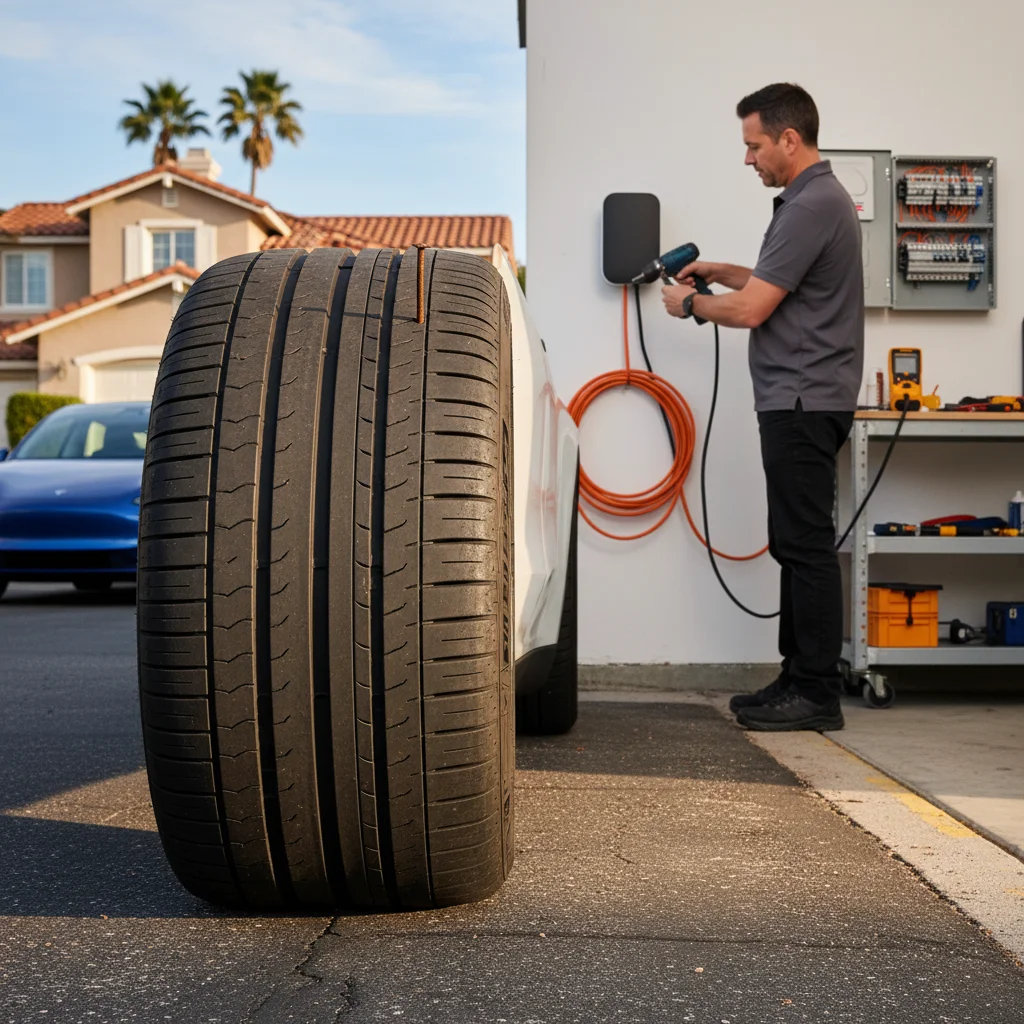
Tesla ships with standard tires on every model. They are not run-flats. A puncture on a hot South Florida road still leaves you on the shoulder. Here is what to carry, what to do when you get a flat, and why the answer is not a longer drive on a flat tire.
The short answer
Tesla does not ship with run-flat tires. The standard tires on the Model 3, Model Y, Model S, and Model X are conventional radials. A puncture on a hot South Florida road leaves you on the shoulder, the same as any car. Run-flat tires are an aftermarket option some owners install, but they are not the factory setup.
What run-flat tires are
Run-flat tires are reinforced on the sidewall so the tire can carry the weight of the car for a short distance after losing air. They let you drive 50 miles or so at reduced speed to reach a service center. They are common on some luxury and performance cars but not on most consumer EVs.
The trade-offs:
- Run-flats are heavier than standard tires, which reduces range.
- Run-flats wear faster and are more expensive to replace.
- Run-flats give a harsher ride because of the stiffer sidewall.
- Run-flats still need to be replaced after a puncture; they are not permanent fixes.
Why Tesla does not ship with run-flats
Tesla optimizes for range and ride quality. Run-flats would reduce both. The standard tires on the Model 3 and Model Y are low-rolling-resistance radials that maximize range. The standard tires on the Model S and Model X are performance-oriented radials that prioritize handling.
Tesla does offer a tire repair kit and, for some models, an accessory compact spare. The factory setup assumes the driver carries a kit and either plugs a puncture or calls for help.
What to do when you get a flat on a South Florida road
Get as far off the lane as you can
Use the remaining momentum to reach the shoulder. Aim for an emergency pull-off or an exit ramp.
Set your hazards
A Tesla’s hazard lights run on the 12V battery. If the 12V is healthy, the hazards run for a long time. If the 12V is weak, they run for minutes.
Stay or exit based on conditions
If traffic is moving fast and close, exit the car on the passenger side and move upwind of the lane. Get past the guardrail if there is one. If traffic is light and you have a wide shoulder, stay with the car.
Try a plug repair if the puncture is small
A tire repair kit can plug a small puncture in the tread. The kit comes with the car. Follow the kit’s instructions. A plugged tire is not a permanent fix; it is a way to reach a tire shop.
Call for help
Two paths cover most of the South Florida freeway network:
- Tesla roadside for a tire change with the spare, or a tow if no spare.
- A local mobile tire service for a fresh tire delivered to your location.
A mobile tire service that brings a fresh tire to your shoulder is often faster than the dispatched Tesla roadside provider.
What a local mobile operator does
A mobile operator working the South Florida metro brings:
- A jack sized for the Tesla.
- A fresh replacement tire if you want one.
- A tire repair kit for a pluggable puncture.
- A 12V jump pack in case the 12V is also low.
The operator swaps the tire at your location. You drive away on a working tire without a tow.
For a puncture that can be plugged, the operator plugs the tire and reinflates it. You drive away without a spare.
Why a hot South Florida shoulder is the worst spot
Three things make a flat on a South Florida expressway its own situation:
- Traffic moves fast and close. Sitting on the shoulder of I-95, the Turnpike, or I-75 is dangerous.
- Heat softens the asphalt and slows the dispatched service. A 30-minute roadside stop stretches to 45 or 60.
- The dispatched service may not have a Tesla-compatible jack. Some providers refuse Tesla calls.
For a Model 3 or Model Y with a tire repair kit and no spare, the path is a tow to a tire shop. The driver is exposed on the shoulder the whole time the tow is being dispatched.
How to avoid the next flat
- Check tire pressure monthly. Heat raises pressure; cold fronts lower it. The recommended pressure is on the door pillar.
- Replace tires before the tread is gone. Tesla recommends replacement at 4/32 inch on Model 3 and Model Y.
- Watch for nails and screws on construction zones. The South Florida road network has a lot of active work.
- Carry a tire repair kit and a portable inflater in the car.
What about run-flat aftermarket tires
Some Tesla owners install run-flat tires as an aftermarket upgrade. The trade-offs above apply. Range drops a few percent, the ride is harsher, and replacement cost is higher. For most drivers, the factory setup plus a tire repair kit is the right answer.
Frequently asked questions
Do Teslas come with run-flat tires?
No. Tesla ships with standard radials on every model. Run-flats are an aftermarket option.
What does Tesla include for flat tires?
A tire repair kit on most models. A compact spare kit is available as an accessory on Model 3 and Model Y.
Can I drive a Tesla on a flat tire?
A short distance at low speed to a safe spot is fine. Driving on a flat for any length of time damages the tire and the wheel.
What does a local mobile tire service cost?
The operator quotes you before starting. Charge Pro MIA does not set the rate.
When does a Tesla need a tow, not a tire change?
If the tire is destroyed, the wheel is damaged, or the car has additional issues, the next step is a tow to a shop.
When to call us
If your Tesla has a flat tire anywhere in Miami-Dade or Broward, call us. A mobile operator meets the car with a jack, a fresh tire, or a tire repair kit. They quote you before starting and bill you directly.
Call us at (786) 963-2995 to reach a local operator.