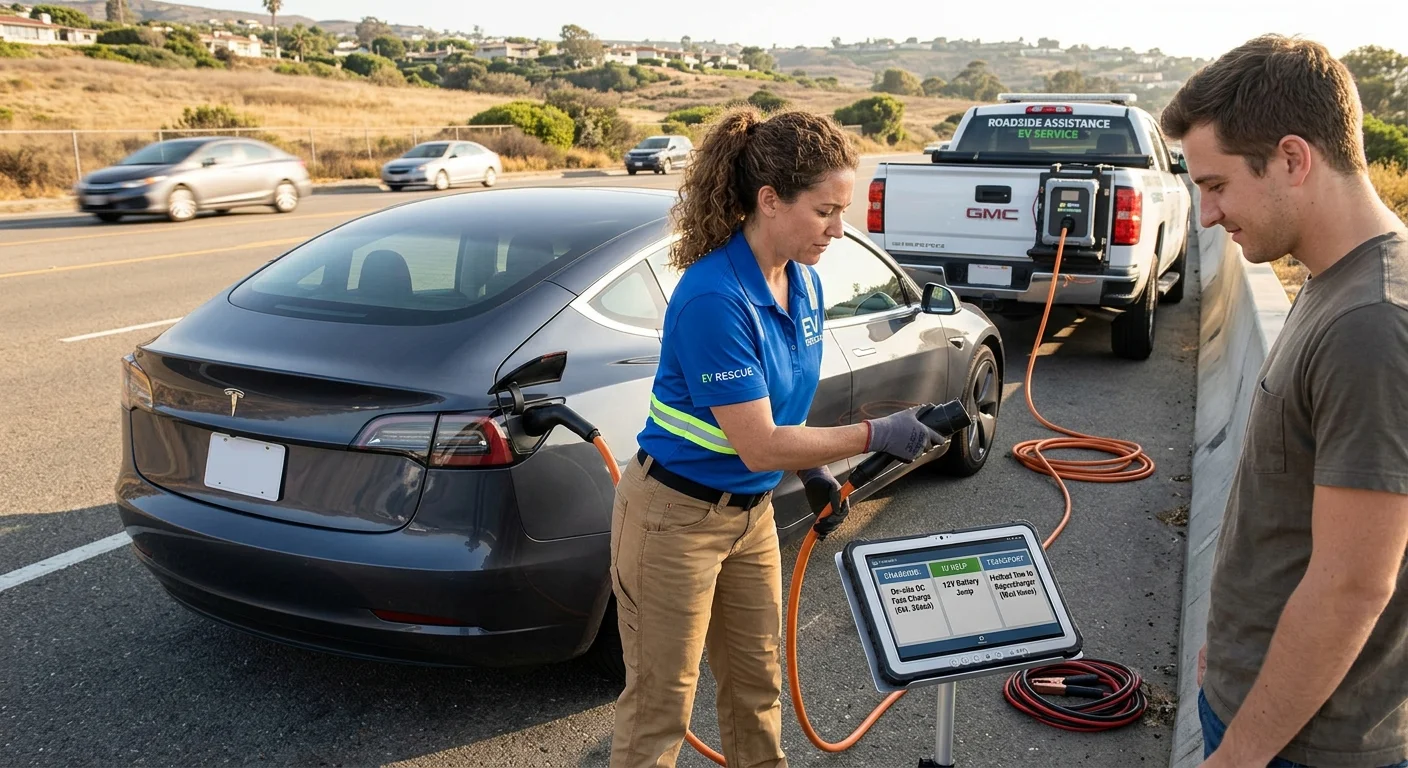
Your electric car has died. Doors locked or unlocked, dashboard lit or dark, traction pack showing 4% or 80%. The right next step depends on which system failed. Here is how to tell, and what each path looks like in South Florida.
The short answer
There are three dead-EV situations, and the right recovery is different for each:
- The traction pack is low but the 12V is fine. A mobile charge at your location gets you moving again.
- The 12V is flat or failing. A jump delivered to the car wakes it. The traction pack can still have range.
- The high-voltage system is faulted, the car was in an accident, or it sat in floodwater. That is a tow, not a charge.
How to tell which one you have
Look at three things before you call anyone.
The dashboard
A traction-pack-low car usually still has a working dashboard. The screen reads 0% or “Battery Empty,” and the car may go into a reduced-power mode. The lights, locks, and touchscreen still work because the 12V is fine. You can unlock the doors, put on hazards, and call.
A 12V-flat car is dark. Doors do not unlock from the fob. The interior lights do not come on when you pull the handle. The dashboard does not boot. The car looks like it has no power at all, even though the traction pack may still have plenty of charge.
A high-voltage fault can look like either. The car may show a “Service Vehicle” or “Service High-Voltage System” message, or it may simply refuse to wake. Watch for clicking sounds under the car, a burning smell, or visible damage.
The traction-pack state
If the dashboard is up, the state of charge is right there. Below about 5% the car will not move. Between 5 and 15% the car may still drive but should not start a long trip. Above 20% and the car is fine for short errands; if it died with that much range, the issue is usually a 12V or a fault.
The 12V symptoms
A 12V that has been failing often gives days of warning. Watch for:
- The key fob taking several presses.
- “Low 12V Battery” messages on the driver display.
- The screen booting to the logo and dying.
- Lights flickering or dimming at idle.
If you have seen any of these and now the car is dead, the 12V is the prime suspect.
What to do for each case
Traction pack low
This is the cleanest dead-EV situation. The car still works. The pack just ran out before you reached a charger. A mobile rescue operator brings a 240V Level 2 source to your location. The session typically adds 10 to 20 miles of range in 15 to 30 minutes of charging. That is charging time, not a promise about when someone arrives.
Common South Florida situations:
- A driver who misjudged the run from Aventura to Hollywood on US-1.
- A tourist whose rental ran low on the causeway to Miami Beach.
- A condo owner who ran the pack down without a home plug.
- An airport returner who sat in traffic on 836 or 95.
The operator meets the car in any of these places and tops you off at the curb.
12V flat or failing
A jump from a portable pack wakes the car. Once the dashboard is up, you can drive. If the 12V has died once in this heat, it is going to die again. A replacement battery and a charging-system check at a service center save the next call.
Common South Florida situations:
- A car parked at MIA for ten days.
- A car in a PortMiami cruise garage for a week.
- A car in a Brickell or Aventura tower during a long trip.
- A car that lives outside in Hialeah, Miramar, or Homestead, where summer heat has cooked the 12V.
A mobile operator meets the car in the garage, jumps the 12V from a stable external source, and the driver goes on. If the 12V is dead beyond recovery, the operator replaces it on the spot.
High-voltage fault or accident
Set your hazards. Get clear of traffic. Call for a flatbed. Florida Statute 316.194 lets a disabled vehicle stay where it is if it cannot practicably be moved. A tow operator on contract with your insurance or roadside card will take the car to a qualified shop.
A car that sat in floodwater is its own category. NHTSA warns that residual salt in a flooded lithium pack can short days or weeks later, causing fires. Do not park a flood-exposed EV within 50 feet of a structure and do not charge or drive it until it has been inspected. About 36 EVs flooded by Hurricane Ian in 2022 later caught fire. Tow it to a service center.
When a mobile operator is the right call
A mobile rescue operator fits almost every South Florida dead-EV situation that is not an accident or a high-voltage fault. The operator brings:
- A 240V Level 2 source with J1772, NACS, or both, depending on the car.
- A 12V jump pack.
- A 12V replacement battery for most models.
- Tools for a stuck charge port.
The operator quotes you before starting and bills you directly. There is no charge for the diagnostic itself.
If you are unsure which case you have, call us and describe the symptoms. A dispatcher walks you through the steps.
How to avoid the next dead-EV moment
- Drive the car at least once a week.
- Keep the 12V healthy. Replace it every two to three years in this climate.
- Top up before long sits, and keep a portable Level 1 or Level 2 EVSE for emergencies.
- Watch the dashboard for warnings before the 12V goes flat.
- Park in shade or a garage when you can.
Frequently asked questions
How do I tell whether my dead EV is a 12V or a traction-pack issue?
Look at the dashboard. If it is lit, the 12V is fine and the traction pack is the issue. If it is dark, the 12V is the prime suspect.
Can I jump an EV with another car?
Yes, with care. Follow the owner’s manual jump points. Do not use your EV to jump another car; that role is inbound only.
Does a dead EV need a tow?
Only if the high-voltage system is faulted, the car has visible damage, or it sat in floodwater. Most dead EVs are jumpable or chargeable at your location.
What does a mobile operator charge for a top-up?
The operator quotes you before starting. Charge Pro MIA does not set the price; the local operator does.
What happens after a flood-exposed EV dies?
Do not charge it. Do not park it near a structure. Tow it to a service center and have it inspected before any further use.
When to call us
If your electric car has died anywhere in Miami-Dade or Broward, call us and describe the symptoms. We will connect you with a local operator who can charge it, jump it, or tell you it needs a tow.
Call us at (786) 963-2995 to reach a local operator.