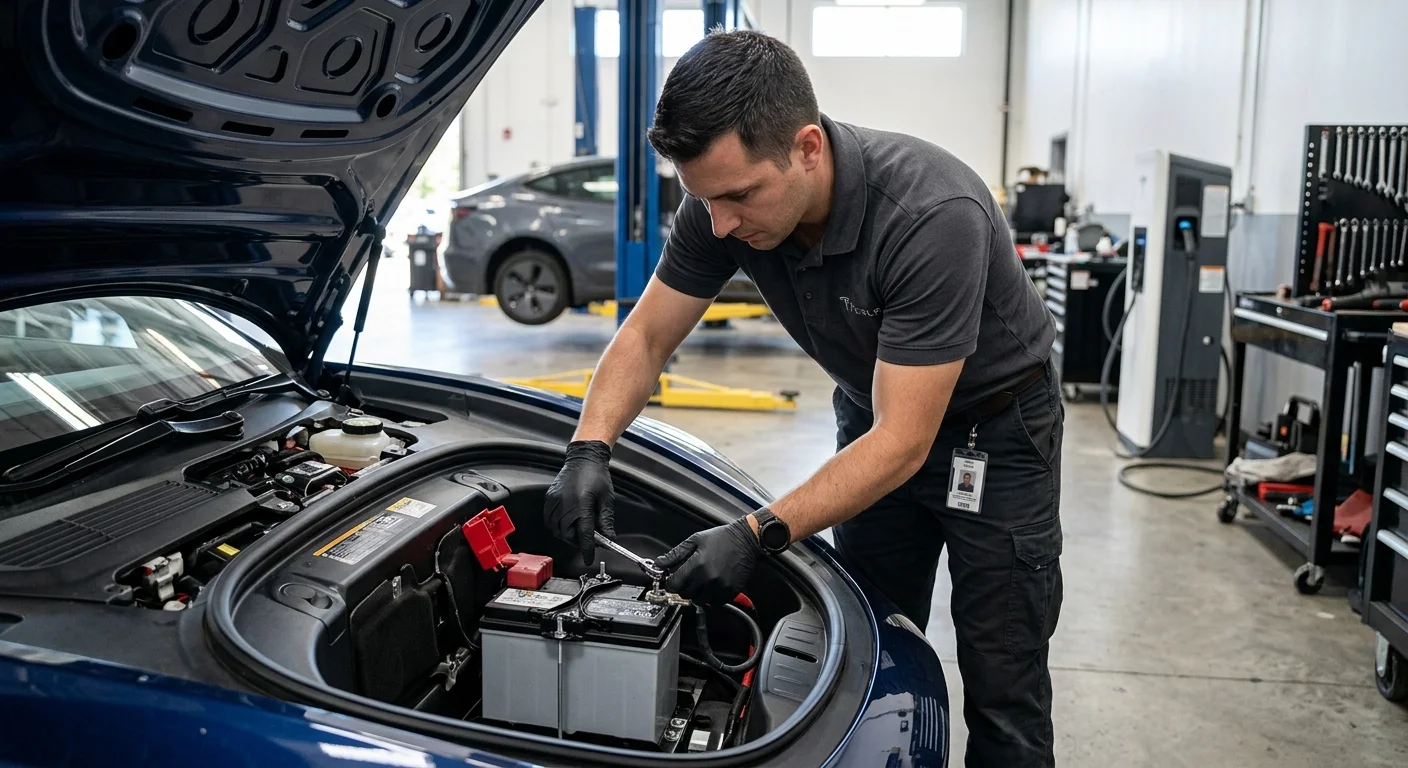
Every modern EV has a small 12-volt battery hidden somewhere under the hood or in the frunk. It does not move the car. It wakes the car, runs the computers, and lights up the touchscreen. When it dies, the car looks dead even though the high-voltage traction pack may still be at 80%. In South Florida’s heat, that little 12V is one of the most failure-prone parts of the car.
The short answer
An EV 12V battery is a service item with a shorter life than the traction pack. Heat, time parked, and accessory drain all wear it out. Most EVs need a 12V replacement every two to four years in this climate, sooner if the car lives outside. Watch for the warning signs and replace before it strands you.
What the EV 12V actually does
The 12V battery in an EV does the same job it has always done in a gas car: run the low-voltage electronics. It powers the body control module, the infotainment screen, the door locks, the interior and exterior lights, and the contactors that close the high-voltage circuit between the traction pack and the drive unit. Without a healthy 12V, the car cannot wake.
The traction pack keeps the 12V topped off through a DC-to-DC converter while the car is awake. While the car is parked, the 12V is on its own. A modern EV draws milliamps to keep telematics, security, and keyless entry awake, and a long sit can drain a healthy 12V below the threshold the body control module needs to boot.
Newer EVs ship with lithium 12V packs that hold their charge better and last longer. Lead-acid 12V packs are still the standard on most models and age fast in heat.
Why heat matters in South Florida
Every roughly 15F rise above 77F halves the useful life of a lead-acid battery. Miami-Dade and Broward push ambient temperatures well past 90F from May through September, with daily highs above 90F on about 60 days a year in a normal year. A lead-acid 12V that would last five years in a milder climate is aging twice as fast here. Three years of calendar life in Miami is closer to six years of calendar life in Atlanta.
Heat damage cannot be reversed. A 12V that has cooked in summer will not recover in winter. Once the plates sulfate or the case swells, replacement is the only answer.
Signs a 12V is on its way out
The 12V usually gives days of warning before it strands you. Watch for:
- “Low Battery” or “12V Battery Needs Service” messages on the driver display.
- The key fob takes several presses to unlock the doors.
- The interior lights dim or flicker at idle.
- The infotainment screen takes longer to boot.
- The car wakes to the logo, then dies.
- The windows move more slowly than usual.
- The climate control fan sounds sluggish at first start.
Any combination of these is a 12V in trouble. A replacement within the next week saves the next call.
When to replace on a schedule
In South Florida, replace on a calendar schedule rather than waiting for a failure. Most lead-acid 12V batteries in this climate last two to three years of calendar life. Lithium 12V packs last longer, often five years or more. If your car came with a lithium 12V from the factory and it is more than five years old, replace it before it strands you in summer.
If the car lives outside or in an uninsulated garage, shorten the calendar window. Heat soak in a closed garage accelerates the aging.
What the replacement costs
A 12V battery for an EV is usually a standard group-size lead-acid or AGM unit. The part is inexpensive. The labor is what drives the cost because the battery sits under a panel that has to come off and because some cars want the new battery registered with the body control module. The total at a dealer is often several hundred dollars. An independent shop can do it for less.
Charge Pro MIA does not set the price. The operator or shop that does the work quotes you before starting.
What to do when a 12V strands you
A dead 12V looks dramatic but is usually recoverable on the spot.
Reach the jump points
Every EV has manual jump points. They are usually under the hood, marked with a red cover or a + symbol. The Tesla Model 3 and Y have them behind the frunk panel on the passenger side. The Model S and X use the panel under the hood. The Chevy Equinox and Bolt use the under-hood posts. Your owner’s manual shows the exact location.
Apply a clean external 12V source
A portable lithium jump starter connected to the right posts wakes the car. Match polarity, follow the manual’s connection order, and disconnect in the order the manual gives. A clean source avoids voltage spikes that can damage the DC-to-DC converter.
A mobile rescue operator carries the right pack and knows the order for your model. They quote you before starting and bill you directly.
Drive to a shop for replacement
Once the car wakes, drive it to a service center or mobile mechanic within days. A jumped 12V that has died once in this heat will die again. The shop swaps the battery, registers it with the body control module if needed, and resets any charging fault codes.
If the 12V is dead beyond recovery, a mobile operator may carry a fresh unit and replace it on the spot. Ask when you call.
How to extend the next 12V’s life
- Park in shade or a garage when you can. Heat is the killer.
- Drive the car at least once a week.
- Unplug accessories like dash cams and OBD-II dongles for long sits.
- Replace on a calendar schedule rather than waiting for a failure.
- Watch for the warning messages in the weeks before a failure.
Frequently asked questions
How long does an EV 12V battery last in South Florida?
Two to three years of calendar life for a lead-acid 12V in this climate, sometimes less for a car that lives outside. Lithium 12V packs last longer, often five years or more.
What does a 12V failure look like?
A dark dashboard, no response to the fob, no interior lights. The traction pack can still have range; the 12V is the gateway.
Can I replace an EV 12V battery myself?
Often yes, but some cars require the new battery to be registered with the body control module. A shop or mobile mechanic with EV experience handles that step.
Does a mobile rescue operator carry a 12V replacement?
Many do, for common models. Ask when you call.
When does a dead EV 12V need a tow, not a jump?
Almost never. A dead 12V is jumpable. A high-voltage fault or accident is a tow.
When to call us
If your EV has died and you suspect the 12V, call us before you assume the worst. A mobile operator meets the car, jumps the 12V, and either gets you moving or replaces the battery on the spot.
Call us at (786) 963-2995 to reach a local operator.