The EV battery type that matters when you’re stranded isn’t cell chemistry. It’s the traction pack versus the 12-volt system. That split decides a Level 2 top-up or an on-site jump.
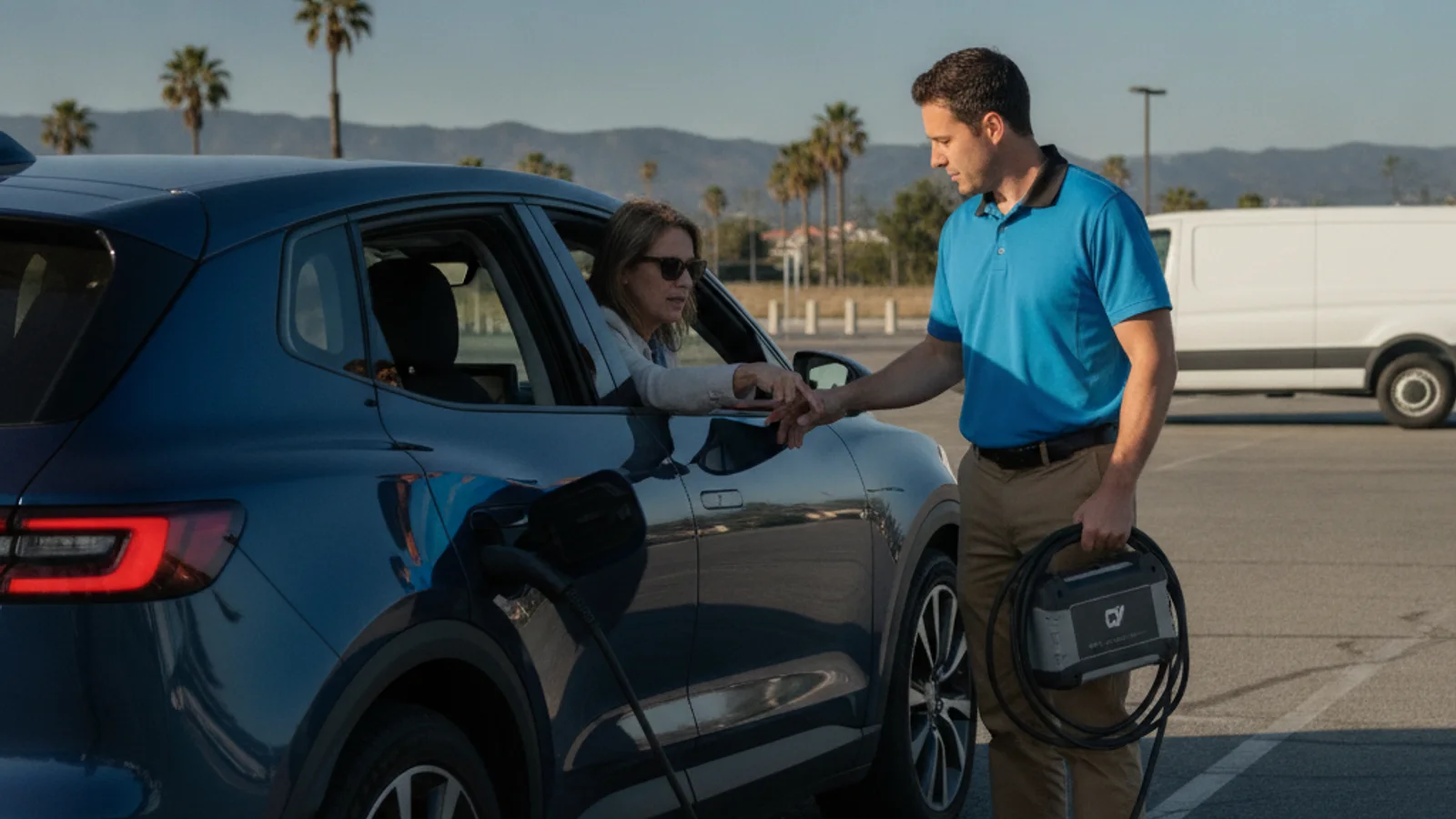
Traction pack versus 12-volt, not chemistry
Every EV carries two batteries with different jobs. Mix them up and you call the wrong help.
The traction pack lives under the floor. It stores the energy that turns the motor. You refill it at a wall plug or a public charger. Buying guides treat EV battery types as pack chemistry. NMC and LFP labels belong in that shopping talk. They don’t pick the help that reaches you tonight.
The 12-volt battery is the small one. It doesn’t drive the car. It wakes the computers and the door handles. It also closes the relays that let the pack connect. If that battery dies, the car can go fully dark. The pack underneath can still be full.
That’s the roadside fork. An empty pack is an energy problem. A failed 12V is a low-voltage problem. One needs a charge. The other needs a jump or a replacement, if your maker allows it.
Charge Pro MIA is a referral line. It matches stranded drivers with independent local operators. It doesn’t own trucks, hold a license, or set prices. The operator quotes you before work starts and bills you directly. The pros we connect you with are licensed and insured. They bring a 240-volt Level 2 source to the car. That’s a native NACS plug, plus CCS or J1772 adapters for non-Tesla EVs. They typically add 10 to 20 miles of range in 15 to 30 minutes of charging. That’s charging time, never an arrival time. They also jump or replace a dead 12V on site. They handle Tesla and every major EV brand.
Heat is what wears the small battery here
South Florida is flat. Range here isn’t a hill problem. Miami-Dade’s Atlantic Coastal Ridge tops out around 23 to 24 feet. Broward’s Pine Island Ridge is about 29 feet. What you lose is heat, air conditioning, and cars that sit.
NWS Miami normals put July and August highs at 91F. A normal year brings about 64 days at or above 90F. Recurrent Auto studied about 30,000 EVs. It found about 5% range loss at 90F, and about 17 to 18% at 100F.
The 12-volt story is harder. Battery University notes that every roughly 15F rise halves lead-acid life. Heat damage doesn’t reverse. That’s why so many EVs won’t wake after a week in a garage.
Older housing makes the backup plan thinner. North Miami is 82.7% pre-1980. Miami Springs is 89.5%. Many of those buildings never got a home charger. Doral is only 5.5% pre-1980. Weston is 7.0%. That doesn’t change which battery failed. It changes whether you can limp home after a top-up.
Florida Power and Light serves essentially all of Miami-Dade and all of Broward. Homestead is the confirmed exception. Parts of that city run on Homestead Public Services Energy. Confirm the boundary at homesteadfl.gov or (305) 224-4800.
After MIA or a cruise, start with the 12V
A car left for a week often comes back silent. The traction pack is usually fine. The 12V drained keeping systems alive.
Miami International’s public parking includes the Dolphin Garage, the Flamingo Garage, the Ibis Garage, and Park 6. The airport page says the Ibis Garage holds ChargePoint ports across its levels. Park 6 opened in summer 2026 with charging on site. A dead car there is still, most days, a 12V problem. Our airport parking 12V guide walks through that silent-car case.
No EV charging is listed at PortMiami’s garages or Lot E. Port Everglades lists the Heron and Palm garages, and no EV charging is listed there either. After a cruise, don’t assume the pack hit zero. Check whether the car will even wake.
You’ll see the same silent-car pattern after a long sit at Hard Rock Stadium in Miami Gardens. It shows up at Kaseya Center downtown, and at loanDepot park in Little Havana. The car looks totally dead. The pack often isn’t.
What the dash still tells you
Chemistry talk doesn’t sort the call. The make, model, year, and the exact dash message do.
A reading at empty, or 0 miles of range, points at the traction pack. A black screen points at low voltage. So does a handle that won’t present. So does wording that names the 12V or auxiliary battery. Repeat the message word for word. “It died” doesn’t help. “The screen went black in the Flamingo Garage” does.
Note what still works. Interior lights, the key fob, and the charge-port latch run on 12 volts. If some of those still answer while the car won’t drive, tell the operator. If nothing answers, say that too.
Jump points differ by brand and even by year. A Tesla frunk post isn’t a Rivian layout. A Mustang Mach-E isn’t a Hyundai Ioniq. That’s why non-Tesla EV rescue is its own path. Don’t copy a video from another model.
See what happens when an EV 12V dies for the heat mechanism here. The 12V versus high-voltage pack post is the Tesla version of this fork.
A Level 2 top-up versus an on-site jump
Once you know which battery failed, the next step narrows.
Mobile EV charging fits when the traction pack is empty and the car can take a plug. That’s a Level 2 top-up at the car, not a shop visit. It gets you enough range to move.
An on-site 12V jump fits when the low-voltage system failed. It also has to be a procedure your maker allows. Some cars have a post behind a cover or in the frunk. Some don’t.
Transport fits when you can’t tell which system failed. It also fits when equipment can’t reach the car. It fits when the maker’s message calls for a shop. Ask the operator which category they think they’re in.
EV roadside assistance is the broader path when you’re still sorting charge, jump, or a ride. Charge Pro MIA connects you with a local operator who works that decision on site.
If you’re on a highway, move off the travel lane
Florida Statute 316.194 says leave a stopped vehicle off the main-traveled part where practicable. Leave room for passing traffic. Leave a clear view from 200 feet each way. Statute 316.194(2) exempts a genuinely disabled vehicle that can’t practicably be moved. Call *FHP (*347) so Florida Highway Patrol and Road Rangers know you’re there.
Road Rangers jump-start vehicles and change flats. They also tow a disabled car from the travel lanes to a safe spot, free of charge. District 6 covers Miami-Dade’s I-95, I-195, I-395, and I-75. It also covers SR-826, the Palmetto. District 4 covers Broward’s I-95 from the Miami-Dade line north. It also covers portions of I-595 and I-75. Their published material doesn’t mention EV charging. They can still jump a 12V or move you off a travel lane. They don’t bring a Level 2 source. That’s the work a matched mobile operator does.
If a private lot starts a non-consent tow, Florida Statute 715.07 applies. Arrive before the car is fully removed and you can stop it. That’s on payment of no more than half the posted rate. Miami-Dade caps those rates in Code Section 30-476. Broward uses Code Section 20-176.22. Confirm the posted schedule on site.
Name the actual place when you call. Kendall, The Hammocks, and Tamiami are census-designated places, not cities. The City of Miami is one of 34 municipalities in Miami-Dade. Miami Beach is a separate city, reached only by causeway. University of Miami sits in Coral Gables. Access changes by street. Chemistry doesn’t.
Details only your manual can confirm
A general article can’t tell you where your jump posts sit. It can’t say whether your maker supports a roadside 12V jump. Those details vary by make, model, and year.
The current owner’s manual is the first stop. Charge Pro MIA has no verified pack-capacity, pack-voltage, or cell-mix figures for any model. Those numbers don’t belong in a roadside call anyway. If you need them, use the maker’s own specs.
If you can’t tell which battery failed, say so. Say you don’t know if it’s the pack or the 12V. That’s a cleaner start than a guess. Call when the car won’t wake, won’t take a charge, or shows a warning you can’t sort. We’ll connect you with a local operator who works through that split on site. Call (786) 963-2995 and we’ll match you with help.