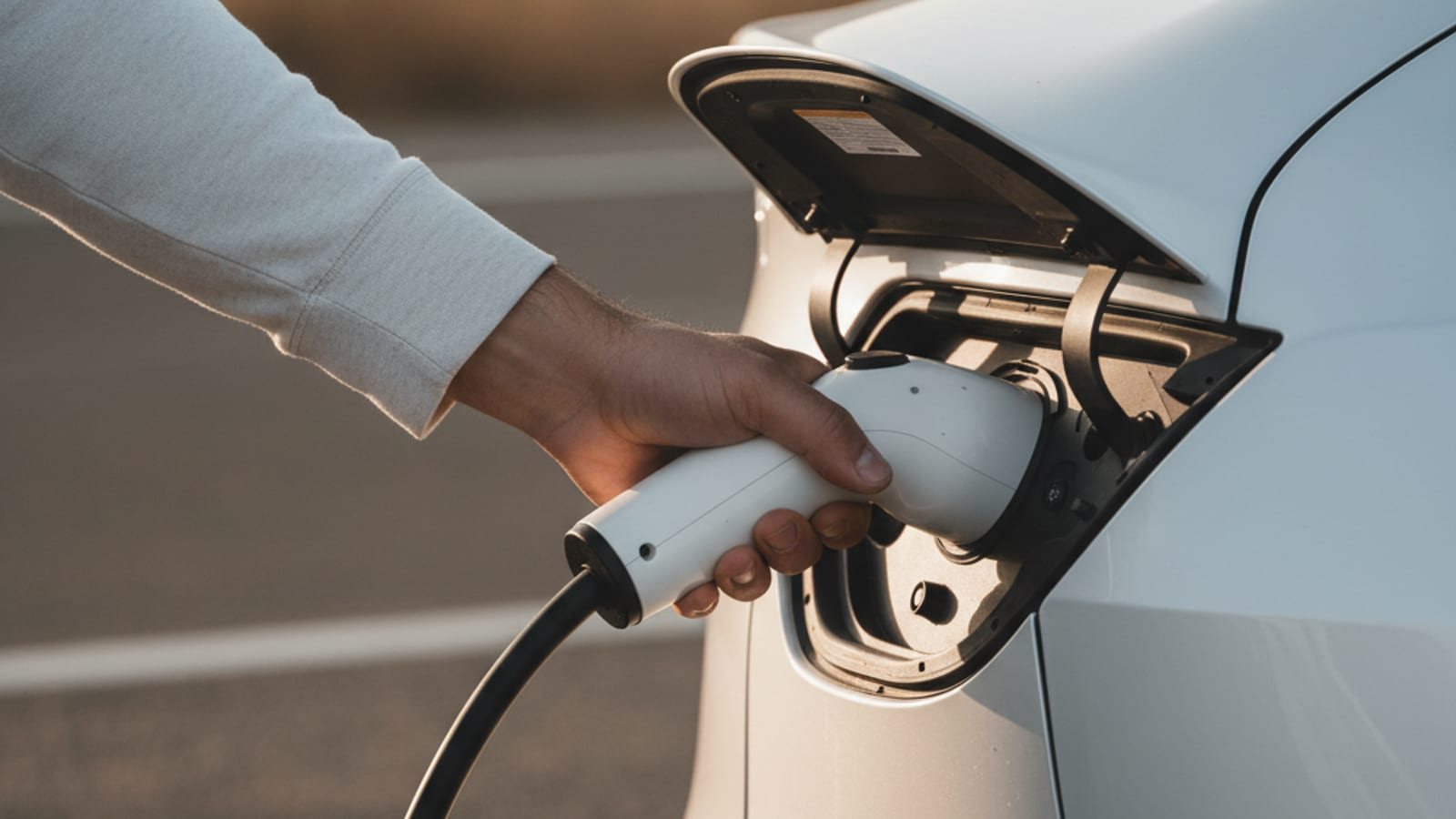
You walk back to the car after dinner in Brickell or shopping in Aventura, and the charger cable will not come out. The session is over, the station says complete, and the latch is still locked. You tug, twist, and the cable stays put. Here is what is going on and how to free it without breaking anything.
The short answer
A stuck charge cable is almost always one of three things: the session did not properly end, the cable lock did not release, or the car’s 12V is too low to unlock the port. Tesla, Ford, Rivian, Chevy, Hyundai, and most other EVs have a manual release hidden behind a panel. The manual release is the fix. If the manual release does not work, the 12V is the next suspect.
Why the cable stays locked
EV charge cables have a locking pin in the connector. The pin engages when the session starts and disengages when the session ends cleanly. Several things can keep the pin locked:
- The session did not end on the station side. The cable still thinks it is plugged into an active session.
- The car did not signal “session complete.” The cable is waiting for the car to authorize release.
- The 12V is too low to actuate the lock solenoid.
- A mechanical fault in the latch or release cable.
The most common in South Florida is the 12V. The same heat that wears out the 12V also makes the lock solenoid sluggish. A car that has been parked in a hot garage, in the sun at Dolphin Mall, or on the street in Hialeah is more likely to show a sticky latch.
Try the soft fixes first
Before you go hunting for the manual release, try the easy paths.
End the session from the station
If you have access to the station screen or app, end the session through the station. The cable lock should release within a few seconds. Some stations require you to tap the screen to confirm; some need the connector returned to its holster before they release.
End the session from the car
In a Tesla, tap the charging icon on the touchscreen and press “Stop Charging.” In a Ford or Rivian, the touchscreen has a similar button. In a Chevy Equinox EV or Bolt, the myChevrolet app can end the session. Some cars only release the cable once the session ends through the car, not the station.
Lock and unlock the car
Lock the car with the fob, wait five seconds, and unlock again. The body control module sometimes resets the latch state on a full lock cycle.
Try both release buttons
Most connectors have a button or lever that releases the lock. Press it firmly while gently pulling the cable. Don’t yank. A stuck latch on the car side can feel like it is welded in place when it just needs a clean signal.
The manual release for common models
If the soft fixes fail, find the manual release.
Tesla Model 3 and Model Y
The Model 3 and Y manual release cable sits behind the small trim panel on the passenger side of the frunk area. Pull the panel off, look for a small loop or cable, and pull it gently but firmly. The cable latch releases.
Tesla Model S and Model X
The Model S and X have a manual release pull located behind the panel near the charge port. Lift the panel and pull the release.
Ford Mustang Mach-E and F-150 Lightning
The Mach-E and Lightning have a manual release cable behind a panel in the cargo area, near the charge port. The owner’s manual shows the exact spot.
Rivian R1T and R1S
The Rivian manual release is behind a panel in the bed of the R1T or near the charge port on the R1S. The Rivian app has a “release cable” command that works if the 12V is healthy.
Chevy Equinox EV and Bolt
The Equinox EV manual release is in the cargo area behind a panel. The Bolt’s is similar.
Hyundai Ioniq 5, Ioniq 6, and Kia EV6
Hyundai and Kia EVs use a manual release behind the charge port door or in the frunk area, depending on the model.
Polestar 2, Volvo XC40 Recharge
Polestar and Volvo use a manual release behind a panel near the charge port.
The owner’s manual for your car shows the exact location and the exact cable to pull. If you do not have the manual in the car, the manufacturer app usually has a digital copy.
When the 12V is the cause
If the manual release does not work, the 12V is the next suspect. A 12V too low to actuate the solenoid will also fail to release the manual release’s interlock on some models.
A portable 12V jump starter connected to the manual’s jump posts often wakes the car enough to release the latch. Once it releases, end the session properly and drive to a shop for a new 12V if the old one is past it.
A mobile rescue operator carries the right pack and knows the manual release for your model. They quote you before starting and bill you directly.
When the latch is broken
If the manual release does not work and a 12V jump does not wake the car, the latch itself has failed. This is rare but real. The cable is held by a mechanical fault, not an electrical one. A shop has to open the charge port assembly to free it.
Set your hazards if the car is in a public spot. Florida Statute 316.194 lets a disabled vehicle stay where it is if it cannot practicably be moved. A flatbed to a service center is the next step.
How to avoid the next stuck cable
- End the session through the station first, then through the car. The order matters on some networks.
- Lock and unlock the car before pulling. A clean handshake prevents sticky states.
- Keep the 12V healthy. Replace it every two to three years in this climate.
- Avoid letting the car sit at a public charger for hours. The session can time out and leave the latch locked.
Frequently asked questions
Why won’t my charging cable release?
Most often the session did not end cleanly or the 12V is too low to actuate the latch. End the session through the station and the car, then try the manual release.
Where is the manual release on a Tesla Model 3?
Behind the small trim panel on the passenger side of the frunk area. Pull the panel and pull the loop gently but firmly.
Can a dead 12V keep the cable locked?
Yes. The latch solenoid needs 12V to release. A jump wakes it.
Does a mobile operator carry tools to free a stuck cable?
A mobile operator carries a 12V jump pack and knows the manual release for common models. They quote you before starting.
What if the manual release does not work?
The latch itself has failed. The car needs a flatbed to a service center.
When to call us
If your charging cable is stuck and you cannot free it with the manual release, call us before you force anything. A mobile operator meets the car, jumps the 12V if that is the cause, and frees the cable on the spot.
Call us at (786) 963-2995 to reach a local operator.