A stall in Margate is a commute problem, not an airport one. You’re inland in northwest Broward, on the SR-7 spine or the Turnpike. Miami International and Fort Lauderdale-Hollywood International sit well south and east of you. The car usually stops on a weekday errand or a Sample Rd run. Sometimes it’s the last stretch home through Paradise Gardens or Oriole. What you do next depends on what actually failed. It also depends on whether you can get off the travel lane.
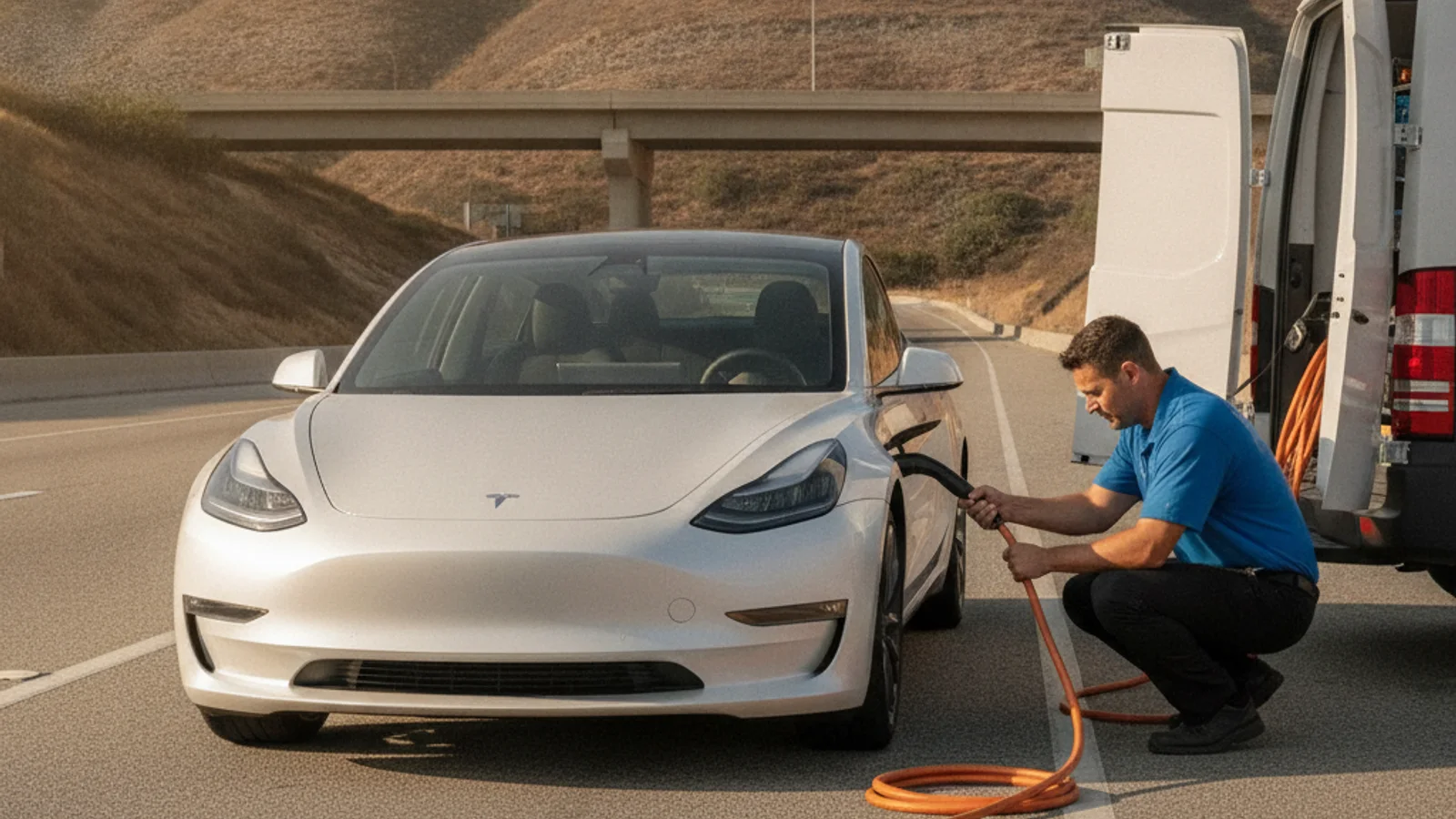
Margate stalls are ordinary weekday stalls
Margate covers 8.76 square miles of Broward County. Census ACS figures for 2019-2023 put the city at 58,418 people. The 2024 estimate is 60,650. About 58% of the housing was built before 1980. Many drivers here never had a Level 2 wall box put in.
Florida Power and Light serves Margate. FPL EVolution Home is the utility’s residential Level 2 program, when a building can take it. Plenty of older rentals can’t.
The commercial spine is State Road 7, also signed US-441. Atlantic Blvd, Sample Rd, and Coconut Creek Parkway cut east and west. Florida’s Turnpike is the fast north-south run. Calypso Cove and the Margate City Center redevelopment sit on the local map. Coconut Creek, Coral Springs, Tamarac, North Lauderdale, and Pompano Beach sit on every side.
This isn’t a beach causeway stall, and it isn’t a week in an MIA garage. Heat and air conditioning eat range here, not hills. South Florida is flat. Recurrent Auto’s study of about 30,000 EVs found about 5% range loss at 90F. Loss is about 17 to 18% at 100F. Summer afternoons bring thunderstorms, and low-lying streets flood in heavy rain.
Get out of the travel lane first
If the car still rolls, use it. Ease right until you’re on the widest paved edge you can reach. On the Turnpike, that means a real shoulder, not a gore point. Florida’s Turnpike Enterprise runs the Turnpike and the Sawgrass Expressway. Both are all-electronic, with SunPass or toll-by-plate. There’s no cash booth to tuck behind.
Florida Statute 316.194 covers a stop on a highway outside a municipality. Get the car off the main-traveled part where you can. Leave room for passing traffic and a clear view from 200 feet each way. A genuinely disabled vehicle that can’t move off the road is exempt.
On SR-7 through Margate, the frontage is busy and the curb cuts are tight. A dead car in a turn lane is harder to see than one in a shopping-center aisle. If you can reach a City Center lot, do that. A side street in Paradise Gardens or Oriole works too.
Hazards on. Seatbelt on. Stay inside if you’re still near moving traffic. Don’t walk around the charge port on an active shoulder. If there’s smoke, a collision, a blocked lane, or anyone at risk, call 911 first. Officers’ instructions beat this page.
Florida Highway Patrol takes disabled-motorist reports at *FHP (*347). The Road Ranger Service Patrol is run by FDOT. Crews can jump a 12-volt and change a tire. They can also tow a disabled vehicle out of the travel lanes to a safe spot, free of charge. District 4 covers Broward, including the I-95 corridor. Road Ranger materials don’t mention EV charging. A Level 2 top-up isn’t what they bring.
Two kinds of dead, and they aren’t the same job
“The EV died” covers two failures. Mix them up and you ask for the wrong help.
A depleted traction pack usually warns you first. The dash shows low charge or zero range before the accelerator stops answering. That’s an empty-pack stall.
A 12-volt failure looks like a brick. Lights go dark. The car won’t shift out of park. Door handles, locks, or the app may stop responding even though the last range reading looked fine. South Florida heat is hard on that small battery. Salt-laden humid air doesn’t help. A car that sat a week in a Margate apartment lot may not wake up. The main pack can still be fine.
Write down the exact warning text. Don’t paraphrase it. Check whether interior lights, locks, and the phone app still work. A cabin that unlocks but won’t drive is one story. A fully dark cabin is another.
Don’t open the high-voltage pack. The owner’s manual for your year is the only procedure that applies. If you don’t have it, say so.
Tell the operator the make, model, and year. Tesla and every other major EV brand show up on these streets. Connector type matters if the job is a charge. Level 2 in the field uses J1772 or J3400, also called NACS, on Tesla. Non-Tesla cars often need a CCS or J1772 adapter.
Tell them the road like a dispatcher would
“I’m in Margate” is too wide. SR-7, the Turnpike, Sample Rd, and a gated courtyard are four different access problems.
Name the road, the direction, and the nearest cross street. Northbound SR-7 near Atlantic Blvd is usable. Westbound Sample Rd toward Coconut Creek Parkway is usable. “Near Calypso Cove” or “in the City Center lots” beats a ZIP code.
If you can see a mile marker, an overpass, or a plaza sign, include it. If you’re in Paradise Gardens or Oriole, say the neighborhood.
Access is half the call. An open shoulder is one job. A gated apartment with a keypad is another. Mention a locked gate, a code, a tight turnaround, or a tow-away sign.
Florida Statute 715.07 covers private-property tows. The operator must stop and return the vehicle if you appear before it’s fully removed. Get to the car if you can.
If someone else has to authorize service, say whether that person is standing there.
When a mobile charge is the right ask
Ask about a charge when the symptoms look like an empty pack. The spot also has to let a service vehicle park and work safely. A City Center lot, a driveway, or a store aisle can work. A paved shoulder past a merge can too. That’s where mobile EV charging is even on the table. A live Turnpike lane isn’t.
Charge Pro MIA is a referral line. It matches stranded EV drivers with independent local operators. The brand doesn’t own trucks, doesn’t set prices, and doesn’t quote an arrival window. The operator quotes you before any work starts and bills you directly. The EV roadside assistance page is the overview of what that match looks like.
Operators typically bring a 240-volt Level 2 source to the car. They use a native NACS plug, plus CCS or J1772 adapters for non-Tesla EVs. A roadside session is usually about adding 10 to 20 miles of range. That takes 15 to 30 minutes of charging. That’s time on the cable, not a clock on when someone appears. The goal is enough range to reach a fixed plug, not a full battery.
The operator decides if that session fits. If the charge port is stuck, wet, or throwing a fault, say that.
When a jump or a move is the better call
A 12-volt failure doesn’t get fixed by a Level 2 cable. The useful ask is an on-site jump or a 12-volt swap. That’s the work behind a Tesla 12V battery jump, including non-Tesla EVs.
Transport is more likely when the location is unsafe, the port won’t take a plug, or the fault is still a mystery. Out-of-charge recovery is how we connect you with an operator who makes that call on site. Don’t coach the loading. Hand the manual’s towing section to whoever arrives.
If you stalled on the Sawgrass, stay in the car. Read stranded on the Sawgrass Expressway before you walk near express-lane traffic. Coral Springs sits on the same inland grid. See Coral Springs EV roadside help. Coconut Creek and Tamarac are the other close edges. Once you can move, use EV charging in Margate to plan the next plug.
Call when the car has stopped and you need a match
Call when the EV has stopped in Margate and you aren’t sure whether you need a charge, a 12-volt jump, or a move. Share the warning text, the make and year, and the cross street. We match you with a local operator. That operator quotes before starting.
Call (786) 963-2995 and we’ll connect you with an independent EV rescue operator.