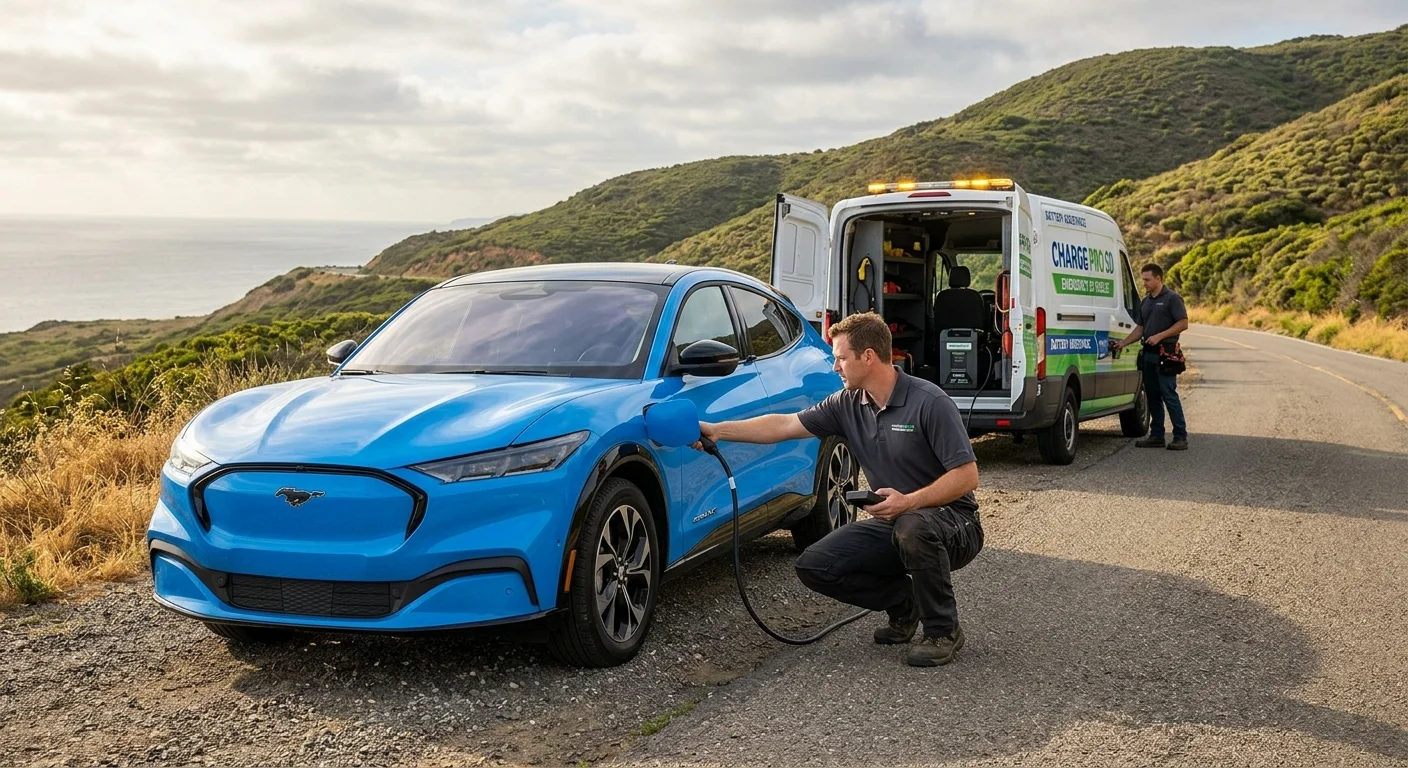
Westchester sits west of the Palmetto and the Turnpike Extension, a neighborhood of older single-family homes and small multifamily buildings. The housing is from the 1950s through the 1980s, most lots do not have a garage, and few properties were built with the electrical service an EV charger needs. Many owners park in driveways or on the street and rely on public stations. When a charge runs out, the question is where the help comes from.
The short answer
A Westchester EV that runs out of charge or sits dead does not need a tow to a shop. A mobile rescue operator brings a 240V Level 2 source to your driveway, curbside spot, or apartment lot, with the right connector for Tesla, CCS, or J1772. The session typically adds 10 to 20 miles of range in 15 to 30 minutes of charging. That is charging time, not a promise about when someone arrives.
Why Westchester drivers call a mobile operator
Three patterns come up on every block.
No home charger, no garage plug
Westchester’s housing stock predates the EV era. Driveways and assigned parking spots are the rule. Most owners charge at malls, public libraries, or a DC-fast station on Bird Road or the Palmetto. A missed stop leaves a low or empty pack with nowhere nearby to plug in.
A mobile operator brings the plug to the car. The car charges in place and the driver goes on.
Apartments and small multifamily
Many Westchester addresses are triplexes, fourplexes, and small condos. The building’s electrical service is rarely set up for shared charging, and a tenant installing a personal charger depends on the landlord or HOA. Until that gets worked out, the only charging is what the driver arranges. A mobile operator fills the gap.
Heat-stressed 12V in older cars
South Florida’s heat ages lead-acid 12V batteries faster than any other component. A car parked outside in west Miami-Dade cooks its 12V over the summer. Owners see “12V Battery Needs Service” warnings, then the car refuses to wake one morning. A jump from a mobile operator wakes the car; the next step is a fresh 12V.
What a mobile operator covers
A mobile rescue operator working in west Miami-Dade brings:
- A 240V Level 2 source on a truck or trailer.
- A NACS connector for Tesla, plus CCS and J1772 adapters for other brands.
- A 12V jump pack for dead low-voltage batteries.
- A 12V replacement for common models.
- Tools for a stuck charge port.
The operator quotes you before any work starts and bills you directly. Charge Pro MIA’s number reaches a local operator who covers Westchester and the surrounding areas.
What to do before the operator arrives
A few minutes of preparation makes the visit faster.
Pull as close to a curb or driveway as you can
The operator vehicle needs room to pull up next to the car. A driveway works. A curbside spot in front of the house works. A narrow alley behind a triplex does not.
Note any access notes for an apartment lot
Gate codes, parking space numbers, and lot manager notes help the operator reach you on the first try. If your apartment lot has a tight gate, mention it when you call.
Have the connector type ready
Tesla uses NACS. Most non-Tesla EVs use CCS or J1772. The operator brings adapters, but knowing which your car takes speeds the call.
When a tow is the right call
A mobile charge fits most Westchester EV situations, but a tow is the right call when:
- The high-voltage system has a fault code on the dashboard.
- The car was in a collision and will not move under its own power.
- The car sat in floodwater after a king tide or a storm surge.
- The charge port is mechanically jammed.
Florida Statute 316.194 lets a disabled vehicle stay where it is if it cannot practicably be moved. A tow operator on contract with your insurance takes the car to a qualified shop.
A car that sat in floodwater needs special handling. NHTSA warns against parking a flood-exposed EV within 50 feet of a structure and against charging it until a service center has inspected the pack.
How to keep the next call from happening
- Plan your charges around the public stations you know work, including at Dadeland Mall, FIU’s campus, or the Dolphin Mall chargers.
- Keep the 12V healthy. Replace it every two to three years in this climate.
- Carry a portable Level 1 or Level 2 EVSE for emergencies. A household outlet adds miles overnight.
- If your building has an unused electrical panel, ask the landlord about installing shared chargers. Florida Statute 718.113(8) gives condo owners the right to install their own chargers in their limited common-element space; apartment buildings fall under Chapter 83 and depend on the lease.
Frequently asked questions
Does Westchester have public EV charging?
There are stations at malls and along Bird Road and the Palmetto. A complete station map could not be confirmed at the time of writing. Plan ahead for the stations you know work.
Can a mobile operator come to an apartment lot?
Yes, if the lot allows operator vehicles through the gate. Have the access code ready when you call.
What connector does my car use?
Tesla uses NACS. Most non-Tesla EVs in the US use CCS or J1772, depending on the model year. The operator brings the adapters to cover all three.
Does a mobile charge work on a curbside spot?
Yes. The operator pulls the truck up next to the car and runs the Level 2 cable.
What does a mobile charge cost?
The operator quotes you before starting. Charge Pro MIA does not set the rate.
When to call us
If your EV is low or dead anywhere in west Miami-Dade, call us. A mobile operator meets the car with a 240V Level 2 source and a 12V jump pack. They quote you before starting and bill you directly.
Call us at (786) 963-2995 to reach a local operator.