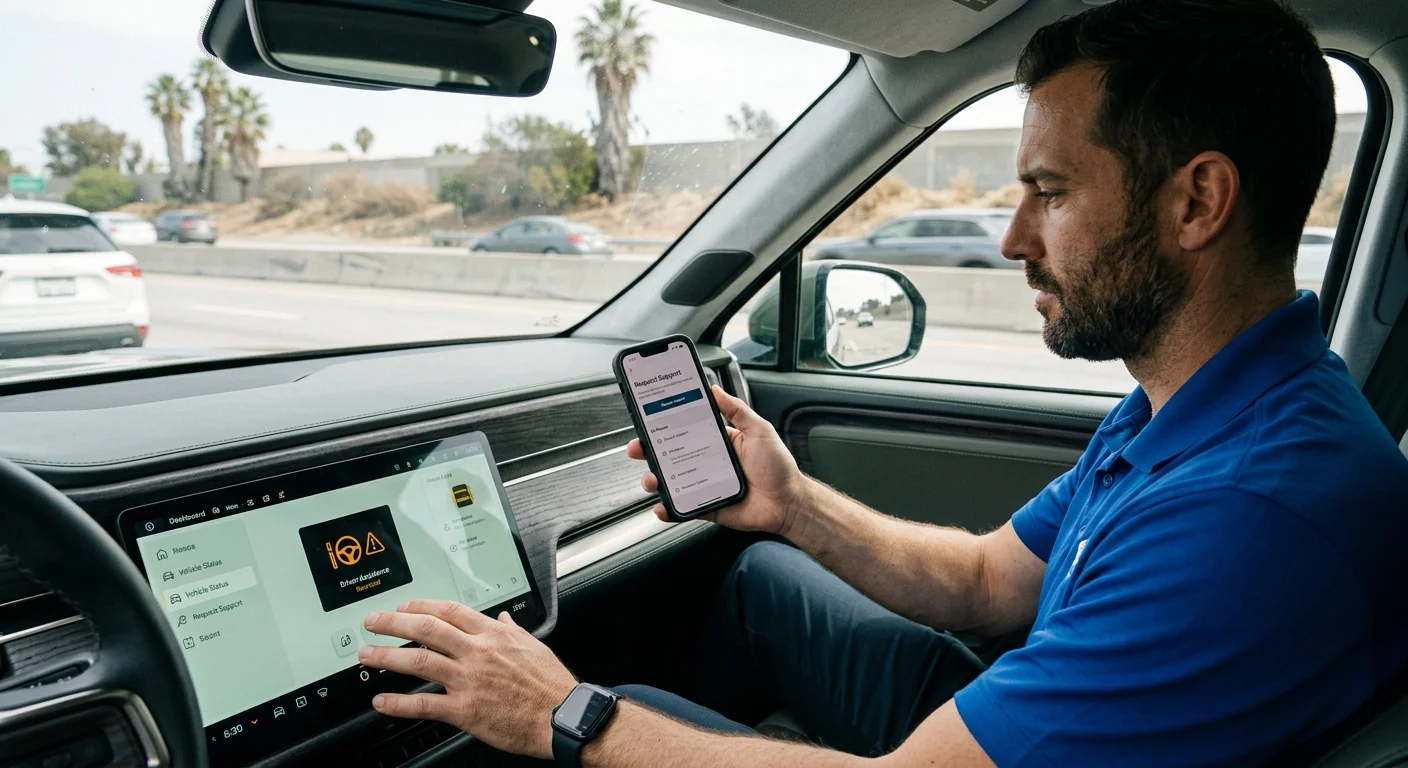
Rivian owners see two distinct features in their car’s menu: Highway Assist and Rivian Roadside. They sound similar and they share a brand, but they do completely different things. One is a driving aid. The other is a help line. Here is the difference and when each one matters.
The short answer
Rivian Highway Assist is a hands-on driver aid that helps you steer, accelerate, and brake on mapped highways. It is not a self-driving system and it does not help when you are broken down on the side of the road. Rivian roadside is the help line you call when the R1T or R1S will not move. They are different products, in different apps, for different situations.
What Rivian Highway Assist actually does
Rivian Highway Assist is the brand’s adaptive cruise and lane-keeping system. It uses cameras and radar to keep the R1T or R1S centered in its lane on mapped highways, and to manage speed relative to traffic ahead. The driver keeps their hands on the wheel and their eyes on the road. The system disengages if the driver takes their hands off for too long or if conditions exceed what the system can handle.
Highway Assist is active on certain mapped highways in South Florida, including portions of I-95, the Turnpike, I-75, and I-595. It is not a substitute for the driver. It does not navigate for you, it does not change lanes by itself on most model years, and it does not work on city streets or in construction zones.
Highway Assist will not help you when:
- The car has run out of charge.
- The 12V battery is dead.
- The traction pack has a fault.
- The car is in a parking garage.
- The car is stuck in traffic that requires an unusual maneuver.
It is a comfort feature for long drives, not a recovery feature for when the car has stopped.
What Rivian roadside actually covers
Rivian roadside is the help line you reach through the Rivian app or the number in the owner’s manual. The program is included with the car for the warranty period. After that, owners can renew through Rivian or use a third-party provider.
Rivian roadside covers:
- Towing to the nearest Rivian service center or qualified shop.
- Lockout assistance.
- Flat-tire change with the spare.
- Fuel delivery for a gas car, where applicable.
- Winching if the car is stuck.
It does not cover:
- A 240V top-up at the car. The card dispatches a flatbed, not a Level 2 truck.
- An on-location 12V jump for a Rivian parked in a Brickell tower or a MIA garage.
- A manual charge port release for a stuck cable.
- Off-hours mobile service.
Why this matters in South Florida
The Rivian R1T and R1S are popular with drivers who take long trips through the Everglades, up the Turnpike toward central Florida, or west on I-75 toward Naples. Highway Assist helps on those corridors. When the car actually needs help, the Rivian roadside card has gaps.
The South Florida Rivian calls that come up most often:
- A Rivian in a Brickell or Aventura tower for a long vacation. The 12V is flat from sitting. A jump gets it moving.
- A Rivian at MIA for ten days. Same drain, same fix.
- A Rivian at 3% on a stretch of US-1 with no working charger in range. A mobile charge at the curb is the clean answer.
- A Rivian with a stuck cable at a public station. The manual release is the fix.
None of those fits the flatbed-to-a-shop model that Rivian roadside provides. They fit a mobile rescue operator.
When Rivian roadside is the right call
There are situations where Rivian roadside is exactly the right number:
- A Rivian with no power after a collision in Davie or Miramar.
- A Rivian that cannot unlock after a fender bender in Hollywood or Fort Lauderdale.
- A Rivian that needs a flatbed after a mechanical failure on US-27 in the Redland.
For those calls, the card covers the tow to a Rivian service center or a contracted shop.
For everything else, the gap is real and the answer is a mobile operator.
What a mobile rescue operator does for a Rivian
A mobile operator working the South Florida metro brings:
- A 240V Level 2 source with a CCS connector for the R1T and R1S.
- A 12V jump pack.
- A 12V replacement battery for common models.
- Tools for a stuck charge port.
The session typically adds 10 to 20 miles of range in 15 to 30 minutes of charging. That is charging time, not a promise about when someone arrives. The operator quotes you before starting and bills you directly.
Common Rivian situations in this metro
- A Rivian parked at MIA for ten days. The 12V is flat. A mobile operator meets the car in the garage, jumps the 12V, the driver goes on.
- A Rivian in a Brickell tower for a long weekend. Same drain, same fix.
- A Rivian at 4% on the Palmetto with no working charger in range. A mobile operator meets the car at an exit and tops off.
- A Rivian with a stuck cable at a public station. The operator brings the tools for the manual release.
Frequently asked questions
Does Rivian Highway Assist drive the car by itself?
No. It is a hands-on driver aid. The driver keeps their hands on the wheel and eyes on the road.
Does Rivian roadside cover a mobile EV charge?
No. The card covers a tow, lockout, flat-tire change with the spare, and fuel delivery. It does not dispatch a 240V truck to your location.
Does Rivian roadside cover a 12V jump?
The card dispatches a contracted service that can attempt a 12V jump. Whether the truck carries the right pack for an EV depends on the provider.
Where does Rivian roadside tow a car in South Florida?
The destination is set by the contracted dispatcher. Most often it is the nearest Rivian service center or a contracted shop.
When does a Rivian need a local operator, not Rivian roadside?
When the car needs a 240V top-up, a 12V jump at your location, or a manual charge port release. Rivian roadside dispatches a flatbed for those calls.
When to call us
If your Rivian is low or dead anywhere in Miami-Dade or Broward, call us before you call for a tow. A mobile operator meets the car with a 240V Level 2 source and a 12V jump pack. They quote you before starting and bill you directly.
Call us at (786) 963-2995 to reach a local operator.