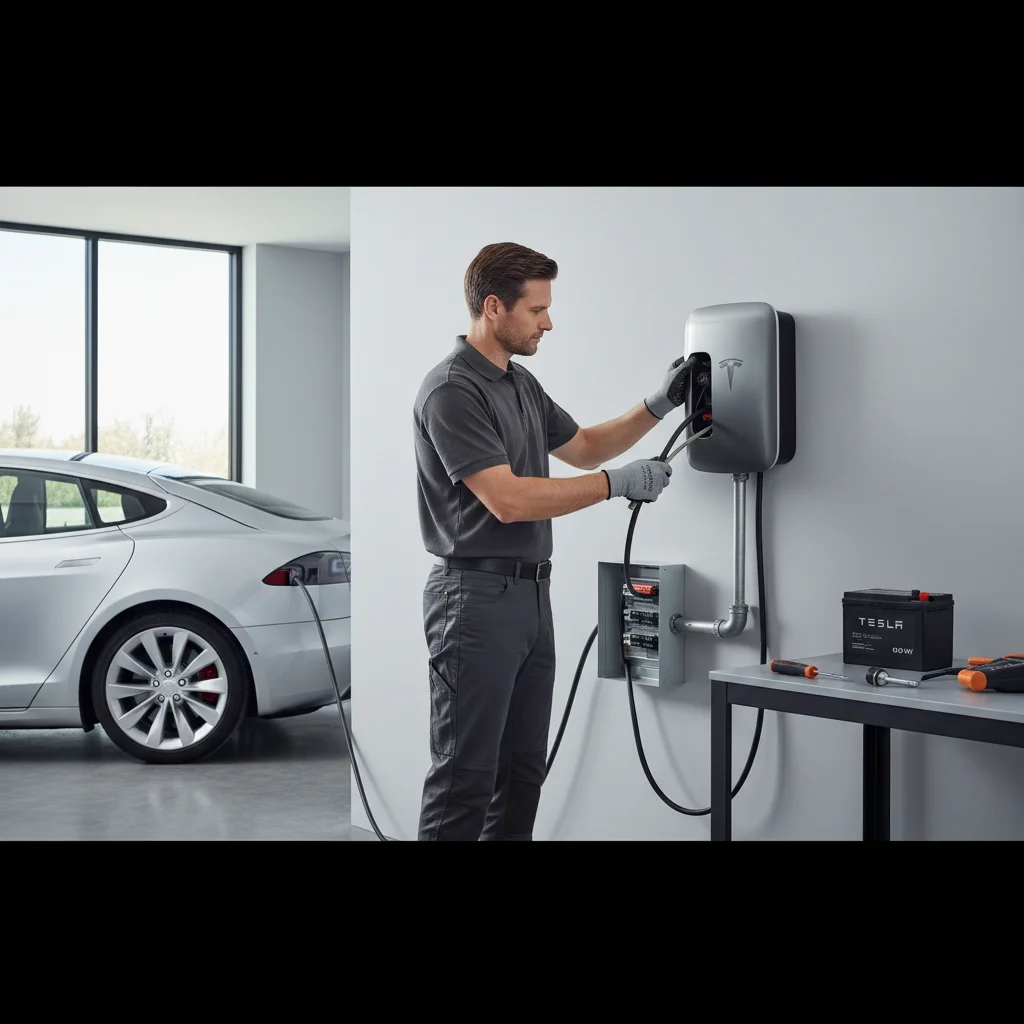
If your Tesla 12V keeps dying in this climate, you are not alone. South Florida’s sustained summer heat wears the 12V faster than the manual expects, and long garage dwell at airports and car owners finishes the job. The right move is a replacement on a calendar schedule rather than waiting for the next failure.
The short answer
Replace a Tesla 12V every two to three years of calendar life in this climate for lead-acid, three to five years for the newer lithium units. The replacement is straightforward on most models. A mobile operator working the South Florida metro can swap it at your location for common Tesla models. Charge Pro MIA does not set the price.
What the 12V does in a Tesla
The 12V battery in a Tesla is small and light. It is not there to move the car. Its job is to wake the car, run the computers, light up the touchscreen, close the high-voltage contactors, and power the locks and lights. The high-voltage pack keeps the 12V topped off through a DC-to-DC converter while the car is awake.
When the 12V is gone, the car looks dead even though the traction pack may still be at 80%. A clean external 12V source wakes the car without risking the sensitive electronics.
Why the calendar matters in this climate
Lead-acid and AGM 12V batteries lose about half their useful life for each 15F rise above 77F. South Florida pushes ambient temperatures past 90F for months. A 12V that would last five years in a milder climate is aging twice as fast here. The manual’s calendar assumes a cooler environment.
The pattern that comes up in this metro:
- A Tesla that lives outside or in an uninsulated garage ages its 12V in two to three years of calendar time.
- A Tesla that lives in a tower garage or covered lot ages its 12V in three to four years of calendar time.
- A Tesla that lives in a fully climate-controlled garage ages its 12V closer to the manual’s expected life.
Replace on the shorter side if your car lives in the heat.
When to replace on a schedule
Replace the 12V before the warning messages turn into a dead car. The dashboard usually gives you days of notice. Watch for:
- “12V Battery Needs Service” or “Low Battery” warnings.
- Slow fob response.
- Slow boot times.
- Dim or flickering interior lights.
If you see any of those, replace within the next week.
If the 12V is past two calendar years of life in this climate and you have not replaced it, schedule the swap. A planned replacement costs less than an after-dark call for a tow and a shop visit.
What the replacement looks like
The procedure is straightforward on most models. A technician:
- Opens the frunk or hood.
- Removes the panel covering the 12V.
- Disconnects the negative terminal, then the positive.
- Removes the old battery.
- Installs the new battery.
- Reconnects the positive, then the negative.
- Reinstalls the panel.
- Registers the new battery with the body control module if the model requires it.
Some Tesla models register the new battery automatically. Others need a service tool to register it. A mobile operator working the South Florida metro carries the right tools and a fresh battery sized for the model.
What the replacement costs
The part is inexpensive. The labor at a service center is what drives the cost. A dealer or Tesla service center typically charges several hundred dollars for the swap, with the new battery and the registration step included.
A mobile operator working the South Florida metro usually charges less than a dealer because the work happens at your location and there is no shop overhead. The operator quotes you before starting.
Charge Pro MIA does not set the price. The operator who does the work sets it.
What to do if the 12V has already died
A dead 12V is recoverable on the spot. A mobile operator meets the car with a portable lithium jump pack, wakes the car through the manual’s jump points, and either recommends a replacement or swaps the battery on the spot.
If the 12V is dead beyond recovery, the operator carries a fresh unit for most Tesla models. The swap happens in the same visit.
Why a mobile operator fits the South Florida situation
Most Tesla 12V calls in this metro happen in places a tow truck cannot easily reach:
- A Model Y in a Brickell tower garage.
- A Model 3 at MIA long-term parking.
- A Model S at PortMiami cruise parking.
A mobile operator walks to the car or meets it at the elevator. The tow truck alternative would require blocking lanes, threading ramps, or waiting on a flatbed for hours. The mobile operator brings the right gear and quotes you before starting.
How to keep the next 12V alive
- Drive the Tesla at least once a week.
- Park in shade or a garage. Heat is the killer.
- Replace on a calendar schedule, not a failure schedule.
- Unplug accessories like dash cams and OBD-II dongles for long sits.
- Watch for the warning messages. The 12V usually gives you days of notice.
Frequently asked questions
How long does a Tesla 12V last in South Florida?
Two to three years of calendar life for lead-acid, three to five for lithium. Heat is the dominant factor.
Can a Tesla 12V be replaced at home?
Yes, with basic tools and the procedure from the manual. Some models need the new battery registered with the body control module, which requires a service tool.
What does a Tesla 12V replacement cost?
The part is inexpensive. The labor at a service center or mobile operator is what drives the cost. Charge Pro MIA does not set the rate.
When does a Tesla 12V need a tow, not a jump?
Almost never. A dead 12V is jumpable. A high-voltage fault or accident is a tow.
Where does the Tesla 12V live?
Behind a panel under the frunk on most models, or under the hood on older Model S and Model X cars. The owner’s manual shows the exact spot.
When to call us
If your Tesla is showing 12V warnings anywhere in Miami-Dade or Broward, call us before the next warning turns into a dead car. A mobile operator meets the car, confirms the 12V is the cause, and either jumps it or replaces it on the spot.
Call us at (786) 963-2995 to reach a local operator.