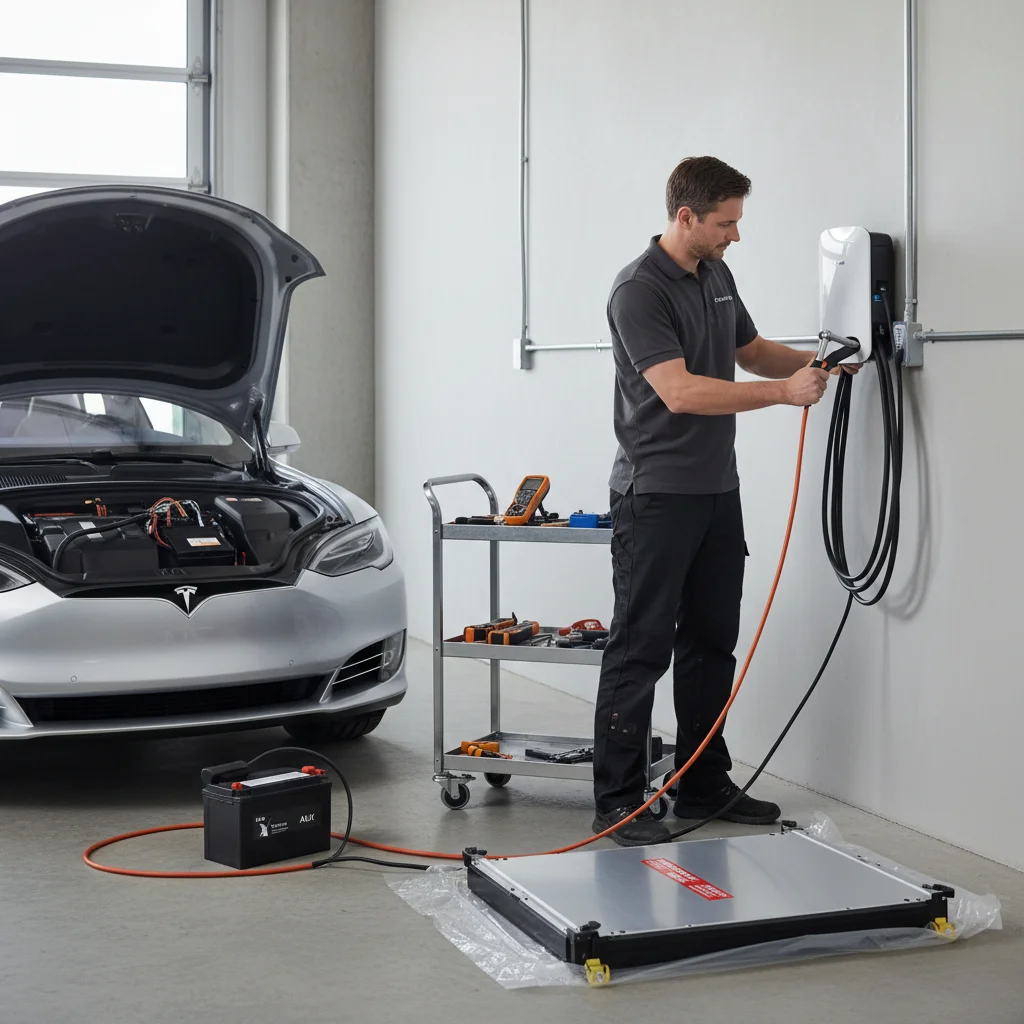
When a Tesla is dead, the question every driver asks is the same: is it the 12-volt battery or the high-voltage traction pack? In South Florida’s heat, the answer is almost always the 12V. The traction pack can sit at 70 or 80% while the 12V has drained flat. Here is how to tell which one is the cause.
The short answer
A dead Tesla is almost always a 12V issue, not a traction-pack issue. The high-voltage pack sits at 70 to 80% for most parked cars in this climate. The 12V is what wakes the car and runs the locks and lights. A jump wakes the car; a replacement is the next step.
What the 12V does
The 12V battery in a Tesla is small and light. It is not there to move the car. Its job is to:
- Wake the car from sleep.
- Run the body control module.
- Light up the touchscreen and driver display.
- Power the door handles and locks.
- Close the high-voltage contactors that connect the traction pack to the drive unit.
The traction pack keeps that 12V topped off through a DC-to-DC converter while the car is awake. While the car is parked, the 12V is on its own. A long sit drains a healthy 12V below the body’s threshold.
What the traction pack does
The high-voltage traction pack is the big battery that moves the car. It is sealed, not a service item, and rarely the cause of a dead-Tesla situation. The pack sits at 70 to 80% for most parked cars in this climate because the thermal management keeps the cells cool and the pack has very low standby draw.
The traction pack becomes the issue only when:
- The pack has been run to 0%.
- A high-voltage fault has shut the pack down.
- The car has been in a collision that damaged the pack.
- The car sat in floodwater that compromised the pack.
In those cases, the dashboard shows a high-voltage warning, the car may click loudly and refuse to wake, or there is visible damage. None of those is a 12V call.
How to tell which one is the cause
The dashboard
A 12V-flat car is dark. No dashboard, no welcome animation, no response from the fob. If the screen has any life at all, the 12V may be weak rather than flat, and the car may wake on a jump.
A traction-pack-empty car has a working dashboard. The screen reads 0% or “Battery Empty,” and the car may go into a reduced-power mode. The lights, locks, and touchscreen still work because the 12V is fine.
The Tesla app
A 12V-flat car usually shows as offline in the Tesla app. The car cannot maintain a network connection on a dead 12V.
A traction-pack-empty car with a working 12V shows up in the app normally. You can see the state of charge and the climate status.
Recent history
A car that sat at MIA for ten days, at PortMiami for a cruise, or in a Brickell tower for a long vacation is a 12V call. A car that drove yesterday and is dead this morning could be either, and a multimeter check is the cleanest confirmation.
How to confirm with a multimeter
A multimeter at the 12V terminals under the frunk panel tells you the answer in seconds:
- A healthy 12V rests around 12.6 volts with the car asleep.
- A failing 12V rests below 12 volts.
- A dead 12V rests below 11 volts.
If the 12V reads under 11 volts, the 12V is the cause. A jump wakes the car.
If the 12V reads 12.6 volts and the car is still dead, the traction pack is the suspect. Set hazards and call for a flatbed.
What to do for each case
12V failure
A jump wakes the car. Drive it to a service center or call a mobile operator for a same-day replacement. The operator quotes you before starting and bills you directly.
Traction pack issue
Set your hazards. Florida Statute 316.194 lets a disabled vehicle stay where it is if it cannot practicably be moved. Call for a tow to a Tesla service center or a contracted shop.
A car that sat in floodwater is its own case. NHTSA warns against parking a flood-exposed EV within 50 feet of a structure and against charging it until it has been inspected.
What a mobile rescue operator does
A mobile operator working the South Florida metro comes to the car with the right equipment. For a Tesla dead-battery call:
- Confirm the 12V is the cause with a multimeter.
- Apply a stable external 12V source through the manual’s jump points.
- If the 12V is dead beyond recovery, replace it on the spot with a fresh unit sized for the model.
- Once the dashboard is up, top up the traction pack from a 240V Level 2 source if it is also low.
The operator quotes you before starting and bills you directly.
Why the South Florida heat matters
Lead-acid and AGM 12V batteries lose about half their useful life for each 15F rise above 77F. South Florida pushes ambient temperatures past 90F for months. The 12V is the part that wears out first in this climate, not the traction pack.
The pattern that comes up in this metro:
- A Tesla that sat at MIA for ten days. The traction pack is at 75%. The 12V is at 8 volts. The dashboard is dark. The answer is the 12V.
- A Tesla in a Brickell tower for a long vacation. Same pattern. The answer is the 12V.
- A Tesla that lives outside in Hialeah or Homestead, where summer heat has cooked the 12V. The answer is the 12V.
How to keep the next call from happening
- Drive the Tesla at least once a week.
- Park in shade or a garage. Heat is the killer.
- Replace the 12V every two to three years in this climate for lead-acid, three to five for lithium.
- Unplug accessories like dash cams and OBD-II dongles for long sits.
- Watch for the warning messages. The 12V usually gives you days of notice.
Frequently asked questions
How do I tell if my dead Tesla is a 12V or the high-voltage pack?
Look at the dashboard. If it is dark, the 12V is the prime suspect. If it is lit and shows 0%, the traction pack is the issue.
Can a Tesla traction pack die from sitting?
Rarely. The pack sits at 70 to 80% for most parked cars in this climate. The 12V is the part that wears out.
What does a Tesla 12V replacement cost?
The part is inexpensive. The labor at a service center or mobile operator is what drives the cost. Charge Pro MIA does not set the rate.
When does a Tesla need a tow, not a jump?
If the dashboard shows a high-voltage fault, the car has visible damage, or it sat in floodwater, the next step is a flatbed to a service center.
Where is the Tesla 12V jump point?
Behind a panel under the frunk on most models, or under the hood on older Model S and Model X cars. The owner’s manual shows the exact spot.
When to call us
If your Tesla is dead anywhere in Miami-Dade or Broward, call us before you assume the traction pack is the issue. A mobile operator meets the car, confirms the 12V is the cause with a multimeter, and either jumps it or replaces it on the spot.
Call us at (786) 963-2995 to reach a local operator.