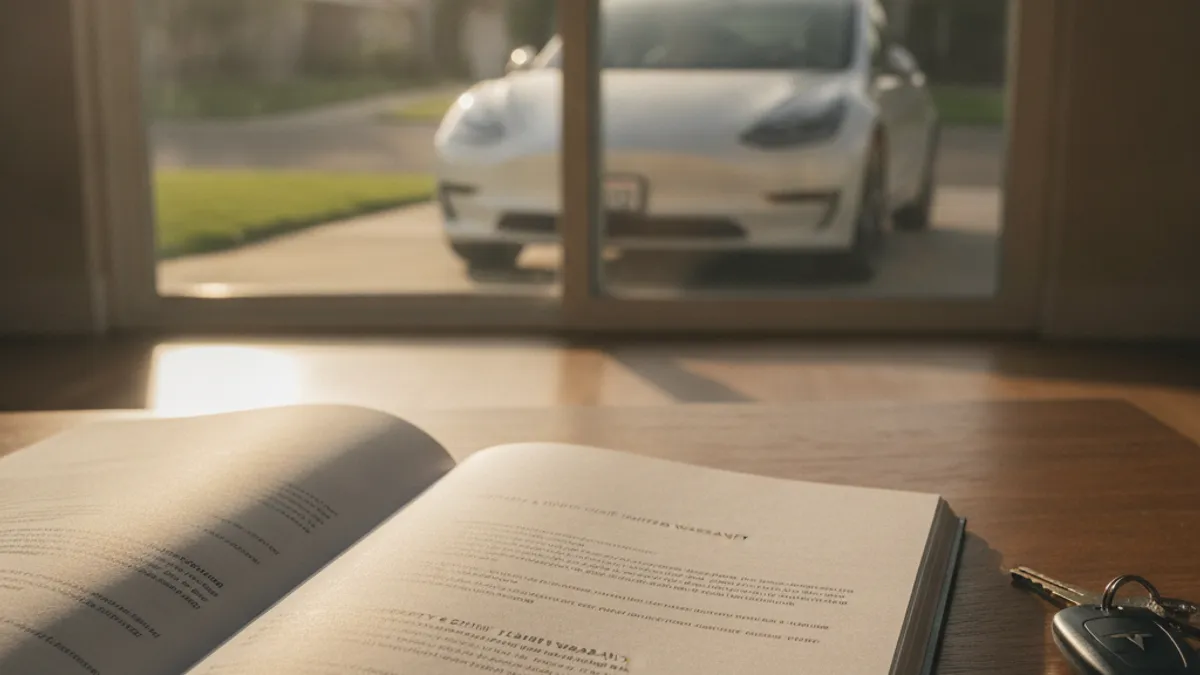
Tesla’s battery warranty covers a pack that loses more than 30% of its capacity within the warranty period, or any pack that fails outright. Heat is the range story on these flat South Florida roads, but the warranty covers heat-driven degradation only when it exceeds the threshold. Here is what the warranty actually does and does not cover.
The short answer
Tesla’s New Vehicle Limited Warranty includes a Battery and Drive Unit warranty. For most current Tesla models, that warranty covers 8 years or 100,000 to 150,000 miles, whichever comes first, with at least 70% battery capacity retention. The warranty covers any pack that fails outright or loses more than 30% of capacity within the warranty period. Heat-driven loss that stays below the 30% threshold is normal operation and is not covered.
What the warranty covers
Tesla publishes the Battery and Drive Unit warranty for each model:
- Model 3 Standard Range and Standard Range Plus: 8 years or 100,000 miles, with at least 70% battery capacity retention.
- Model 3 Long Range and Performance: 8 years or 120,000 miles, with at least 70% retention.
- Model Y Standard Range: 8 years or 100,000 miles, with at least 70% retention.
- Model Y Long Range and Performance: 8 years or 120,000 miles, with at least 70% retention.
- Model S and Model X: 8 years or 150,000 miles, with at least 70% retention.
The warranty covers:
- A pack that fails outright.
- A pack that loses more than 30% of its capacity within the warranty period.
The capacity measurement is done at a Tesla service center with the pack’s diagnostic data. The threshold is the floor; packs that retain more than 70% of capacity at the end of the warranty are not covered for a replacement.
What the warranty does not cover
The warranty does not cover:
- Normal capacity loss below the 70% floor.
- Damage from accidents, floods, or abuse.
- Damage from aftermarket modifications.
- Loss of range from heat or driving patterns.
- Damage from sitting at a high state of charge in hot conditions.
A Tesla that loses 25% of its range over four years in this climate is showing normal aging, not a warranty event. The threshold is 30% loss; anything below that is the owner’s responsibility.
Why heat matters in this climate
The highest natural point in Miami-Dade is the Atlantic Coastal Ridge at roughly 23 to 24 feet. In Broward it is Pine Island Ridge at about 29 feet. There is no grade penalty on range anywhere in the two counties. Range is purely heat, air conditioning, and dwell.
Heat ages lithium cells. NWS Miami 1991-2020 normals put the July and August average high at 91F, with about 64 days a year at or above 90F in a normal year. A Tesla that lives outside in Hialeah, Miramar, or Homestead takes years of calendar wear in months.
Recurrent Auto’s fleet study of about 30,000 EVs finds roughly 5% range loss at 90F and about 17 to 18% at 100F. AAA’s 2019 SAE-standard test found about a 17% range drop at 95F with the AC on. These are normal operation losses, not warranty events. The warranty covers the cases where the pack has lost more than 30% of capacity, which is a much bigger drop.
How to check your pack’s capacity
The cleanest way is at a Tesla service center. The diagnostic reads the cells directly and tells you the current capacity. The check is part of any Tesla service visit.
For an at-home estimate, the in-car display shows a “battery health” indicator on the service screen. The reading is approximate. For a definitive number, the service center is the path.
What the warranty process looks like
If a Tesla pack drops below the 70% capacity threshold within the warranty period, Tesla replaces the pack at a service center. The process:
- Schedule a service visit through the Tesla app.
- The service center runs a battery diagnostic.
- If the pack qualifies, Tesla replaces it with a remanufactured or new unit.
- The car comes back with a fresh pack and the warranty continues for the new pack.
The process is not free if the pack fails outside the warranty or if the failure is not covered. Out-of-warranty pack replacement is expensive because the pack is the expensive part of the car.
What to do while you wait for the pack
A Tesla with a degraded pack does not need to sit in a garage. The car still drives; it just does not drive as far on a charge. A mobile rescue operator covers the day-to-day calls that come up when the pack can no longer reach a working charger:
- A 240V top-up at the curb in Brickell, Aventura, or Fort Lauderdale Beach.
- A 12V replacement when the lead-acid unit finally gives out.
- A jump when the 12V drains from a long sit.
The operator quotes you before starting and bills you directly.
How to slow the next pack’s aging
A Tesla owner cannot stop heat-driven aging in this climate, but a few habits slow it:
- Park in shade or a garage. The cabin and pack both run cooler.
- Keep the state of charge between 20 and 80% for daily driving. Reserve 100% charges for long trips.
- Avoid leaving the car at 100% in the sun.
- Update the software. Tesla has released thermal management improvements over the air.
- Schedule a service visit if the range drops suddenly. A sudden drop can be a single bad cell, not the whole pack.
Frequently asked questions
How long does a Tesla battery last in South Florida?
The traction pack is warranted for 8 years or 100,000 to 150,000 miles depending on the model. Heat ages the pack, but the warranty covers degradation that exceeds the 70% retention threshold.
What does a Tesla pack replacement cost out of warranty?
The pack is the expensive part of the car. Out-of-warranty replacement is several thousand dollars. A Tesla service center or a qualified EV shop can quote you.
Does the Tesla warranty cover heat damage to the battery?
The warranty covers any pack that loses more than 30% of capacity within the warranty period, regardless of cause. Heat-driven loss that exceeds the threshold is covered.
How do I check my Tesla’s battery health?
The in-car display shows an approximate reading. For a definitive number, schedule a service visit.
Can a mobile operator help with a degraded pack?
A mobile operator covers the day-to-day calls that come up when the pack can no longer reach a charger. The pack itself is a service center item.
When to call us
If your Tesla is showing a sudden range drop anywhere in Miami-Dade or Broward, call us before you assume the worst. A mobile operator meets the car with a 240V Level 2 source and a 12V jump pack. They quote you before starting and bill you directly.
Call us at (786) 963-2995 to reach a local operator.