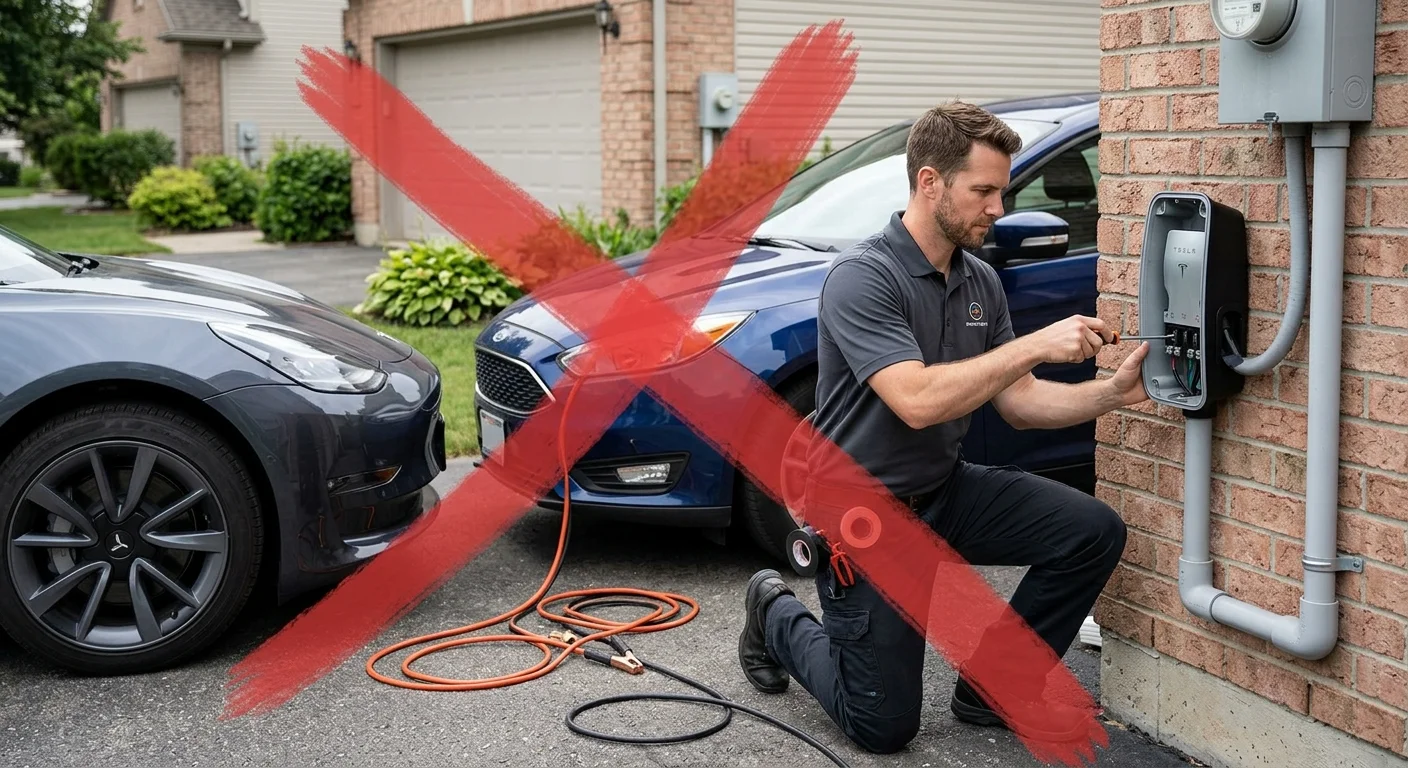
Someone in the parking lot has their hood up and asks if you can give them a jump. You have a Tesla. It feels rude to say no. Here is why saying no is the right call, and what to offer instead.
The short answer
A Tesla should never be used to jump-start another vehicle. The 12V system is not built for the high-current demand of a starter motor, and the failure modes are expensive. Use a portable jump starter, offer to call a service, or give the driver a ride to a safe place.
What the Tesla 12V actually does
The 12V battery in a Tesla is small and light. Its job is to wake the car, run the computers, light up the screen, and close the contactors that connect the high-voltage pack to the drive unit. The high-voltage pack keeps that 12V topped off through a DC-to-DC converter while the car is awake.
The 12V is not designed to deliver hundreds of amps to a starter motor. A gas car’s starter demands exactly that. Asking a Tesla’s low-voltage system to do that work risks:
- Damaging the DC-to-DC converter. Repair runs into four figures.
- Damaging the 12V battery itself.
- Damaging the computer modules that run the car.
- Voiding Tesla’s warranty for the affected components.
In South Florida’s heat, the 12V is already under stress from ambient temperatures well above 90F through the summer. Adding a high-current discharge pushes a stressed system past what it was engineered to handle.
What Tesla’s manual says
Tesla is direct about this in the owner’s manuals for Model 3, Model Y, Model S, and Model X. The manuals tell you how to receive a jump and tell you not to give one. The jump posts under the frunk panel are inbound only. They exist to let an external source safely re-energize the low-voltage system so the car can wake up.
What the gas-car driver actually needs
The driver with their hood up needs hundreds of amps for a few seconds to turn the starter motor. That is a brute-force mechanical job. The right tool is a portable lithium jump starter designed for that exact demand. The starter pack delivers the amps, the gas car starts, and everyone’s electronics stay intact.
If you do not have a portable jumper, your time is better spent calling a service for them. Most stranded drivers in South Florida are within reach of a mobile operator who can come to them, jump the gas car’s battery, and clear the lane.
Why this matters in this climate
South Florida’s heat ages 12V batteries faster than any other factor. Battery University data shows roughly half the useful life for each 15F above 77F. A Tesla’s 12V that would last five years in a milder climate is aging twice as fast here. Using it as a donor for a gas-car jump adds stress the battery does not need.
The pattern that comes up: a Tesla owner in a Hialeah parking lot, a Miami Beach garage, or a Coral Gables office park sees a stranded driver and reaches for the jumper cables. The damage does not show up immediately. It shows up weeks later as a 12V that fails to hold a charge, or a DC-to-DC converter that costs four figures to replace.
What to offer instead
The kindest thing you can do does not require your Tesla to act as a battery.
Carry a portable lithium jump starter
These compact packs are designed for the high-amperage jolt a starter motor needs, and they are completely self-contained. Keep one in the frunk and it will be ready. The stranded driver clamps it on, the gas car starts, and everyone drives away with their own electronics intact.
Call for them
Phone a local service. Most stranded drivers in South Florida are within reach of a mobile operator who can come to them. Charge Pro MIA’s number reaches an operator who quotes the driver before any work starts.
Give them a ride
If the situation is unsafe, give them a ride. A driver stuck on the shoulder of I-95, the causeway to Miami Beach, or US-1 in Cutler Bay needs to be clear of traffic more than they need a jump.
What to do if your own Tesla needs a jump
The flip side matters too. A Tesla’s own 12V can and does die, and when it does, the whole car seems dead. Doors may not unlock, the screen stays black, and the car will not respond. Many owners see a “12V Battery Needs Service” warning in the days before that happens.
A failed 12V is not an empty pack. The high-voltage battery can sit at 80% while the low-voltage side goes flat. A clean, stable external 12V source wakes the car without risking the sensitive electronics. A mobile operator who knows EVs brings the right equipment for that.
If your Tesla is dead anywhere in Miami-Dade or Broward, call (786) 963-2995. An independent local operator meets you with the right gear and quotes you before starting.
Frequently asked questions
Can a Tesla jump-start a gas car?
No. The Tesla 12V is not designed to deliver the current a starter motor demands. Doing it risks damage to the DC-to-DC converter, the 12V, and the car’s computers.
Can a Tesla jump-start another EV?
No, for the same reason. Both cars have low-voltage electronics that are not built to be a donor.
What should you use instead of a Tesla to help a stranded driver?
A portable lithium jump starter is the cleanest tool. You can also phone a service for the driver and, if the car is in traffic, give them a ride out of the lane.
What should you do if your Tesla is dead in South Florida?
Check the manual before attempting a low-voltage jump. Then call (786) 963-2995 to reach a local operator who quotes you before starting.
Does the manual really forbid using a Tesla as a donor?
Yes. The owner’s manual for every Tesla model tells you how to receive a jump and explicitly tells you not to give one.
When to call us
If your Tesla’s 12V has died or you are stranded anywhere in South Florida, do not risk damaging your car’s electronics with a home fix. The operators we connect you with carry the right gear to wake the car safely.
Call us at (786) 963-2995 to reach a local operator.