A Tesla low battery warning is the dashboard telling you that range is below the buffer the car keeps for emergencies. In South Florida’s heat, that warning can come earlier than the manual suggests because AC load eats more range than expected. Here is how to plan the run on these flat roads.
The short answer
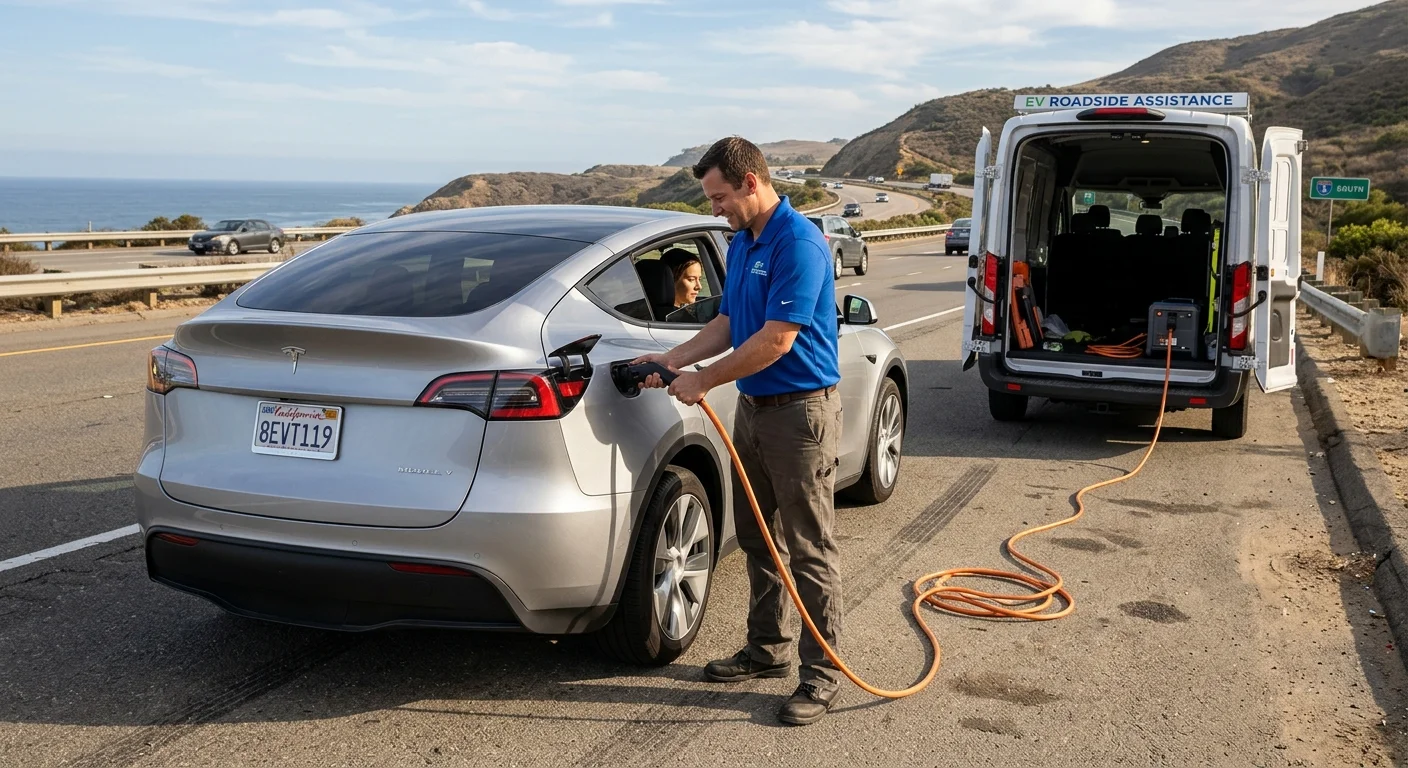
A Tesla low battery warning means the car is below its comfort threshold and needs a charge soon. On South Florida’s flat roads, you have real range left, but heat and AC reduce it faster than the dashboard predicts. Find the nearest working charger, drive gently, and turn off features that draw power. If you cannot reach a charger, a mobile rescue operator brings a 240V top-up to your location.
What the warning actually means
Tesla’s low battery warning appears when the state of charge drops below the buffer the car reserves for climate, locks, and emergency maneuvers. The exact percentage varies by model and software version, but it is usually below 20% on most modern Teslas. The car is telling you to find a charger soon, not that you are about to stall.
The dashboard also shows a more urgent warning when the state of charge drops below about 5%. At that point the car reduces climate output and starts asking the driver to find a charger immediately. Below 0% the car stops moving and goes into a low-power mode that preserves the pack for the next drive cycle.
Why the warning shows up early in this climate
Heat and air conditioning are the range story on these flat roads. Recurrent Auto’s fleet study of about 30,000 EVs finds roughly 5% range loss at 90F and about 17 to 18% at 100F. AAA’s 2019 SAE-standard test found about a 17% range drop at 95F with the AC on. The mechanism is simple: cooling a baked cabin costs far more than holding it cool, and the AC runs most of the year here.
The practical effect is that a Tesla showing 30 miles of range in Miami summer may have closer to 25 miles of real range. The low battery warning can come earlier than expected, and the run to the next charger can come up shorter than the dashboard predicts.
What to do when the warning appears
Find the nearest working charger
Open the in-car navigation or the Tesla app to find the nearest working station. Public stations at malls, parks, and garages in South Florida are clustered around the densest areas: Brickell, Aventura, Doral, Fort Lauderdale, Hollywood, and the beaches. Stations along US-1 south of Cutler Bay and west of I-75 on Alligator Alley thin out, which is why the warnings show up earlier on long runs.
Drive gently
Range extends with gentle inputs:
- Keep speed under 65 mph on the highway.
- Use regenerative braking by lifting off the accelerator early.
- Avoid rapid acceleration.
- Use the AC, but at a moderate setting rather than max.
Turn off features that draw power
The features that draw the most range on a low battery:
- The heat. Set the climate to a moderate temperature, not a cold cabin.
- The seat heaters.
- The audio system at high volume.
- The sentry mode if the car is parked.
Aim for a charger with margin
Plan to reach the charger with at least 5% state of charge. The car’s range estimate is conservative, but the heat penalty is real. Aim for a buffer.
When you cannot reach a charger
If the nearest charger is out of range, the next step is a mobile rescue operator. The operator brings a 240V Level 2 source to your location. The session typically adds 10 to 20 miles of range in 15 to 30 minutes of charging. That is charging time, not a promise about when someone arrives.
Common South Florida low-battery calls:
- A Tesla in Brickell with a tower garage and no home plug.
- A Tesla on US-1 south of Cutler Bay with no working charger in range.
- A Tesla in Fort Lauderdale Beach with no station within walking distance.
- A Tesla in a tower garage in Aventura or Sunny Isles with no home plug.
The operator meets the car at the curb, in the garage, or at a parking lot.
When the next step is a tow
A few low-battery situations call for a tow, not a charge:
- The traction pack is at 0% and the car will not move under its own power.
- The dashboard shows a high-voltage fault.
- The car has visible damage after a curb strike or flood.
Florida Statute 316.194 lets a disabled vehicle stay where it is if it cannot practicably be moved. Set hazards, clear the lane, and call for a flatbed.
How to avoid the next low-battery moment
- Top up at home when you have a plug, or at the stations you know work.
- Plan your charges around the stations that have worked for you before.
- Watch the range estimate as the AC runs in summer. Plan for a buffer.
- Keep a portable Level 1 or Level 2 EVSE for emergencies. A household outlet adds miles overnight.
Frequently asked questions
What does the Tesla low battery warning mean?
The car is below its comfort threshold and needs a charge soon. You have real range left, but find a charger.
How much range does heat cost in South Florida?
Recurrent Auto finds roughly 5% range loss at 90F and 17 to 18% at 100F. AAA found about 17% at 95F with AC on.
How do I find the nearest working charger?
Use the in-car navigation or the Tesla app. Both pull live station availability in most areas.
What if no charger is in range?
Call a mobile rescue operator. The operator meets the car with a 240V Level 2 source.
What does a mobile charge cost?
The operator quotes you before starting. Charge Pro MIA does not set the rate.
When to call us
If your Tesla is showing a low battery warning and you cannot reach a working charger, call us before you hit zero. A mobile operator meets the car with a 240V Level 2 source. They quote you before starting and bill you directly.
Call us at (786) 963-2995 to reach a local operator.