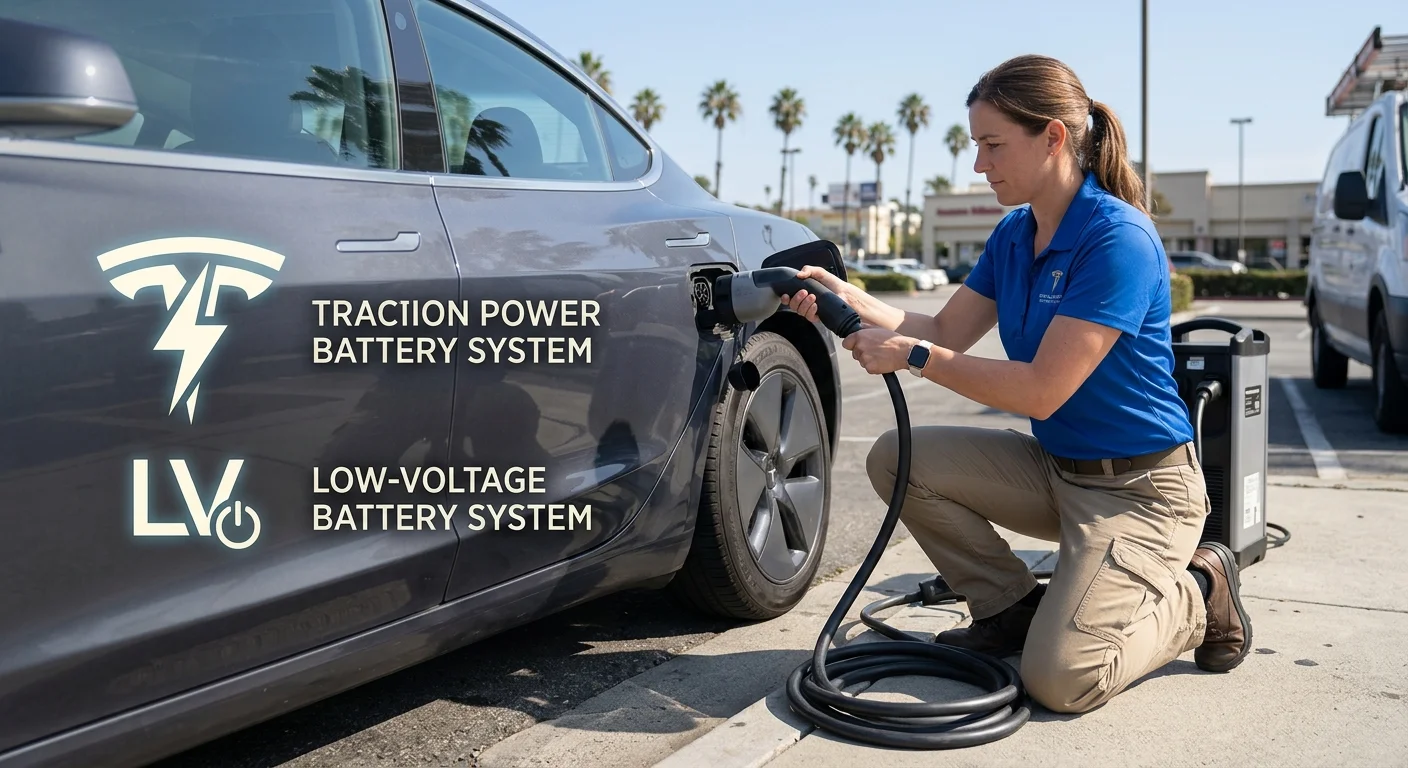
The Tesla Model 3 has two batteries, and they do completely different jobs. The 12-volt battery runs the computers, the locks, and the lights. The high-voltage pack moves the car. Knowing which one is failing tells you whether you need a jump, a top-up, or a tow.
The short answer
The Tesla Model 3 has a small 12V battery under the frunk panel and a large high-voltage pack under the floor. The 12V wakes the car and runs the low-voltage electronics. The high-voltage pack moves the car and is sealed, not a service item. A dead-looking Tesla is almost always a 12V issue, not a pack issue.
Where the 12V battery lives
The Tesla Model 3 12V battery sits behind a plastic panel under the front trunk, on the passenger side. Lift the frunk, remove the panel, and look for a small lead-acid or lithium 12V pack. On older Model 3 cars (2017 through about 2021) the 12V is a flooded lead-acid unit. On newer Model 3 cars (2022 and later) the 12V is a lithium unit, often smaller than the lead-acid one.
The 12V’s job is to:
- Wake the car from sleep.
- Run the body control module.
- Light up the touchscreen and driver display.
- Power the door handles and locks.
- Close the high-voltage contactors that connect the traction pack to the drive unit.
A 12V failure shows up as a dark dashboard, no fob response, no door handles presenting. The traction pack can still be at 70 or 80%.
Where the high-voltage pack lives
The Tesla Model 3 high-voltage pack sits under the floor of the car, between the front and rear axles. It is a large structural battery that holds 50 to 82 kWh depending on the variant (Standard Range, Long Range, Performance). The pack is sealed and not a service item for the owner. Service on the pack is done at a Tesla service center or a qualified EV shop.
The high-voltage pack’s job is to:
- Move the car.
- Power the heating and air conditioning through a heat pump or resistive heater.
- Recharge the 12V through the DC-to-DC converter while the car is awake.
A traction pack issue shows up as a “Battery Empty” reading on the dashboard with the 12V still working, or as a high-voltage fault that the dashboard reports.
Why the locations matter when you are stuck
Knowing which battery is which tells you what to do when the car is dead.
Dark dashboard, no fob response
This is the 12V. The traction pack is almost certainly fine. A clean external 12V source wakes the car. A mobile operator brings the right pack and knows the manual jump points.
Dashboard lit, state of charge at 0%
This is the traction pack. The 12V is fine. A 240V top-up at the car gets you moving. A mobile operator brings the right connector.
Dashboard lit, “Service High-Voltage System” warning
This is the traction pack or the contactor system. A tow is the right call.
Car sat in floodwater
NHTSA warns against parking a flood-exposed EV within 50 feet of a structure and against charging it until it has been inspected. Saltwater residue in a lithium pack can short days or weeks later.
Why South Florida wears the 12V faster
The Model 3 12V battery ages fast in this climate. Lead-acid and AGM units lose about half their useful life for each 15F rise above 77F. South Florida pushes ambient temperatures past 90F for months. The 12V ages in two to three years of calendar time here rather than the four to five the manual expects.
The Model 3 also has a known pattern of 12V drain during long sits. The telematics module, keyless entry, and security systems stay awake while the car is parked. A Model 3 that sits at MIA for ten days, in a Brickell tower for a long vacation, or in a PortMiami cruise lot for a week can come back to a flat 12V even with a healthy traction pack.
How to find the 12V on your Model 3
For 2017-2021 Model 3 cars with the lead-acid 12V:
- Open the frunk.
- Remove the plastic panel on the passenger side.
- Look for the 12V battery under a small cover.
- The positive jump post is under a red plastic cover.
For 2022 and later Model 3 cars with the lithium 12V:
- Open the frunk.
- Remove the plastic panel on the passenger side.
- Look for the lithium 12V, which is smaller than the lead-acid unit.
- The positive jump post is under a red plastic cover.
The owner’s manual shows the exact location and the manual’s jump procedure.
What a mobile rescue operator does
A mobile operator working the South Florida metro comes to the car with the right equipment. For a Tesla Model 3 dead-battery call:
- Confirm the 12V is the cause with a multimeter.
- Apply a stable external 12V source through the manual’s jump points.
- If the 12V is dead beyond recovery, replace it on the spot.
- Once the dashboard is up, top up the traction pack from a 240V Level 2 source if it is also low.
The operator quotes you before starting and bills you directly.
For a Model 3 stuck on a causeway with a 0% traction pack, the operator brings a 240V Level 2 source with a NACS connector and tops the pack up at the curb.
How to keep the next call from happening
- Drive the Model 3 at least once a week.
- Park in shade or a garage. Heat is the killer.
- Replace the 12V every two to three years in this climate for lead-acid, three to five for lithium.
- Unplug accessories like dash cams and OBD-II dongles for long sits.
- Watch for the warning messages. The 12V usually gives you days of notice.
Frequently asked questions
Where is the Tesla Model 3 12V battery?
Behind a plastic panel under the frunk, on the passenger side. The owner’s manual shows the exact spot.
Where is the Tesla Model 3 high-voltage pack?
Under the floor of the car, between the front and rear axles. It is sealed and not a service item.
How long does a Tesla Model 3 12V last in South Florida?
Two to three years of calendar life for lead-acid, three to five for lithium. Heat is the dominant factor.
Can I jump a Tesla Model 3 12V myself?
Yes, with a portable jump starter and the manual’s procedure. Match polarity and disconnect in the order the manual gives.
When does a Model 3 need a tow, not a jump?
If the dashboard shows a high-voltage fault, the car has visible damage, or it sat in floodwater, the next step is a flatbed to a service center.
When to call us
If your Tesla Model 3 is dead or stuck anywhere in Miami-Dade or Broward, call us before you assume the high-voltage pack is the issue. A mobile operator meets the car, confirms the 12V is the cause with a multimeter, and either jumps it or replaces it on the spot.
Call us at (786) 963-2995 to reach a local operator.