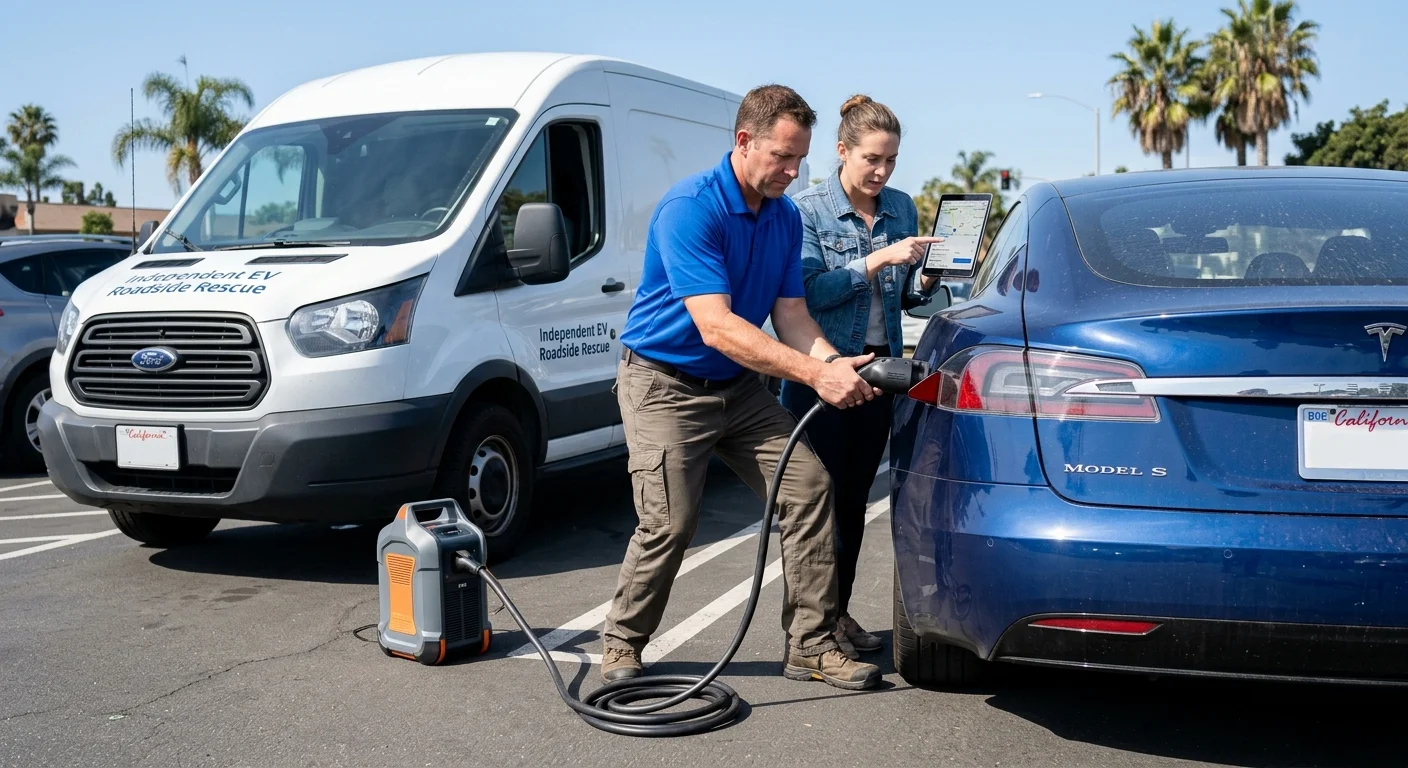
Towing a Tesla Model S with no power requires flatbed-only transport. A wheel-lift or a tow dolly can damage the drive unit, the parking brake actuator, and the underbody. Here is the checklist to follow before the hook goes on, and what Florida law says about where the car can sit until the truck arrives.
The short answer
A Tesla Model S with no power must be transported on a flatbed. Wheel lifts and tow dollies are not safe. Florida Statute 316.194 lets a disabled vehicle stay where it is if it cannot practicably be moved. Set hazards, clear the lane, and call for a flatbed. The driver should stay with the car or move upwind until the truck arrives.
Why a flatbed is the only safe option
The Tesla Model S is a rear-drive or all-drive vehicle with a single-speed transmission and an electronic parking brake. The electronic parking brake is a caliper on the rear rotor that engages when the car loses 12V power. Once it is engaged, the rear wheels cannot turn freely. A wheel-lift tow on a Model S with the parking brake engaged drags the rear wheels, which can damage the brake system and the drive unit.
The other issue is the high-voltage cabling that runs along the underbody. A wheel-lift that contacts the underbody can damage the cable harness. A flatbed carries the car with all four wheels off the ground, which avoids both problems.
Tesla publishes a specific procedure for transporting a Model S with no power. The procedure requires a flatbed and a set of tire straps. The owner’s manual has the diagram.
What to do before the tow truck arrives
Set your hazards
A Model S with a dead 12V has the hazards on a small battery reserve. Turn them on as soon as the car loses power. They will run for a long time on a healthy 12V and only minutes on a dead one.
Get clear of the lane
Florida Statute 316.194 lets a disabled vehicle stay where it is if it cannot practicably be moved. The statute also requires that the vehicle be left off the main-traveled part where practicable, with room left for passing traffic and a clear view from 200 feet each way. Move as far off the lane as you can. On a highway shoulder, that means well to the right with the wheels turned toward the curb.
Stay with the car or move upwind
If traffic is light and you have a wide shoulder, stay with the car. If traffic is moving fast and close, exit on the passenger side and move upwind of the lane. Get past the guardrail if there is one.
Call for help
Two free options cover most of the South Florida freeway network:
- Road Rangers: dial *FHP (*347) from a mobile phone. The Road Rangers will move a disabled vehicle from the travel lanes to a safe location but do not tow EVs to a service center.
- Florida 511: dial 511 for traffic and travel information. This will not dispatch a tow, but it can confirm whether an incident is already on the corridor.
For a tow to a Tesla service center, call your insurance roadside line or a contracted flatbed service. Tesla’s own roadside number dispatches through a contracted network.
What to tell the tow operator
The dispatcher needs:
- The corridor and direction: I-95 northbound, the Turnpike southbound, I-75 eastbound toward Miami, and so on.
- The nearest mile marker or exit number.
- The vehicle state: drivable but low, completely dead, hazards on, dashboard lit or dark.
- Whether you are with the car or have exited.
The operator also needs to know it is a Tesla Model S, not a gas car. Wheel-lift trucks will refuse the call when they hear “Tesla” if they have the right training. Flatbed operators know.
What a mobile rescue operator does for a no-power Model S
A mobile operator working the South Florida metro can often wake the car before the tow arrives:
- Connect a portable 12V jump starter to the manual’s jump points.
- Wake the car enough to put it in tow mode.
- Disengage the electronic parking brake.
- Top up the traction pack from a 240V Level 2 source if needed.
If the car wakes, you may not need a tow. The operator quotes you before starting and bills you directly.
When a tow is the right call
A few situations call for a tow, not a charge:
- The car has visible underbody damage after a curb strike or collision.
- The dashboard shows a high-voltage fault.
- The car sat in floodwater.
- The 12V is so dead the manual release does not respond.
Florida Statute 316.194 lets a disabled vehicle stay where it is. Set hazards, clear the lane, and call for a flatbed.
A car that sat in floodwater needs special handling. NHTSA warns against parking a flood-exposed EV within 50 feet of a structure and against charging it until it has been inspected. Saltwater residue in a lithium pack can short days or weeks later.
How to avoid the next no-power call
- Drive the Model S at least once a week.
- Park in shade or a garage. Heat is the killer.
- Replace the 12V every two to three years in this climate.
- Unplug accessories like dash cams and OBD-II dongles for long sits.
- Watch for warning messages. The 12V usually gives you days of notice.
Frequently asked questions
Can a Tesla Model S be towed with a wheel lift?
No. A Model S with no power has the electronic parking brake engaged and must be transported on a flatbed. Wheel lifts and tow dollies damage the car.
What does Florida law say about a disabled vehicle on the highway?
Florida Statute 316.194 lets a disabled vehicle stay where it is if it cannot practicably be moved. The vehicle must be left off the main-traveled part where practicable.
Can a mobile operator wake a Model S with no power?
Often yes. A clean external 12V source wakes the car and disengages the electronic parking brake. The operator quotes you before starting.
Where do you tow a Model S in South Florida?
The nearest Tesla service center or a contracted shop in Miami or Fort Lauderdale.
When does a Model S need a tow, not a charge?
If the car has visible damage, a high-voltage fault, or sat in floodwater, the next step is a flatbed to a service center.
When to call us
If your Tesla Model S is dead anywhere in Miami-Dade or Broward, call us before you call for a tow. A mobile operator meets the car with a portable jump starter and a 240V Level 2 source. They quote you before starting and bill you directly.
Call us at (786) 963-2995 to reach a local operator.