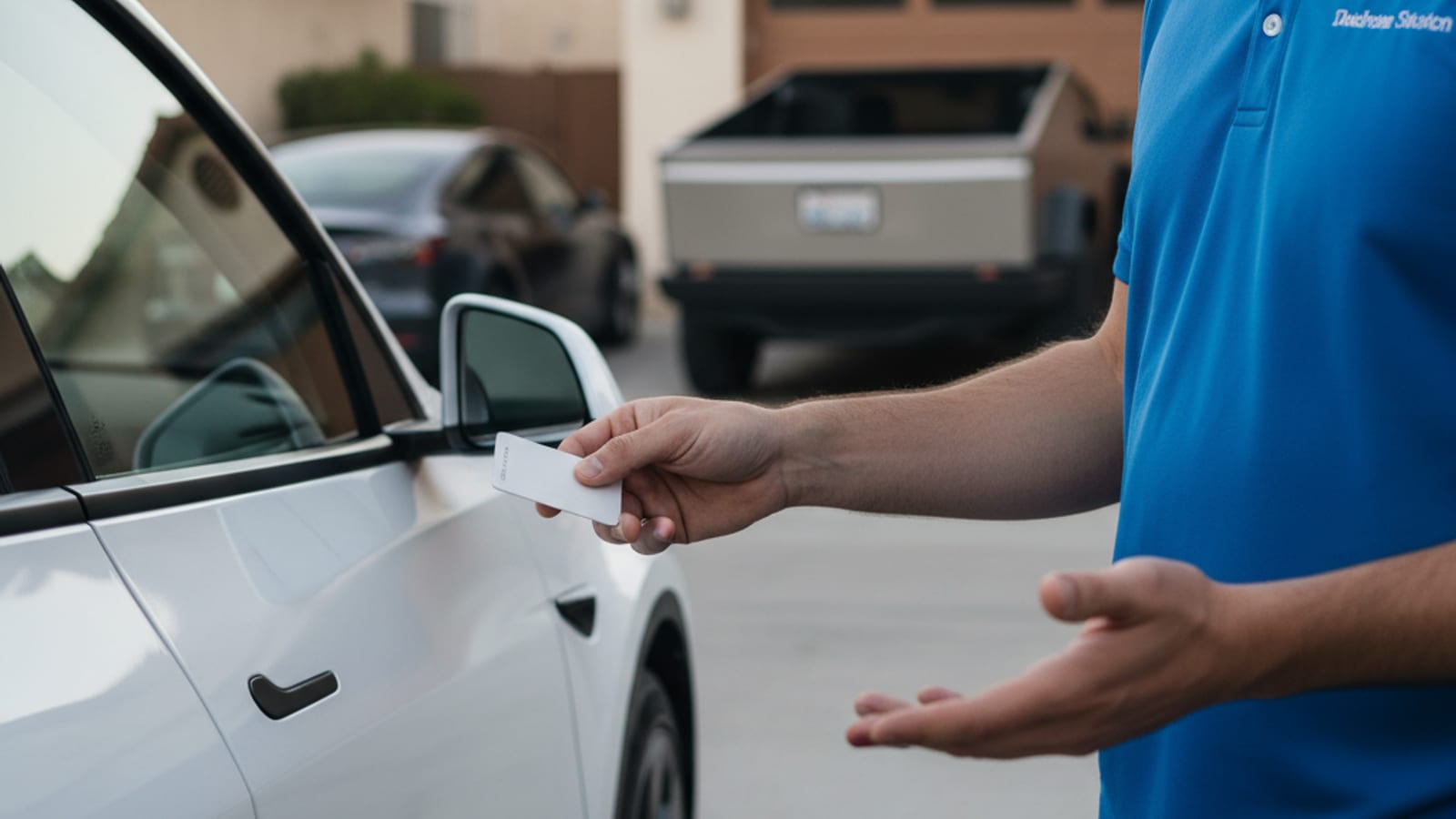
You walk out of a Brickell tower, a Miami Beach valet stand, or a Fort Lauderdale Beach garage and the Model X is dark. The falcon-wing doors will not present, the center screen is black, the start button does nothing. Before you call for a flatbed, work the 12-volt checklist. In South Florida’s heat, the 12V is the most common reason an otherwise healthy Model X will not start.
The short answer
A Tesla Model X that won’t start is almost always a 12V issue. The high-voltage traction pack can sit at 70% while the 12V has drained flat. The 12V is what wakes the car, runs the computers, lights up the dashboard, and closes the high-voltage contactors. A clean external 12V source gets the Model X back.
Why the Model X 12V dies in this climate
The Tesla Model X uses a 12V battery that lives under the hood, on the passenger side. The Model X draws more 12V than the Model S because the falcon-wing doors need power to present and align, and the center touchscreen is larger and brighter. The 12V has to be sized for that load.
Lead-acid and AGM 12V batteries lose about half their useful life for each 15F rise above 77F. South Florida’s sustained summer heat pushes ambient temperatures above 90F for months. A Model X parked outside or in an uninsulated garage ages its 12V faster than the manual suggests.
The Model X also has a known pattern of drain during long sits. The telematics module, keyless entry, falcon-wing door actuators, and security systems stay awake while the car is parked. A Model X in a Brickell tower for a long vacation, at MIA for ten days, or in a Port Everglades cruise lot for a week can come back to a flat 12V even with a healthy traction pack.
Common South Florida calls:
- A Model X in a Brickell or Aventura tower for a long weekend. The 12V drains flat from the falcon-wing door actuators.
- A Model X at MIA for ten days. Same drain, same fix.
- A Model X at Port Everglades cruise parking for a week. Same pattern.
What to check before you call
The dashboard state
A 12V failure shows itself in stages:
- The door handles and falcon-wing doors do not present on approach.
- The key fob takes several presses.
- The interior lights dim or flicker when the door opens.
- The dashboard takes a long time to boot, or does not boot at all.
- The start button does not respond.
If the car is fully dark, the 12V is past the warning stage. A jump is the next step.
Try a fob reset
Press and hold both the lock and unlock buttons on the Model X fob for about five seconds. This resets the fob’s handshake with the car. If the doors respond and the dashboard lights up, you caught the system mid-stall, not mid-failure.
Look at the 12V itself
The Model X 12V is under the hood, on the passenger side. Look for a swollen case, a wet or crystallized top, or a sulfur smell. Any of those means the battery has failed and needs replacement.
Try a portable jump
A portable lithium jump starter connected to the manual’s jump posts wakes the car. Match polarity, follow the manual’s connection order, and disconnect in the order the manual gives. A clean source avoids voltage spikes that can damage the DC-to-DC converter.
If the dashboard lights come up and the car responds, drive to a service center for a 12V replacement within the next few days.
What a mobile rescue operator does
A mobile operator working the South Florida metro comes to the car with the right equipment. For a Model X no-start call:
- Confirm the 12V is the cause with a multimeter.
- Apply a stable external 12V source through the manual’s jump points.
- If the 12V is dead beyond recovery, replace it on the spot with a fresh unit sized for the Model X.
- Once the dashboard is up, top up the traction pack from a 240V Level 2 source if it is also low.
The operator quotes you before starting and bills you directly.
When the situation calls for a tow, not a charge
Some Model X no-starts are not 12V issues:
- A loud click from under the hood, then silence.
- “Service High-Voltage System” on the driver display.
- Visible underbody damage after a curb strike or flood.
- A burning smell.
Any of those is a tow. Florida Statute 316.194 lets a disabled vehicle stay where it is if it cannot practicably be moved. Set hazards, clear the car, and call for a flatbed.
A Model X that sat in floodwater is its own case. NHTSA warns against parking a flood-exposed EV within 50 feet of a structure and against charging it until it has been inspected.
How to keep the next call from happening
- Drive the Model X at least once a week.
- Park in shade or a garage. Heat is the killer.
- Replace the 12V every two to three years in this climate for lead-acid or AGM.
- Unplug accessories like dash cams and OBD-II dongles for long sits.
- Watch for warning messages in the weeks before a failure.
Frequently asked questions
Why does a Tesla Model X not start in hot weather?
The 12V battery ages faster in heat. The Model X’s higher 12V load from the falcon-wing doors and the larger screen makes the issue more visible than on other models.
Can I jump a Model X myself?
Yes, with a portable jump starter and the manual’s procedure. Match polarity and disconnect in the order the manual gives.
What does a mobile rescue operator charge for a Model X 12V jump?
The operator quotes you before starting. The price depends on the work and any parts if a replacement is needed. Charge Pro MIA does not set the rate.
When does a Model X need a tow, not a jump?
If the dashboard shows a high-voltage fault, the car has visible damage, or it sat in floodwater, the next step is a flatbed to a service center.
Where does the Model X 12V live?
Under the hood, on the passenger side. The owner’s manual shows the exact spot.
When to call us
If your Tesla Model X has died anywhere in Miami-Dade or Broward, call us before you assume the worst. A mobile operator meets the car, confirms the 12V is the cause, and either jumps it or replaces it on the spot.
Call us at (786) 963-2995 to reach a local operator.