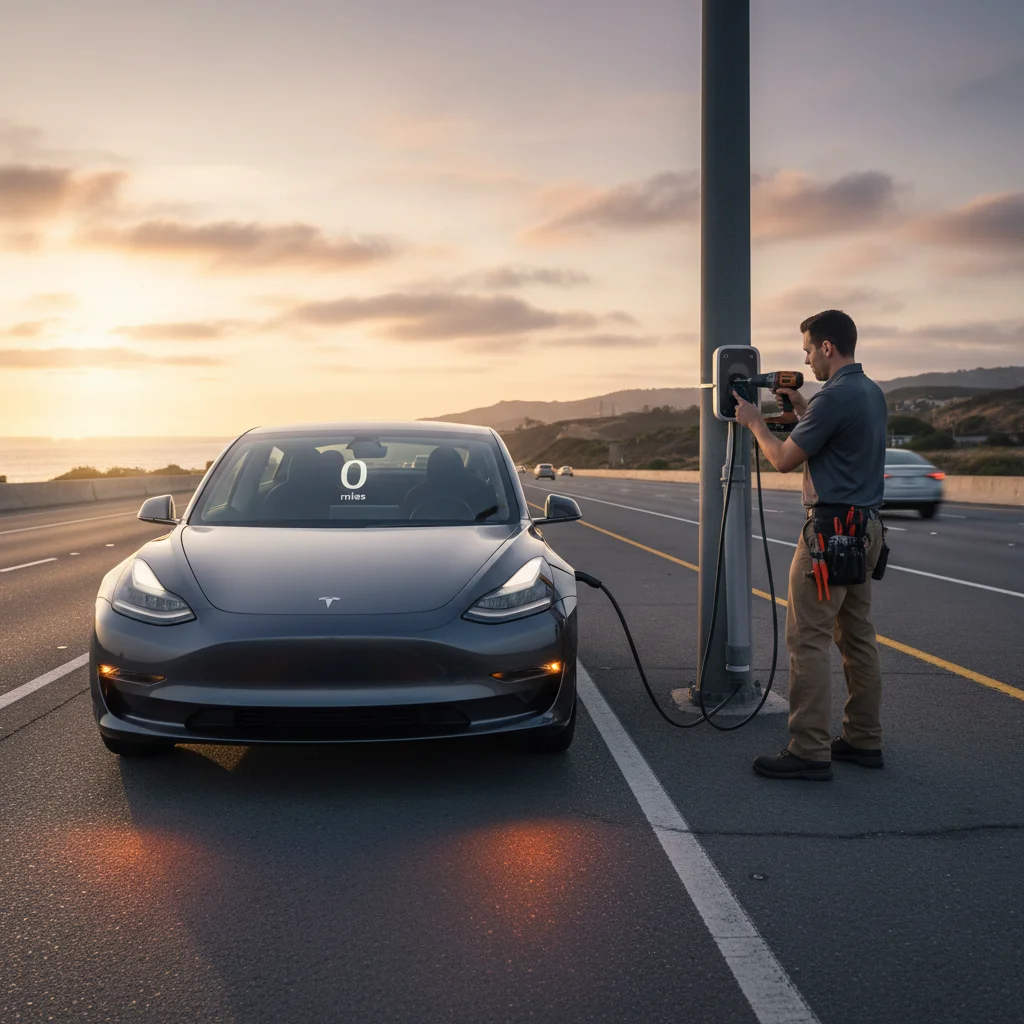
Your Tesla just hit 0% on a South Florida road. The dashboard is warning you to pull over. The car will lose propulsion in a few minutes. Here is what to do in the next five minutes, and how a mobile rescue operator gets you back on the road.
The short answer
A Tesla at 0% keeps the dashboard lit and the power steering working for a short window after the warning. Use the remaining momentum to reach the shoulder, an exit ramp, or a parking lot. Set your hazards. Call for help. A mobile rescue operator brings a 240V Level 2 source with a NACS connector and tops off the pack at your location. The session typically adds 10 to 20 miles of range in 15 to 30 minutes of charging.
What to do in the next five minutes
Step 1: Hazards on
The instant the warning appears, turn on the hazard lights. The 12V battery is what powers the hazards, and a 12V that is healthy will run them for a long time.
Step 2: Steer to the shoulder
Even a low Tesla can usually coast. Use the remaining momentum to get as far right as possible. Aim for a paved shoulder, an emergency pull-off, or an exit ramp. The traveled lane is the dangerous place; the shoulder is where you wait.
Step 3: Stay or exit based on traffic
Florida Statute 316.194 lets you stay with the vehicle if it cannot be moved and you are clear of the traveled lanes. If traffic is moving fast and close, exit the car on the passenger side and move upwind of the lane. Get past the guardrail if there is one.
Step 4: Call for help
From a safe position, call for help. Three paths cover most of South Florida:
- Road Rangers: dial *FHP (*347) from a mobile phone. Florida Highway Patrol and the Road Ranger Service Patrol answer through the same number. The Road Rangers patrol I-95, 95 Express, I-195, I-395, I-75, 75 Express and SR-826 (the Palmetto) in Miami-Dade 24/7 through District 6. In Broward they cover I-95 plus portions of I-595 and I-75 through District 4. The Road Rangers will move a disabled vehicle from the travel lanes to a safe location but do not bring a 240V EV charger.
- Charge Pro MIA’s number: a local mobile operator who brings a 240V Level 2 source to your location.
- Tesla roadside: for a tow to a service center, not a mobile charge.
What to tell dispatch
The dispatcher will ask a few questions. Be ready with:
- The corridor and direction: I-95 northbound, the Turnpike southbound, I-75 eastbound toward Miami, and so on.
- The nearest mile marker or exit number. Florida freeways are mileposted.
- The closest cross street or landmark. A gas station, an overpass, a named exit.
- The vehicle state: drivable but low, completely dead, hazards on, dashboard lit or dark.
- Whether you are with the car or have exited.
If you have exited and moved upwind, say so. The operator wants to find you, not the car.
What the Road Rangers can and cannot do
The Road Rangers handle the highway portion. They will:
- Pull up behind your car with flashing lights.
- Confirm you are safe and the car is in a position that does not block traffic.
- Jump-start a 12V battery.
- Change a flat tire with the spare on the car.
- Tow the car to the nearest safe location off the highway.
The Road Rangers will not bring a 240V EV charger. If your traction pack is empty and the 12V is fine, the Road Rangers can clear you from the travel lanes to a safe pull-off or exit, then a mobile operator takes over with a charge.
What a mobile operator does for a Tesla at zero
A mobile rescue operator working the South Florida freeway network meets the car at the shoulder, at an exit ramp, or at a safe pull-off nearby. The operator brings:
- A 240V Level 2 source with a NACS connector.
- A 12V jump pack for cars with low-voltage symptoms.
- Tools for a stuck charge port.
The session typically adds 10 to 20 miles of range in 15 to 30 minutes of charging. That is charging time. The operator quotes you before starting and bills you directly.
If the highway patrol has already moved the car off the travel lanes and you are waiting at an exit or a nearby lot, the operator meets you there.
When the next step is a tow, not a charge
Some Tesla-at-zero situations call for a tow, not a charge:
- The car has visible underbody damage after a curb strike or a collision.
- The dashboard shows a high-voltage fault.
- The car sat in floodwater.
- The car cannot be moved to a safe spot even with a charge.
Florida Statute 316.194 lets a disabled vehicle stay where it is. Set hazards, clear the lane, and call for a flatbed. A tow operator on contract with your insurance takes the car to a qualified shop.
A car that sat in floodwater is its own category. NHTSA warns that residual salt in a flooded lithium pack can short days or weeks later. Do not park a flood-exposed EV within 50 feet of a structure and do not charge it until it has been inspected.
How to avoid the next zero-percent moment
- Top up before long corridors. The Turnpike and I-75 between Weston and Naples are the longest without services.
- Watch the GOM (guess-o-meter) in hot weather and in headwind. Range drops faster than the dashboard predicts.
- Keep the 12V healthy. Replace it every two to three years in this climate.
- Carry the number for both the Road Rangers (*FHP) and a mobile operator.
Frequently asked questions
Can I stay with my Tesla on a Florida freeway shoulder?
Yes, if the car is off the traveled lanes. Florida Statute 316.194 lets a disabled vehicle stay where it is if it cannot practicably be moved.
Do the Road Rangers help with EV charging?
No. They jump-start a 12V, change a flat with the spare, and tow a disabled car to a safe spot. They do not bring a 240V EV charger.
Who can charge my Tesla on a freeway shoulder?
A mobile rescue operator. The operator meets the car at the shoulder, at an exit, or at a safe pull-off nearby with a 240V Level 2 source.
What if my Tesla has a high-voltage fault on the freeway?
Set hazards, clear the lane, and call for a flatbed. Do not try to drive the car or charge it.
What if the car sat in floodwater?
Do not charge it. Do not park it near a structure. Tow it to a service center and have it inspected before any further use.
When to call us
If your Tesla has hit zero on a South Florida road and you need a 240V top-up at the shoulder or a nearby pull-off, call us. We will connect you with a mobile operator who knows the corridor and has the right gear.
Call us at (786) 963-2995 to reach a local operator.