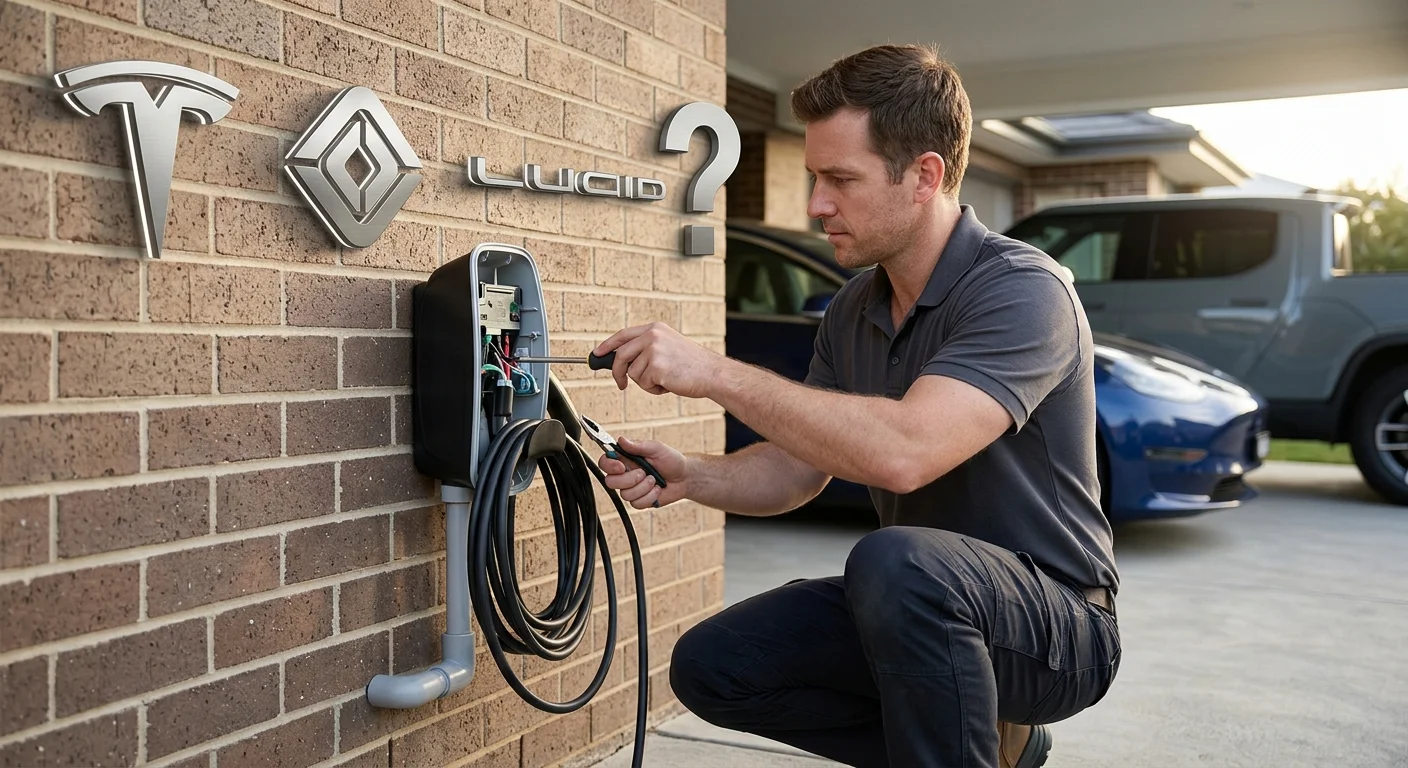
Tesla, Rivian, and Lucid all run roadside assistance programs for their cars. All three follow the same basic shape: included for the warranty period, dispatched through a contracted network, and built around the tow-to-a-shop model. None of them bring a 240V plug to your South Florida shoulder. Here is how each one fits, and where the gap is.
The short answer
Tesla, Rivian, and Lucid all include roadside assistance for the warranty period. All three dispatch through contracted networks. None of them dispatch a 240V truck to your location. In South Florida, where most no-start calls trace to a 12V and most low-pack calls trace to a missing home plug, a local mobile operator is the path for the on-location calls.
How the three programs compare
The three programs cover the same gas-car-shaped services:
- Towing to the nearest service center or a qualified shop.
- Lockout assistance.
- Flat-tire change with the spare on the car (where applicable).
- Fuel delivery for a gas car, where applicable.
- Winching if the car is stuck.
None of them dispatch a 240V Level 2 truck. None of them deliver a 12V jump to your location. None of them cover a manual charge port release for a stuck cable.
The differences between the three are around renewal pricing, response time commitments, and where the cars can be towed.
Tesla roadside
Tesla’s included roadside covers all four current models with the same program. The card dispatches through a contracted network and pays for towing, lockout, flat-tire change with the spare, fuel delivery for a gas car, and winching. The 2026 update raised the per-disablement limit and clarified the response time commitment for high-traffic metros.
What the card covers:
- Towing to the nearest Tesla service center or a qualified shop.
- Lockout assistance.
- Flat-tire change with the spare.
- Winching.
What the card does not cover:
- A 240V top-up at the car.
- A 12V jump delivered to your location.
- A manual charge port release.
Tesla has service centers in Miami and Fort Lauderdale. The contracted tow destination is usually a Tesla service center in the metro.
Rivian roadside
Rivian’s included roadside covers the R1T and R1S with the same program. The card dispatches through a contracted network and pays for the same services as Tesla. The 2026 program clarified the per-disablement limits and the after-hours response.
What the card covers:
- Towing to the nearest Rivian service center or a qualified shop.
- Lockout assistance.
- Flat-tire change with the spare.
- Winching.
What the card does not cover:
- A 240V top-up at the car.
- A 12V jump delivered to your location.
- A manual charge port release.
Rivian has a service center in the South Florida metro. The contracted tow destination is usually a Rivian service center or a contracted shop in Miami or Fort Lauderdale.
Lucid roadside
Lucid’s included roadside covers the Air sedan and the Gravity SUV. The card dispatches through a contracted network. Lucid has fewer service centers than Tesla or Rivian, so the contracted tow destination is more often a qualified shop than a Lucid service center.
What the card covers:
- Towing to the nearest qualified shop.
- Lockout assistance.
- Flat-tire change with the spare (where applicable).
- Winching.
What the card does not cover:
- A 240V top-up at the car.
- A 12V jump delivered to your location.
- A manual charge port release.
Lucid’s South Florida service network is thinner than Tesla’s or Rivian’s. A Lucid owner may end up at a contracted shop in Miami or Fort Lauderdale rather than a Lucid location.
The gap all three miss
The South Florida EV stranding pattern is different from the gas-car pattern. Most calls are:
- A dead 12V in a tower garage. The traction pack has range. A jump at the curb is the answer.
- A low pack with no home plug. A 240V top-up at the curb is the answer.
- A stuck cable at a public station. A manual release is the answer.
None of those fits the tow-to-a-shop model that all three programs are built around. They fit a mobile operator who comes to the car.
What a local mobile operator does
A mobile rescue operator working the South Florida metro brings:
- A 240V Level 2 source with NACS, CCS, and J1772 connectors.
- A 12V jump pack.
- A 12V replacement battery for common models.
- Tools for a stuck charge port.
The session typically adds 10 to 20 miles of range in 15 to 30 minutes of charging. That is charging time, not a promise about when someone arrives. The operator quotes you before starting and bills you directly.
How to set up the right backup
The cleanest setup is to treat the brand’s included roadside as your tow coverage and keep a separate number for the on-location calls.
- Tesla roadside in the Tesla app.
- Rivian roadside in the Rivian app.
- Lucid roadside in the Lucid app.
- Charge Pro MIA’s number in your phone for the on-location calls.
When the card covers the call, use the card. When it does not, use the local operator.
Common South Florida calls
- A Tesla in a Brickell tower for a long vacation. The 12V drains flat. Use the local operator.
- A Rivian at MIA for ten days. Same drain. Use the local operator.
- A Lucid in Fort Lauderdale Beach with a stuck cable. Use the local operator.
- Any of the three with a mechanical failure on a South Florida highway. Use the brand card for a tow to a service center.
Frequently asked questions
Do Tesla, Rivian, and Lucid all include roadside assistance?
Yes, for the warranty period. All three programs dispatch through contracted networks.
Does any of them bring a 240V truck to your location?
No. None of the three dispatch a 240V Level 2 truck to your location.
Does any of them deliver a 12V jump to a tower garage?
The card dispatches a contracted service that can attempt a 12V jump. Whether the truck carries the right pack for an EV depends on the provider. For a guaranteed on-location jump, the local operator is the path.
What does a local mobile charge cost?
The operator quotes you before starting. Charge Pro MIA does not set the rate.
When does any of the three need a tow, not a charge?
If the dashboard shows a high-voltage fault, the car has visible damage, or it sat in floodwater, the next step is a flatbed to a service center.
When to call us
If your Tesla, Rivian, or Lucid is low or dead anywhere in Miami-Dade or Broward, call us before you call for a tow. A mobile operator meets the car with a 240V Level 2 source and a 12V jump pack. They quote you before starting and bill you directly.
Call us at (786) 963-2995 to reach a local operator.