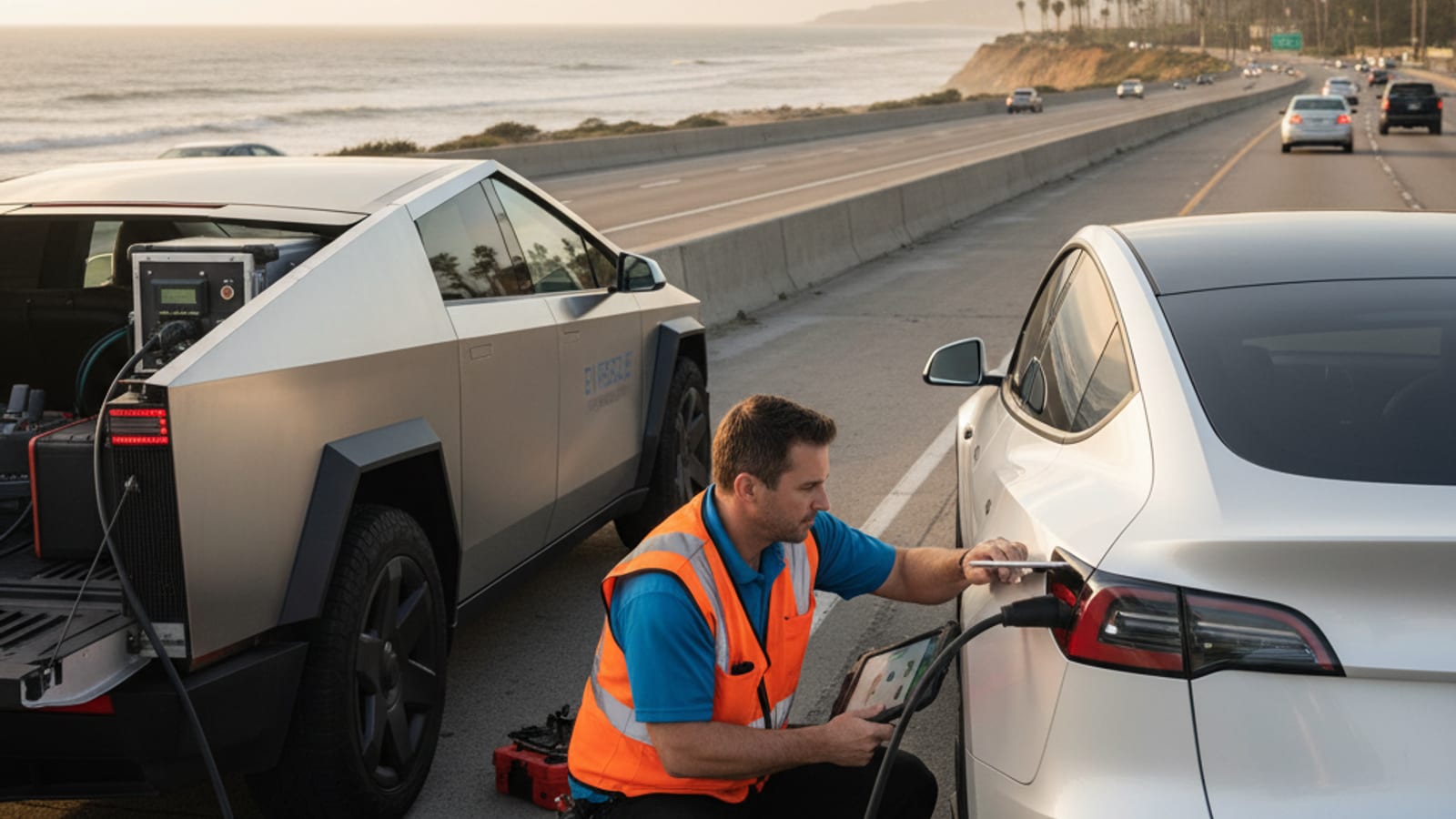
The Tesla roadside assistance phone number is in the Tesla app and the owner’s manual. It routes through a contracted dispatcher who sends a service provider. The call does not go to Tesla’s own service vans. Knowing how the call works, and when to skip it for a local mobile operator, is the difference between a tow to a shop and a 240V top-up at the curb.
The short answer
The Tesla roadside number reaches a contracted dispatcher who sends a tow operator or a service van. The call does not bring a 240V truck to your location. For a 12V jump at a Brickell tower, a 240V top-up at the curb, or a manual charge port release, you need a local mobile operator. Charge Pro MIA’s number covers the calls the Tesla card does not.
Where the number lives
Three paths reach the same dispatcher:
- The Tesla app’s “Roadside” button.
- The number in the owner’s manual.
- The number on the Tesla website’s support page.
All three route through the same dispatcher. The app is usually the fastest because it sends your location automatically.
How the call works
When you tap Roadside in the Tesla app, the request goes to a contracted dispatcher. The dispatcher reads your location and the nearest provider. In South Florida, that is usually a flatbed operator on contract. The dispatcher calls you back, confirms the location, and dispatches the truck.
A few things that come up:
- The dispatcher may ask whether the car is drivable. A “yes” sometimes routes you to a non-tow service; a “no” gets you a flatbed.
- The tow destination is set by the policy and may be a non-Tesla shop if there is no Tesla service center close.
- The card has a per-disablement limit. Repeated tows in a single event stack against the limit.
- After-hours calls route to a smaller network of providers. The response time stretches.
If you want to keep your options open, ask the dispatcher to confirm the destination before you accept. You can also refuse the tow and call a mobile rescue operator instead, paying out of pocket for a top-up at your location.
What the card covers
The Tesla roadside card covers the gas-car-shaped services:
- Towing to the nearest Tesla service center or a qualified shop.
- Lockout assistance.
- Flat-tire change with the spare on the car.
- Fuel delivery for a gas car, where applicable.
- Winching if the car is stuck.
It does not cover:
- A 240V top-up at the car. The card dispatches a flatbed, not a Level 2 truck.
- A 12V jump delivered to a Brickell tower or a MIA garage.
- A manual charge port release for a stuck cable.
- Off-hours mobile service.
When the card is the right call
The card fits the calls that need a shop:
- A Tesla with no power after a collision in Davie or Miramar.
- A Tesla that cannot unlock after a fender bender in Hollywood.
- A Tesla with a mechanical failure that needs a flatbed to a service center.
For those calls, the card covers the tow and the driver does not pay out of pocket.
When the card is the wrong call
The card does not fit the calls that need on-location help:
- A Tesla in a Brickell tower with a dead 12V. Use the local operator for a jump.
- A Tesla at 4% in Aventura with no home plug. Use the local operator for a 240V top-up.
- A Tesla with a stuck cable at a public station. Use the local operator for the manual release.
What a local mobile operator does
A mobile rescue operator working the South Florida metro brings:
- A 240V Level 2 source with a NACS connector.
- A 12V jump pack.
- A 12V replacement battery for common Tesla models.
- Tools for a stuck charge port.
The session typically adds 10 to 20 miles of range in 15 to 30 minutes of charging. That is charging time, not a promise about when someone arrives. The operator quotes you before starting and bills you directly.
How to set up the right backup
The cleanest setup is to treat Tesla’s included roadside as your tow coverage and keep a separate number for the on-location calls.
- Tesla roadside in the Tesla app and on a card in the glove box.
- Charge Pro MIA’s number in your phone for the on-location calls.
When the card covers the call, use the card. When it does not, use the local operator.
Common South Florida calls
- A Model Y in a Brickell tower for a long vacation. The 12V drains flat. Use the local operator.
- A Model 3 at MIA for ten days. Same drain. Use the local operator.
- A Model S in Fort Lauderdale Beach with a stuck cable. Use the local operator.
- A Model X with a mechanical failure on US-1. Use the Tesla card for a tow to a service center.
Frequently asked questions
What is the Tesla roadside number?
It is in the Tesla app and the owner’s manual. The app’s “Roadside” button is the fastest way to reach the dispatcher.
Does Tesla roadside cover a mobile EV charge?
No. The card dispatches a flatbed for tow calls and a service van for lockout and tire changes. It does not dispatch a 240V truck.
What does a local mobile charge cost?
The operator quotes you before starting. Charge Pro MIA does not set the rate.
When does a Tesla need a tow, not a charge?
If the dashboard shows a high-voltage fault, the car has visible damage, or it sat in floodwater, the next step is a flatbed to a service center.
Where does Tesla roadside tow a car in South Florida?
The destination is set by the contracted dispatcher. Most often it is the nearest Tesla service center in Miami or Fort Lauderdale.
When to call us
If your Tesla is low or dead anywhere in Miami-Dade or Broward, call us before you call for a tow. A mobile operator meets the car with a 240V Level 2 source and a 12V jump pack. They quote you before starting and bill you directly.
Call us at (786) 963-2995 to reach a local operator.