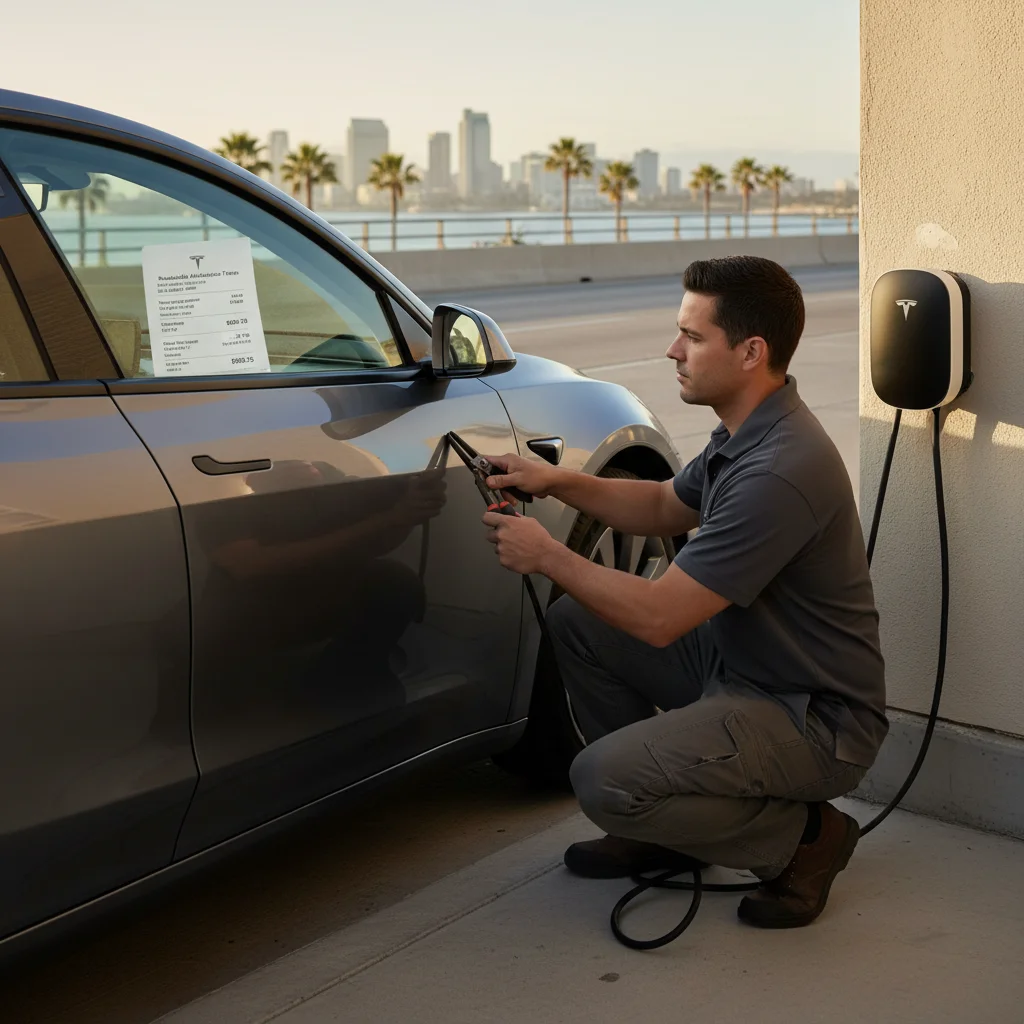
Tesla’s included roadside assistance covers all four current models with the same program: Model 3, Model Y, Model S, and Model X. The card dispatches through a contracted network and pays for towing, lockout, flat-tire change with the spare, fuel delivery for a gas car, and winching. The stranding pattern is not the same across models. Here is what each one tends to need in South Florida.
The short answer
Tesla roadside coverage is identical across the four current models. What differs is what fails first and where the car tends to strand. Model 3 and Model Y owners see more dead 12V calls in tower garages and airport parking. Model S and Model X owners see the same, plus the unique challenges of the older 12V chemistry and the falcon-wing door load.
What the Tesla roadside program covers for all models
The included roadside assistance covers:
- Towing to the nearest Tesla service center or a qualified shop.
- Lockout assistance.
- Flat-tire change with the spare on the car.
- Fuel delivery for a gas car, where applicable.
- Winching if the car is stuck.
It does not cover a 240V top-up at the car. It does not dispatch a 12V jump pack to your location. It does not cover a manual charge port release.
Model 3
The Model 3 is the highest-volume Tesla in South Florida. The 2017-2021 cars use a flooded lead-acid 12V. The 2022 and later cars use a lithium 12V. Both fail in this climate.
Common South Florida Model 3 calls:
- A Model 3 in a Brickell tower for a long vacation. The 12V drains flat.
- A Model 3 at MIA for ten days. Same drain.
- A Model 3 at PortMiami cruise parking for a week. Same pattern.
The lead-acid 12V ages in two to three years of calendar time. The lithium 12V lasts longer, often four to five years.
Model Y
The Model Y is the second-highest-volume Tesla. The early cars use a flooded lead-acid 12V; the 2023 and later cars use a lithium 12V. The stranding pattern is similar to the Model 3.
Common South Florida Model Y calls:
- A Model Y in an Aventura or Sunny Isles tower for a long weekend. The 12V drains flat.
- A Model Y at FLL for ten days. Same drain.
- A Model Y at Port Everglades cruise parking for a week.
Model S
The Model S has gone through more 12V revisions than the other models. The 2012-2015 cars use a flooded lead-acid 12V under the hood. The 2016-2020 cars use an AGM 12V in the same location. The 2021 refresh and later use a lithium 12V under the frunk, similar to Model 3.
Common South Florida Model S calls:
- A Model S in a Brickell or Sunny Isles tower for a long vacation. The 12V drains flat.
- A Model S at MIA for ten days. Same drain.
- A Model S that lives outside in Pinecrest, where summer heat has cooked the 12V.
The lead-acid Model S 12V ages in two to three years of calendar time. The AGM version lasts a bit longer. The 2021 refresh lithium 12V lasts four to five years.
Model X
The Model X uses a single 12V chemistry, an AGM unit under the hood on the passenger side. The Model X draws more 12V than the Model S because the falcon-wing doors need power to present and align, and the center touchscreen is larger.
Common South Florida Model X calls:
- A Model X in a Brickell or Aventura tower for a long weekend. The 12V drains flat from the falcon-wing door actuators.
- A Model X at MIA for ten days. Same drain.
- A Model X at Port Everglades cruise parking for a week.
The Model X 12V ages in two to three years of calendar time. The falcon-wing load makes it slightly more vulnerable than the Model S.
Why the stranding patterns differ
The Model 3 and Model Y are the most common cars in this metro. They sit in tower garages more than the Model S or X because their owners are younger and more likely to live in condos. The dead 12V in a tower pattern is what shows up in calls.
The Model S and Model X tend to live in single-family homes in Pinecrest, Palmetto Bay, Weston, and Parkland. They see less 12V drain from garage dwell but more from summer heat aging the battery in outdoor parking.
What to keep in your phone
The cleanest setup is to treat Tesla roadside as your tow coverage and keep a separate number for the on-location calls the card does not cover.
- Tesla roadside in the Tesla app and on a card in the glove box.
- Charge Pro MIA’s number for a 240V top-up at your location, a 12V jump, or a manual charge port release.
When the card covers the call, use the card. When it does not, use the local operator.
What a local operator does
A mobile rescue operator working the South Florida metro brings:
- A 240V Level 2 source with a NACS connector.
- A 12V jump pack.
- A 12V replacement battery for each model.
- Tools for a stuck charge port.
The session typically adds 10 to 20 miles of range in 15 to 30 minutes of charging. That is charging time, not a promise about when someone arrives. The operator quotes you before starting and bills you directly.
Frequently asked questions
Does Tesla roadside cost more for Model S or X?
No. The included roadside coverage is identical across all four current models.
Which Tesla model strands most in South Florida?
The Model 3 and Model Y strand most often because they are the highest-volume cars and live in tower garages. The 12V ages fast in this climate for all models.
Does Tesla roadside cover a 12V jump?
The card dispatches a contracted service that can attempt a 12V jump. Whether the truck carries the right pack for an EV depends on the provider.
What does a local mobile charge cost?
The operator quotes you before starting. Charge Pro MIA does not set the rate.
When does a Tesla need a tow, not a charge?
If the dashboard shows a high-voltage fault, the car has visible damage, or it sat in floodwater, the next step is a flatbed to a service center.
When to call us
If your Tesla Model 3, Model Y, Model S, or Model X is low or dead anywhere in Miami-Dade or Broward, call us before you call for a tow. A mobile operator meets the car with a 240V Level 2 source and a 12V jump pack. They quote you before starting and bill you directly.
Call us at (786) 963-2995 to reach a local operator.