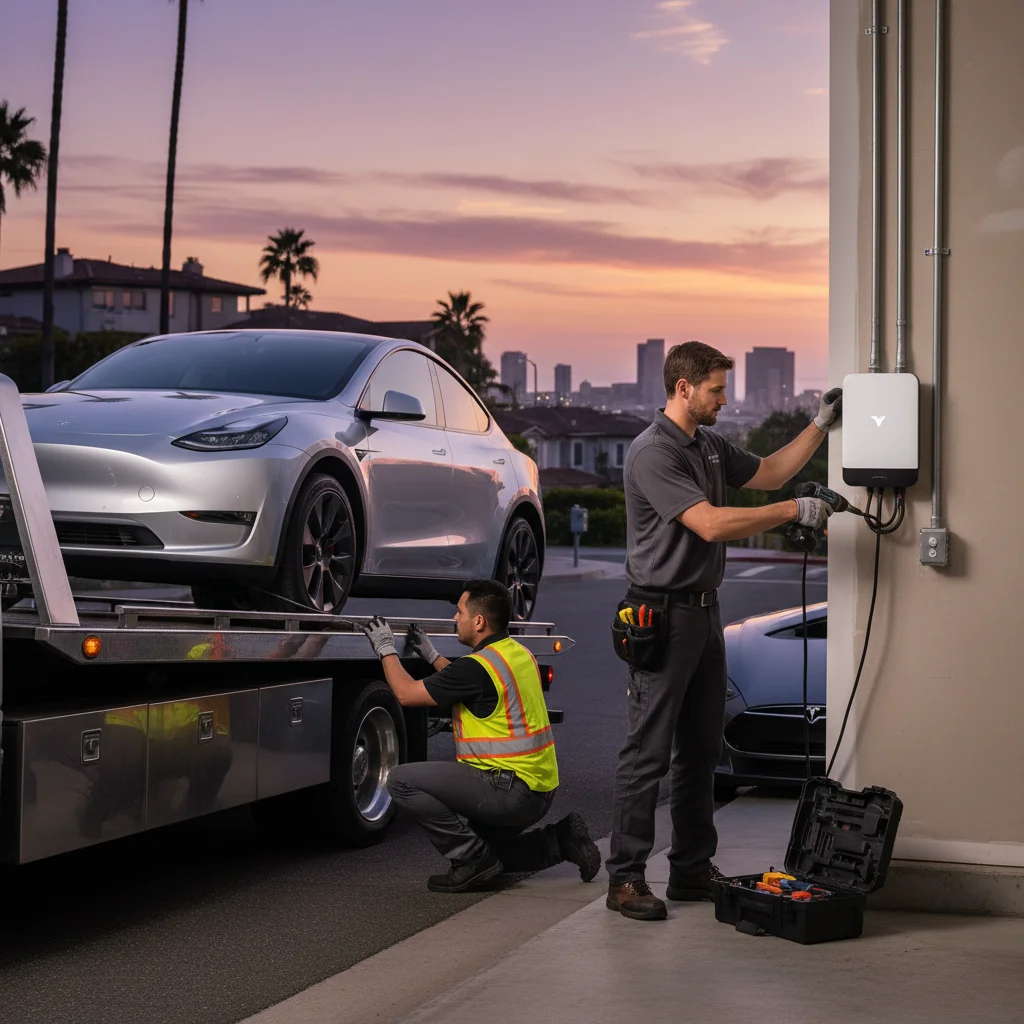
Tesla roadside does not send Tesla’s own service vans. The program dispatches a contracted network of tow operators and service providers. Florida private-property tow rules apply when that contractor meets you in a garage. Here is who shows up and what your rights are.
The short answer
Tesla roadside dispatches a contracted network of tow operators and service providers. In South Florida, that means a third-party flatbed operator with a Tesla-compatible setup, or a service van for lockout and tire change. Florida Statute 715.07 covers the rules the contractor has to follow when towing from private property, including the right to half-rate if you appear before the car is fully removed.
Who shows up
Tesla’s roadside program is a contract between Tesla and a network of providers. When you tap Roadside in the Tesla app or call the number in the owner’s manual, the request goes to the network dispatcher. The dispatcher reads your location and the nearest provider. The dispatched provider is usually a flatbed operator on contract.
What the dispatched provider looks like:
- A flatbed truck with a Tesla-compatible setup.
- A driver trained on EV-specific transport procedures.
- Tools for the standard roadside services.
- A contracted rate with Tesla, not with you.
The provider bills Tesla for covered services. The driver may not know your car is a Tesla until they arrive. Some providers refuse Tesla calls because they do not have the right equipment. The dispatcher reroutes to a provider who does.
Why Florida private-property tow rules matter
If the dispatched provider meets you in a parking garage, an apartment lot, or another private property, Florida Statute 715.07 sets the rules:
- The provider must stop and return the vehicle if the owner appears before the car is fully removed, on payment of no more than one-half the posted tow rate.
- The property must carry a permanent, reflective, correctly sized “tow-away zone” sign at each access, posted at least 24 hours ahead, except appurtenant to a single-family home or when personal notice is given.
- The towed vehicle must be stored within a 10-mile radius in a county of 500,000-plus (both Miami-Dade and Broward qualify) and released within one hour of request.
- The operator must file its rate schedule with local law enforcement and post it at the storage site.
If the contractor tows from private property without following the sign rule, you may have a claim under 715.07. The statute is specific about signage, posting, and the half-rate return rule.
What the contractor can and cannot do
The contractor can:
- Tow the car from the garage to the nearest Tesla service center or a contracted shop.
- Lockout the car without damage.
- Change the tire with the spare on the car.
- Provide a small amount of fuel for a gas car.
- Winch the car out of a ditch or a tight spot.
The contractor cannot:
- Refuse to return the car if you appear before it is fully removed from private property (715.07).
- Charge you the full tow rate if you appear in time.
- Store the car more than 10 miles from the property in Miami-Dade or Broward.
- Take more than an hour to release the car once you have paid.
What to do if the contractor takes the car
If the contractor has already moved the car:
- Go to the storage site. The contractor must release the car within an hour of your request.
- Pay the posted rate. The rate schedule is filed with local law enforcement and posted at the site.
- Check the signs at the property. If the property did not have the required sign, the tow may not have been lawful under 715.07.
If the contractor refuses to release the car or charges a rate not on the posted schedule, the dispute is with the contractor and the property. Miami-Dade Code Section 30-476 and Broward Code Section 20-176.22 cap nonconsent tow rates; the cap is on the rate schedule, not a specific number.
How to avoid a contractor call in the first place
- Keep the 12V healthy. Replace it every two to three years in this climate.
- Drive the car at least once a week.
- Park in a garage or covered lot when you can.
- Watch for warning messages. The 12V usually gives you days of notice.
For the calls the contractor card does not cover (a 240V top-up at the curb, a 12V jump at your location, a manual charge port release), a local mobile operator is the path.
What a local mobile operator does
A mobile rescue operator working the South Florida metro brings:
- A 240V Level 2 source with a NACS connector.
- A 12V jump pack.
- A 12V replacement battery for common Tesla models.
- Tools for a stuck charge port.
The session typically adds 10 to 20 miles of range in 15 to 30 minutes of charging. That is charging time, not a promise about when someone arrives. The operator quotes you before starting and bills you directly.
How to set up the right backup
The cleanest setup is to treat Tesla’s included roadside as your tow coverage and keep a separate number for the on-location calls.
- Tesla roadside in the Tesla app and on a card in the glove box.
- Charge Pro MIA’s number in your phone for the on-location calls.
When the card covers the call, use the card. When it does not, use the local operator.
Frequently asked questions
Who shows up when you call Tesla roadside?
A contracted third-party provider. In South Florida, that is usually a flatbed operator on contract with the network.
Does Tesla roadside cover a mobile EV charge?
No. The card covers a tow, lockout, flat-tire change with the spare, fuel delivery for a gas car, and winching. It does not dispatch a 240V truck.
What does Florida law say about a tow from private property?
Florida Statute 715.07 sets the rules: the operator must stop and return the car if you appear before it is fully removed, on payment of no more than half the posted tow rate; the property must have the right signage; the car must be stored within 10 miles; the rate schedule must be filed and posted.
What does a local mobile charge cost?
The operator quotes you before starting. Charge Pro MIA does not set the rate.
When does a Tesla need a tow, not a charge?
If the dashboard shows a high-voltage fault, the car has visible damage, or it sat in floodwater, the next step is a flatbed to a service center.
When to call us
If your Tesla is low or dead anywhere in Miami-Dade or Broward, call us before you call for a tow. A mobile operator meets the car with a 240V Level 2 source and a 12V jump pack. They quote you before starting and bill you directly.
Call us at (786) 963-2995 to reach a local operator.