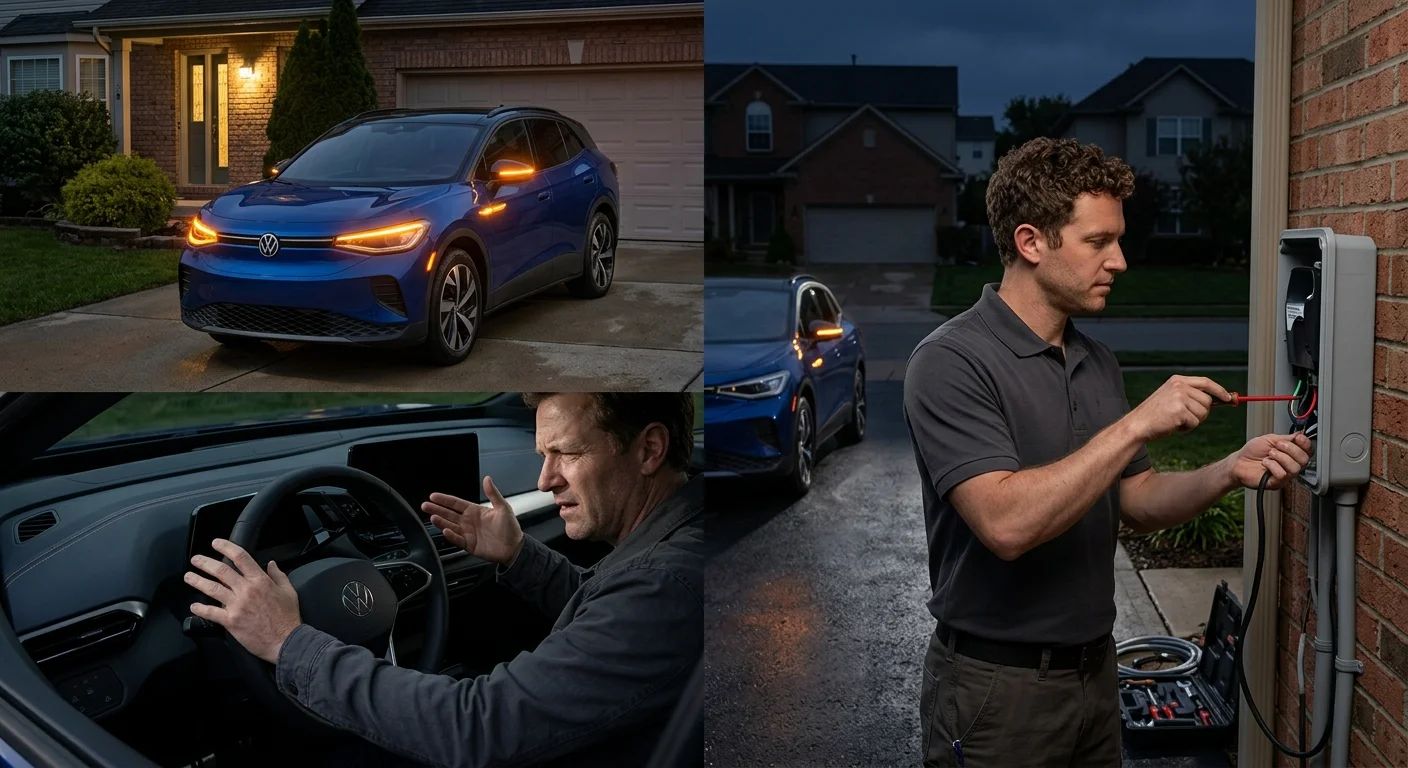
You walk out of a Brickell tower, a Hollywood garage, or a Davie driveway and the ID.4 is dark. No door handles, no dashboard, no response from the start button. Before you call for a flatbed, work the 12-volt checklist. In South Florida’s heat, the 12V is the most common reason an otherwise healthy ID.4 will not start.
The short answer
A VW ID.4 that won’t start is almost always a 12V issue. The high-voltage traction pack can sit at 70% while the 12V has drained flat. The 12V is what wakes the car, runs the computers, lights up the dashboard, and closes the high-voltage contactors. A clean external 12V source gets the ID.4 back.
Why the ID.4 12V dies in this climate
The ID.4 uses a small lithium 12V battery that lives under the hood, behind the front trunk panel. Lithium 12V packs handle heat better than lead-acid and last longer in mild climates. They are not immune to South Florida’s sustained heat. An ID.4 parked outside or in an uninsulated garage ages its 12V faster than the manual suggests.
The ID.4 also has a documented pattern of 12V failures in this climate. VW has issued technical service bulletins covering parasitic drain and 12V behavior on the ID.4. The pattern: heat, long dwell, and accessory drain combine to push the 12V below the threshold the body control module needs. The driver returns to a dark car.
Common South Florida calls:
- An ID.4 in a Brickell or Hollywood tower for a long weekend. The 12V drains flat.
- An ID.4 at FLL for ten days. Same drain, same fix.
- An ID.4 that lives outside in Hialeah or Homestead, where summer heat has cooked the 12V.
What to check before you call
The dashboard state
A 12V failure shows itself in stages:
- The door handles do not present on approach.
- The key fob takes several presses.
- The interior lights dim or flicker when the door opens.
- The dashboard takes a long time to boot, or does not boot at all.
- The start button does not respond.
If the car is fully dark, the 12V is past the warning stage. A jump is the next step.
Try a fob reset
Press and hold both the lock and unlock buttons on the ID.4 fob for about five seconds. This resets the fob’s handshake with the car. If the doors respond and the dashboard lights up, you caught the system mid-stall, not mid-failure.
Look at the 12V itself
The ID.4 12V is in the front trunk area behind a panel. Look for a swollen case or a faint smell. Lithium 12V packs are sealed but can fail internally. A failing 12V needs replacement, not just a jump.
Try a portable jump
A portable lithium jump starter connected to the manual’s jump posts wakes the car. Match polarity, follow the manual’s connection order, and disconnect in the order the manual gives. A clean source avoids voltage spikes that can damage the DC-to-DC converter.
If the dashboard lights come up and the car responds, drive to a service center for a 12V replacement within the next few days.
What a mobile rescue operator does
A mobile operator working the South Florida metro comes to the car with the right equipment. For an ID.4 no-start call:
- Confirm the 12V is the cause with a multimeter.
- Apply a stable external 12V source through the manual’s jump points.
- If the 12V is dead beyond recovery, replace it on the spot with a fresh lithium unit.
- Once the dashboard is up, top up the traction pack from a 240V Level 2 source if it is also low.
The operator quotes you before starting and bills you directly.
When the situation calls for a tow, not a charge
Some ID.4 no-starts are not 12V issues:
- A loud click from under the hood, then silence.
- “Service High-Voltage System” on the driver display.
- Visible underbody damage after a curb strike or flood.
- A burning smell.
Any of those is a tow. Florida Statute 316.194 lets a disabled vehicle stay where it is if it cannot practicably be moved. Set hazards, clear the car, and call for a flatbed.
An ID.4 that sat in floodwater is its own case. NHTSA warns against parking a flood-exposed EV within 50 feet of a structure and against charging it until it has been inspected.
How to keep the next call from happening
- Drive the ID.4 at least once a week.
- Park in shade or a garage. Heat is the killer.
- Replace the 12V every three to five years in this climate, sooner if the dashboard warns.
- Unplug accessories like dash cams and OBD-II dongles for long sits.
- Watch for warning messages in the weeks before a failure.
- Apply any VW software updates that address 12V behavior. The OTA updates have improved the situation.
Frequently asked questions
Why does a VW ID.4 not start in hot weather?
The 12V battery ages faster in heat. South Florida’s sustained heat can shorten an ID.4’s 12V life.
Can I jump an ID.4 myself?
Yes, with a portable jump starter and the manual’s procedure. Match polarity and disconnect in the order the manual gives.
What does a mobile rescue operator charge for an ID.4 12V jump?
The operator quotes you before starting. The price depends on the work and any parts if a replacement is needed. Charge Pro MIA does not set the rate.
When does an ID.4 need a tow, not a jump?
If the dashboard shows a high-voltage fault, the car has visible damage, or it sat in floodwater, the next step is a flatbed to a service center.
Where does the ID.4 12V live?
In the front trunk area behind a panel. The owner’s manual shows the exact location.
When to call us
If your VW ID.4 has died anywhere in Miami-Dade or Broward, call us before you assume the worst. A mobile operator meets the car, confirms the 12V is the cause, and either jumps it or replaces it on the spot.
Call us at (786) 963-2995 to reach a local operator.