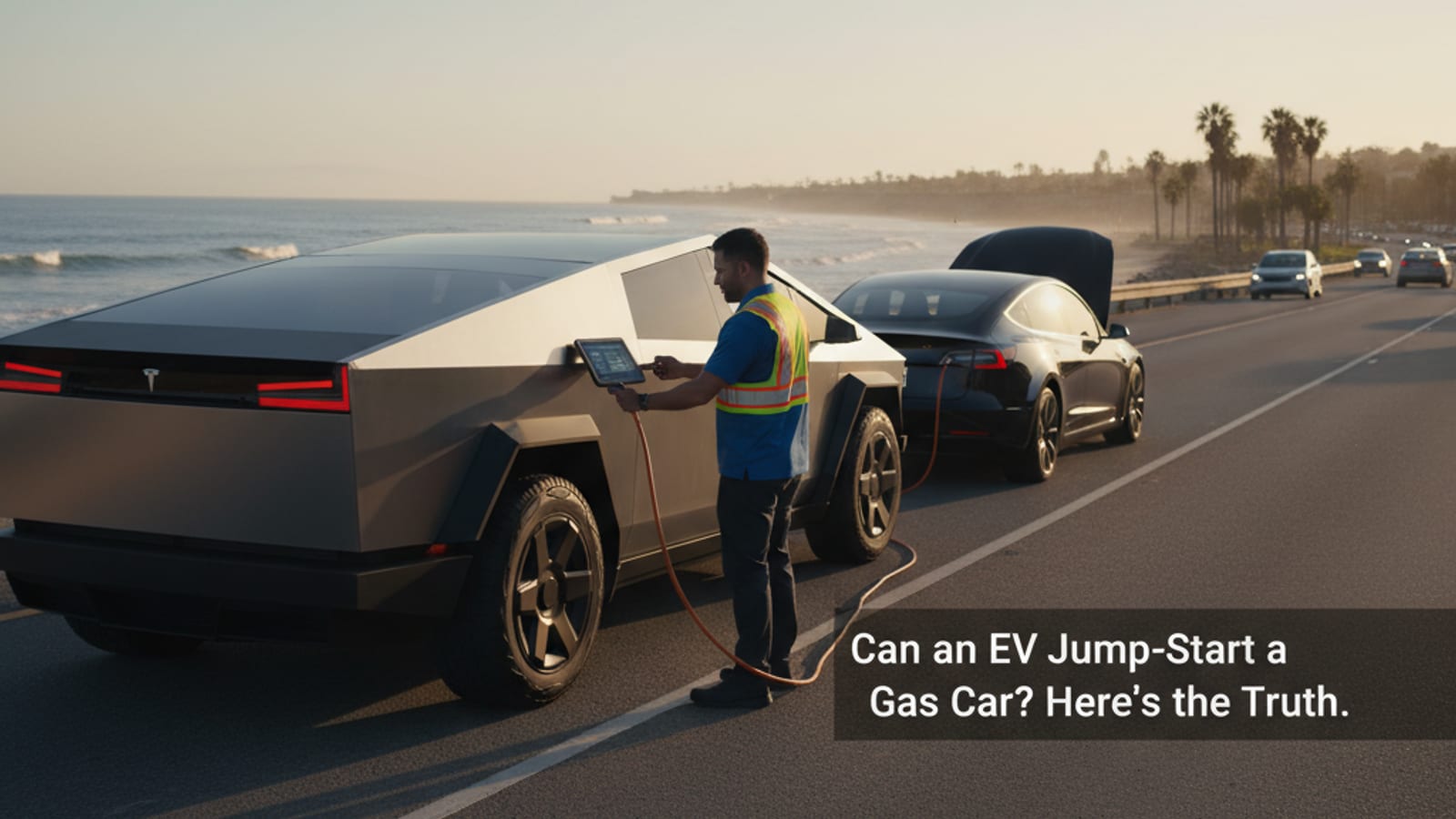
Someone’s gas car is dead on an I-95 shoulder. You’re in the EV beside it. The big pack looks like spare power. It isn’t. Your EV can only lend its small 12V battery. That battery was never meant to crank a starter. On this freeway, that mismatch can stall both of you.
The short answer on an I-95 shoulder
Some EVs can pass 12V current to a gas car. You still shouldn’t try it on the shoulder. Jumper cables never see the traction pack. They only see the accessory 12V. South Florida heat already wears that battery down.
FDOT’s Road Ranger Service Patrol jump-starts vehicles on these corridors. District 6 covers Miami-Dade’s I-95, 95 Express, I-195, and I-395. District 4 covers Broward’s I-95 from the Miami-Dade line north. Dial *FHP (*347) and ask for a Ranger. Crews also tow a disabled car out of the travel lanes, free of charge. That’s the right first call for the gas car. Your EV is the wrong donor.
Why drivers here keep asking
South Florida is flat, so heat, not hills, is what wears batteries here. NWS Miami normals put July and August highs at 91F. A normal year sees about 64 days at or above 90F.
Heat is hard on 12V batteries. Battery University notes that every roughly 15F rise halves lead-acid life. A battery that would last at 77F ages about twice as fast at 93F. At 111F it ages about four times as fast. After a long sit, many cars look dead when only the 12V is empty.
Florida had about 450,400 registered EVs in 2025, per DOE AFDC data. More EVs on I-95 means more people asked to jump a gas car from an EV.
What a jump actually uses
A gas car needs a short, heavy burst so the starter can turn. That burst comes from a 12V battery. Once the engine fires, the alternator takes over.
An EV has two electrical worlds. The big pack moves the wheels. A much smaller 12V wakes the computers, locks, lights, and contactors. A DC-DC converter tops that 12V up while the car is on or charging. If the 12V is dead, a full pack still leaves you with a brick.
Clamp cables from an EV to a gas car. You’re asking an accessory battery to act like a starting battery. Tesla drivers hit the same wall. We cover that in Can a Tesla jump-start another car: the 12V truth.
Why your EV is a poor donor
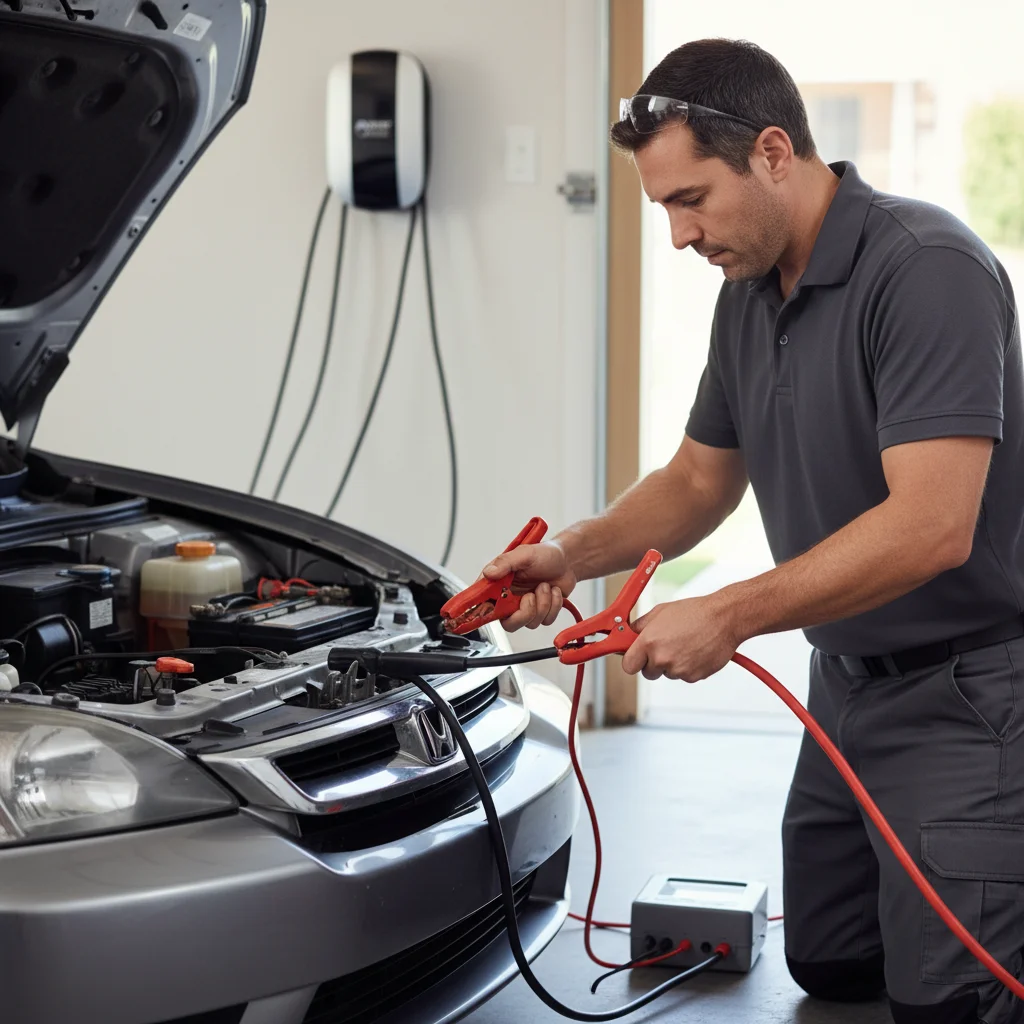
Most EV 12V batteries are sized for computers and accessories. They aren’t sized for a starter that wants hundreds of amps. Older lead-acid 12Vs sag under that load. Newer lithium 12Vs, including many Teslas, often trip protection instead. Either result can flatten your own 12V. Then your EV won’t wake, even with a full pack. Two silent cars on I-95 is worse than one.
A reverse clamp or a spike can hit the EV’s low-voltage circuits. NHTSA still says to connect positive to positive. Put the negative on a ground on the dead car, away from the battery. That advice was written around gas cars. It doesn’t make an EV a safe donor. Tesla’s support pages generally tell owners not to jump other vehicles from a Tesla. The same warning is in Why jump starting a gas car with your Tesla is a bad idea.
Safer steps on the shoulder
Florida Statute 316.194 says to leave a vehicle off the main-traveled part when you can. Leave room for passing traffic. Keep a clear view from 200 feet each way. 316.194(2) exempts a genuinely disabled vehicle that can’t be moved off the road. Hazards on. Stay out of the travel lane.
Call *FHP (*347). Road Rangers jump-start vehicles. They also tow a disabled car from the travel lanes to the nearest safe spot. Their public pages don’t mention EV charging. They still jump a 12V and they still clear a lane. They don’t bring a Level 2 charge.
If the dead car runs on gas, let the Ranger do that jump. If your EV went dark, say so. A 12V jump may wake it. An empty traction pack needs a different truck. For an empty pack on this corridor, read I-95 through Fort Lauderdale left you empty: what now. Then read Your EV died on the freeway: what Florida law says to do.
If it’s your EV that won’t wake
Don’t assume the big battery is empty. In this climate the 12V dies first, especially after sitting. Lights, screens, and handles all run on that small battery. The operators we connect you with can jump a dead 12V on site. They also bring a 240V Level 2 source when the pack is the problem. They use a native NACS plug, plus CCS or J1772 adapters for non-Tesla EVs. That typically adds 10 to 20 miles in 15 to 30 minutes of charging. That’s charging time, never an arrival time.
If you only need the 12V brought back, see How to jump start an electric car without frying the 12V. Tesla steps sit on the Tesla 12V battery jump page. Don’t reverse the job and crank someone else’s starter from your EV.
Skip the cables
On the highway, prefer the Ranger over a DIY clamp. Charge Pro MIA is a referral line. It matches stranded EV drivers with independent local mobile rescue operators. It doesn’t own trucks, employ technicians, or set prices. The operator quotes you before starting and bills you directly. If you need that match, call (786) 963-2995.
Can my EV’s main battery jump a gas car?
No. Jumper cables never tap the traction pack. They only see the 12V accessory battery.
Will Road Rangers jump a gas car on I-95?
Yes. FDOT’s Road Rangers jump-start vehicles and can tow a disabled car out of the travel lanes. Dial *FHP (*347).
What if my Tesla 12V dies while I try to help?
Then you may have two cars that won’t wake. Get a 12V jump for your EV, and let the Ranger handle the gas car.