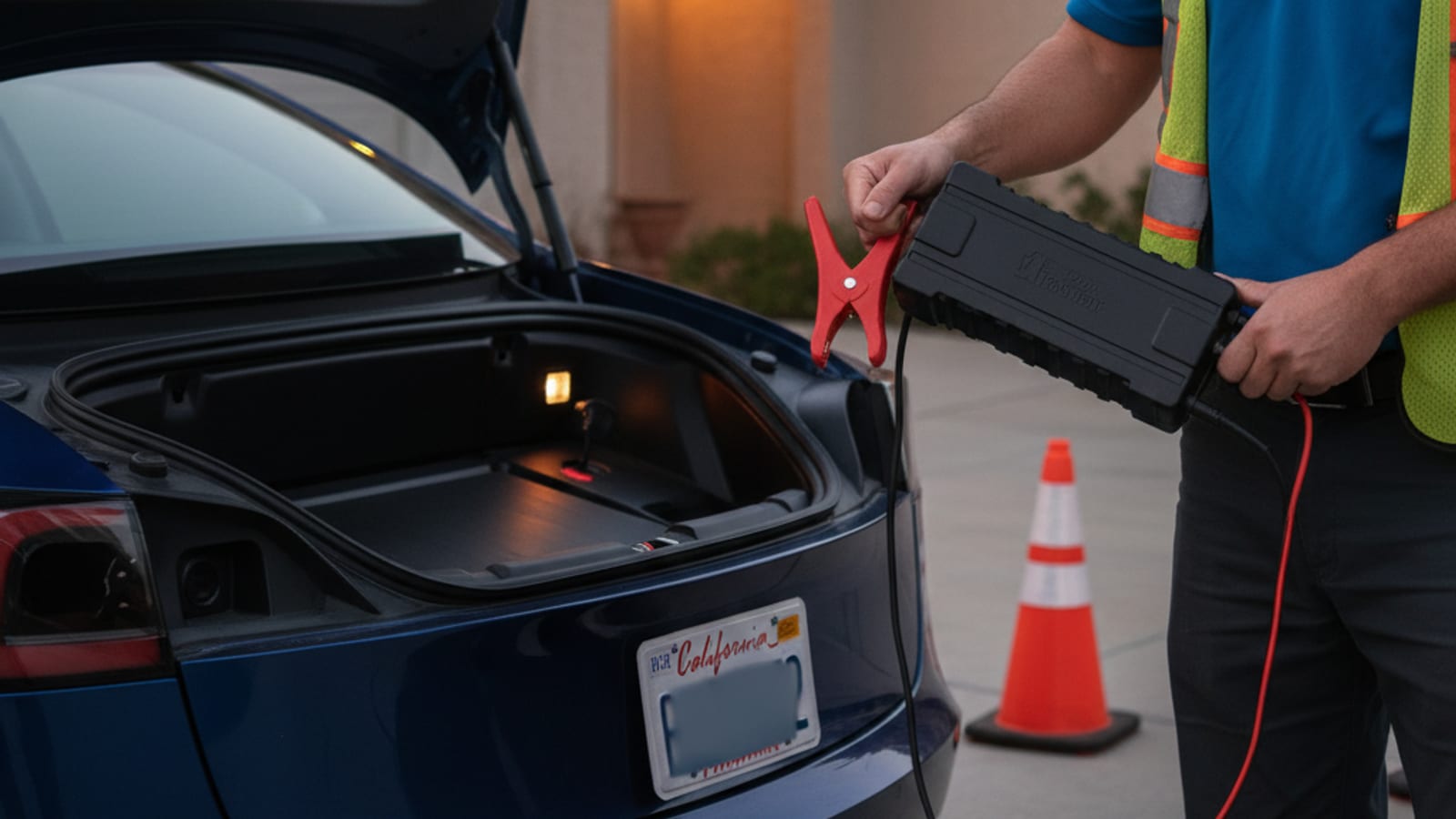
A jump start wakes an electric car’s 12-volt battery, not the traction pack. Use a lithium jump pack on the marked posts, not a running gas car. Most silent EVs at Miami International Airport still have range left. The small 12V died in the heat while you were away.
It’s the 12V, not an empty pack
Every EV still carries a small 12-volt battery. That battery runs the locks, the screens, and the contactors. When the 12V’s dead, those contactors never close and the car’s a brick.
This is the usual story after a flight or a cruise. You left the car in long-term parking. You come back a week later and nothing lights up. People assume they ran the pack down, but they didn’t. The 12V kept modules alive in the heat, then it quit.
At MIA that happens in the Dolphin Garage by North Terminal. It happens in the Flamingo Garage at Central Terminal. The Ibis Garage has ChargePoint ports on its levels. The new Park 6 long-term garage opened in summer 2026 with charging on site. Plenty of drivers never plug in there. The Park and Ride lot at 1350 NW 45 Ave is the same sit. If the car won’t wake, call garage parking at (305) 876-7536 for lot help. Then treat it as a 12V problem. Read Tesla 12V failure after parking for the garage version of this.
PortMiami is the same drain after a week at sea. Northside parking is Garages A, AA, B, C, D, F, and G. Southside is Garages J and K, plus surface Lot E. Port Everglades in Fort Lauderdale uses the Heron and Palm garages. A cruise car that won’t unlock almost never has an empty pack. It’s the 12V sitting dead in the heat.
South Florida heat is why this hits so often. NWS Miami normals put July and August highs around 91F. A normal year sees about 64 days at or above 90F. Battery University notes that every 15F rise roughly halves lead-acid life. A 12V ages about twice as fast at 93F as it does at 77F. At 111F it ages about four times as fast, and that heat damage doesn’t reverse. Drivers coming home through Miami Springs after an MIA trip feel it first.
Don’t jump it from another car
A running gas car feeds about 13.8 to 14.8 volts from its alternator. Jumper cables pass those swings to the dead side. Gas 12V systems tolerate that mess, but EV 12V circuits don’t. They feed a DC-DC converter, body modules, and the battery management system. A spike or reversed leads can cook those parts. Tesla tells owners not to jump from another vehicle. Other makers want a dedicated jump pack too.
Use a lithium jump pack
A jump pack is a small battery with leads already attached. It puts out a controlled 12 volts. That’s enough to wake the 12V without an alternator dump. Look for reverse-polarity protection and several hundred peak amps. Keep it in the frunk or the trunk, and top it off every few months.
How to jump start an electric car without frying it
Same sequence on Tesla, Rivian, Ford, Hyundai, and the rest.
- Confirm the jump pack itself has charge. Most packs show this on LEDs, so charge the pack first if it’s weak.
- Find the 12V posts for your brand. They’re rarely the same as a gas car’s battery clamps.
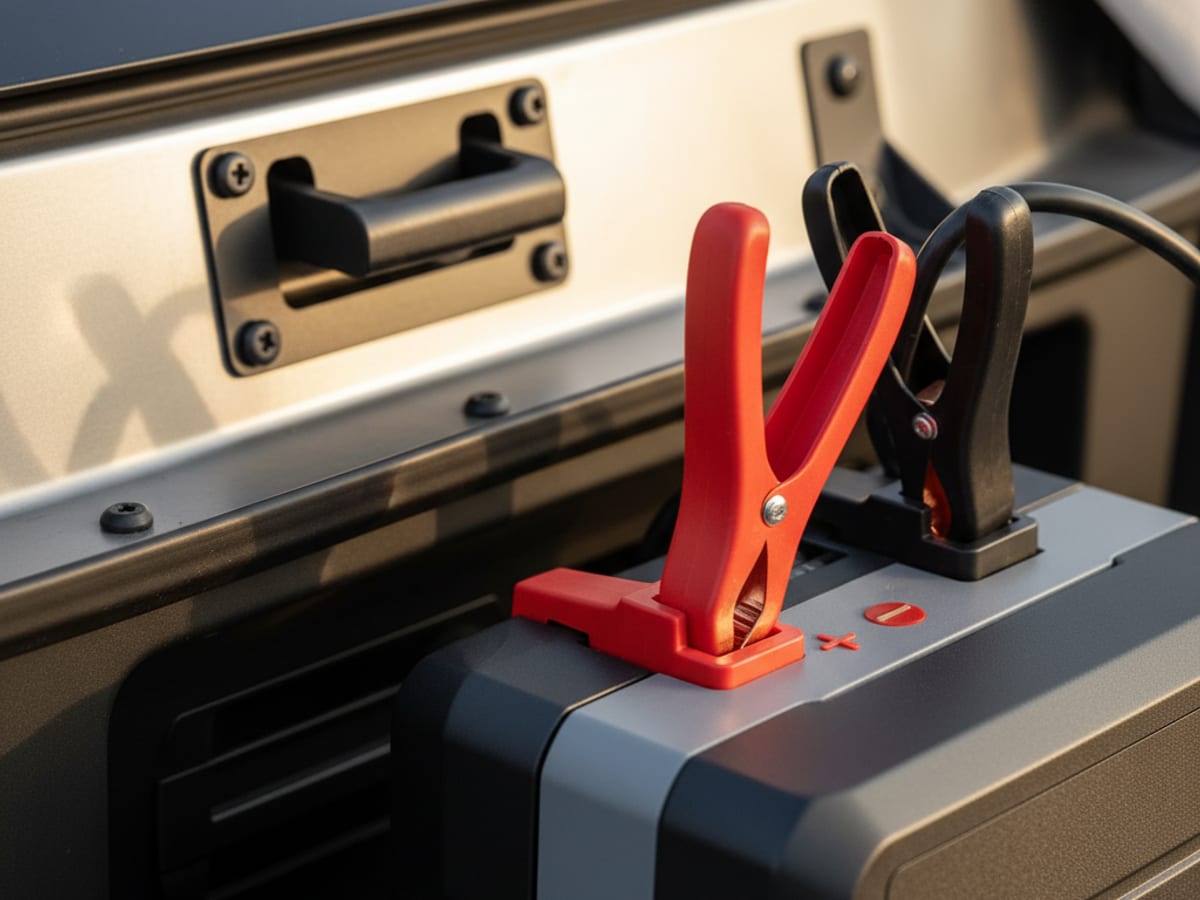
- Clip the red lead to the positive post. Wait for a good-connection light if your pack has one.
- Clip the black lead to the marked ground. Don’t clamp the 12V negative post like a gas sedan.
- Wait about 30 seconds so voltage can settle.
- Wake the car with a handle, the app, or the driver’s door.
- Once it wakes, leave the pack on about two more minutes. That lets the DC-DC converter take over from the traction pack.
- Pull the black lead first, then pull the red.
Red goes to red, and black goes to the marked ground. A decent pack will refuse to fire if you reverse the leads. Cheap cables won’t, and reverse polarity is how you damage the converter. If you’re unsure, stop and call for help.
Where the posts actually are
Access isn’t one layout, so group your car by how you reach 12 volts.
Bumper pigtails
On a Tesla Model 3 or Model Y, pop the driver’s-side tow-eye cover. Two leads sit there, red positive and black ground. Clip the jump pack to those pigtails. After the frunk releases, open it and feed the real 12V longer. Pre-2021 Model S and Model X use that same bumper tow-eye path.
Frunk first, then the battery
On 2021 and newer Model S and Model X, use the front door’s manual release. Inside, pull the frunk release under the carpet. Jump on the 12V terminals in the frunk. A Polestar 2 keeps the 12V in the frunk too. If that lid stays shut, there’s a manual cable behind the driver-side headlight housing.
Rivian R1T and R1S owners often try the fob’s power frunk button. A dead 12V kills that trick, so use the pull cord behind the grille. You’ll remove a small cover plate with a Phillips screwdriver. The 12V sits under a passenger-side panel. Jump the positive post and a marked ground stud. A Ford F-150 Lightning uses a pull loop under the front bumper. Once the frunk is open, the 12V sits on the driver’s side.
12V in the rear, jump posts up front
Hyundai Ioniq 5, Kia EV6, and Kia EV9 hide the 12V under the cargo floor. They still give you jump posts in the front bay. Use the red positive post and the marked ground bolt. Don’t dig out the rear battery if the front posts are there. A Chevrolet Bolt follows the same map, with the 12V under the rear load floor. Jump from the front compartment, red cap on positive, ground stud beside it. A Ford Mustang Mach-E keeps the 12V in the rear. Jump posts are labeled in the frunk. Open the frunk from the app if it still wakes. If it doesn’t, a manual cable sits behind a kickplate on the driver’s floor.
Tesla hardware steps live in the Tesla 12V jump guide. CCS and J1772 cars are on non-Tesla EV rescue when you also need range.
Once the screens come back
Drive it or plug it in. That lets the DC-DC recharge the 12V from the main pack. The jump only borrowed enough voltage to wake the system. If it dies again after you drive away, the battery’s done. A jump isn’t a repair, only a way to move. Operators we connect you with can jump or replace a 12V on site.
Replace a tired 12V before a trip, not after. Heat’s role is in when an EV 12V dies in this climate.
If you’re on the shoulder, not in a garage
A dead 12V on I-95 or the Palmetto isn’t a parking-lot problem. Florida Statute 316.194 says get off the main-traveled part when you can. A genuinely disabled vehicle that can’t be moved is exempt. Dial *FHP (*347) for Florida’s Road Ranger Service Patrol. Rangers jump-start vehicles and can move you off the travel lanes. They don’t bring a Level 2 source, so that’s a separate call.
When to get an operator on site
Skip the DIY jump if you don’t have a pack. Skip it if the frunk is locked and you can’t find the manual release. Rivian and Lightning owners hit that wall a lot. Skip it if you already jumped once and it died again. That 12V needs replacement, not another clip.
If the traction pack is also low, you need both a wake-up and range. Operators bring a 240V Level 2 source to the car. They use a native NACS plug for Tesla. Non-Tesla EVs get a CCS or J1772 adapter. Typical charging time is 10 to 20 miles in 15 to 30 minutes. That’s plug time, not a promise of when someone arrives. Charge Pro MIA doesn’t own trucks or set prices. It matches you with a local mobile rescue operator. The operator quotes you first and bills you directly.
The airport-edge version is Miami Springs EV rescue. For Tesla clips on site, use Tesla 12V battery jump. Broader coverage sits on EV roadside assistance.
If you’re stuck and you need that match, call (786) 963-2995. Confirm the 12V versus the pack before anyone hooks a flatbed. A wake-up in the garage beats a tow through PortMiami.