Yes. Every Tesla carries a 12-volt-class battery besides the traction pack. That small battery wakes the screens, handles, and computers. After a week in MIA parking, it can die first. A sit under Brickell City Centre does the same. The car looks totally dead, but the pack can still hold range. Knowing 12V versus pack is how you get unstuck.
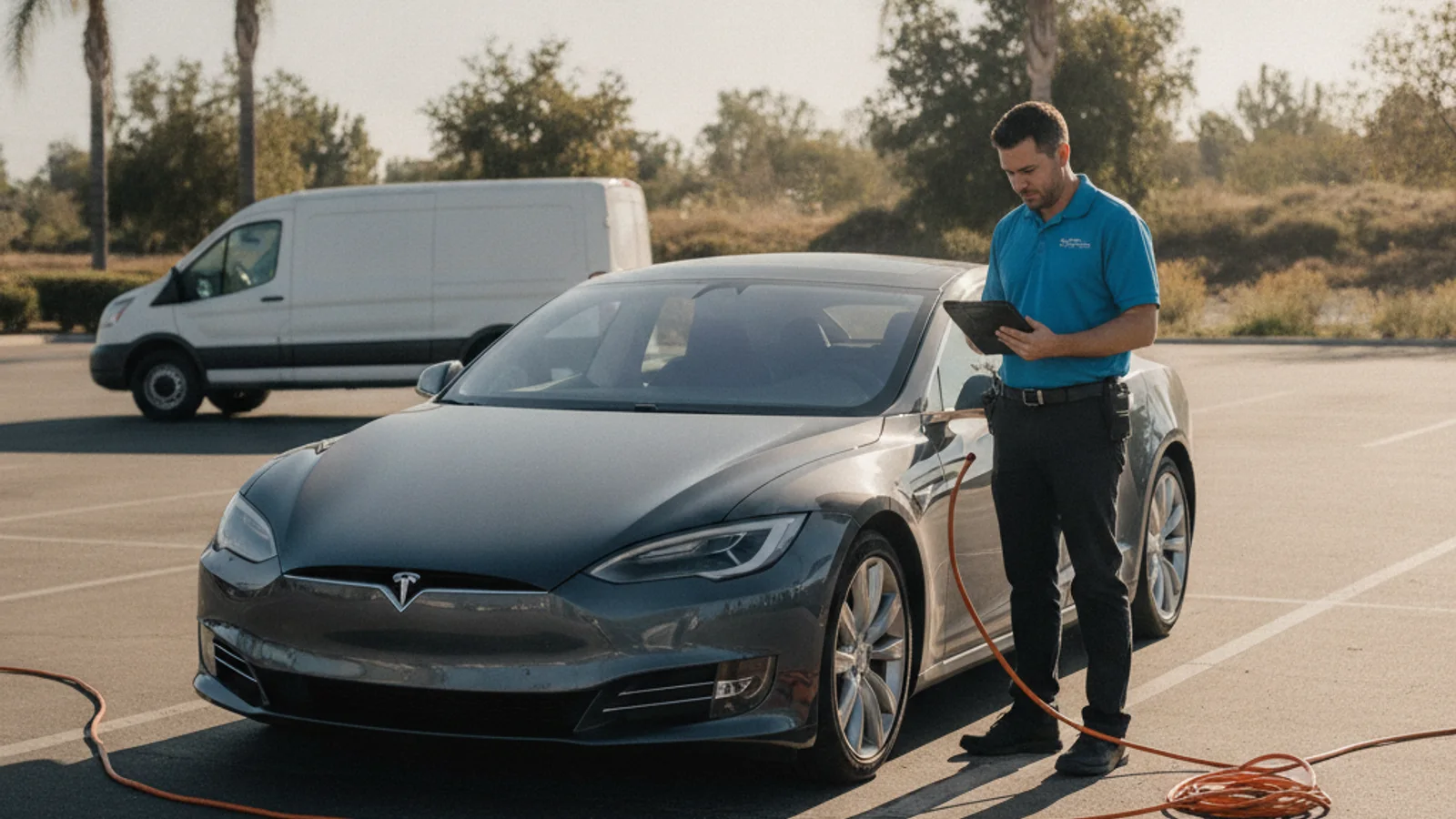
Two batteries, two different failures
Every Tesla on the road has a 12-volt-class battery. That’s the direct answer to the search. Model 3, Model Y, Model S, Model X, and Cybertruck all keep one. It sits beside the high-voltage pack, not inside it.
The pack moves the car. The 12V runs everything that isn’t the motors. Touchscreen, door handles, cameras, and contactors all sit on it. So does the computer that boots the car.
Almost every production EV uses the same split. It isn’t a Tesla-only design. Owners still treat electric as one battery. That’s the mix-up this page is for.
If the 12V drops too far, the car goes dark. The app can’t reach it, and nothing in the cabin answers the key. The pack can still hold the charge you last saw. A silent car with miles left is this failure.
Why the car needs a 12V at all
The traction pack runs at several hundred volts. Motors need that voltage. Door locks and airbag modules don’t, because those parts are built for ordinary automotive voltage.
Tesla keeps the pack behind contactors, which are large relays. They need low-voltage power to close. The 12V wakes the computers first. Then the contactors close, and only then does the pack connect.
The high-voltage side can’t start itself. A gas car uses the same layering, with a starter and an alternator. Tesla applies that idea to a car with no engine.
When you drive, a DC-DC converter steps pack voltage down. It also runs when you’re plugged in, and that’s what keeps the 12V charged. After the car sleeps, the 12V runs the background load alone. The app check and Sentry Mode both draw from it.
The U.S. Department of Energy publishes an overview of how electric vehicles work. It covers this two-system layout without naming one brand’s parts.
MIA, PortMiami, and a week of heat
A Tesla left for a flight often comes back silent. That’s usually the 12V, not an empty pack. The small battery spent the trip holding always-on systems.
Miami International Airport’s public parking includes the Dolphin Garage at the North Terminal. The Flamingo Garage serves the Central Terminal. The Ibis Garage is in the same airport system. The airport page lists ChargePoint ports there. Park 6 is the new long-term garage, opened summer 2026, with charging on site. None of that stops a 12V from draining in the heat while you’re gone.
PortMiami cruise parking includes the northside and southside garages, plus Lot E. Cars sit there the same way after a sailing.
South Florida heat makes this worse. NWS Miami 1991-2020 normals put July and August average highs at 91F. A normal year has about 64 days at or above 90F. Battery University notes that every roughly 15F rise halves lead-acid life. The same chemistry ages about twice as fast at 93F versus 77F. At 111F it ages about four times as fast. Heat damage doesn’t reverse.
The land is flat. Miami-Dade’s Atlantic Coastal Ridge tops out around 23 to 24 feet. Broward’s Pine Island Ridge is about 29 feet. There’s no grade penalty on range in either county. Heat, AC, and dwell are what wear both batteries.
Older housing adds sits without a home plug. North Miami stock is 82.7% pre-1980, and Miami Springs is 89.5%. A home Level 2 keeps the DC-DC working when you park. It doesn’t make a cooked 12V last forever.
FPL serves essentially all of Miami-Dade and all of Broward. Homestead is the confirmed exception, and parts of that city use Homestead Public Services Energy. Confirm the street boundary on the city’s HPS Energy page, or call (305) 224-4800.
Model, year, and why a chart goes stale
Tesla has changed chemistry, location, and access more than once. Model S, 3, X, and Y don’t share one cutoff year.
Some cars use a lead-acid 12V. Others use a lithium low-voltage battery. They age differently, and they aren’t serviced the same way. Location moves too. Some sit where you can picture the frunk. Others need trim off, or work from below. That isn’t a driveway job.
Don’t trust a generic year table on a forum. Tesla runs changes mid-production, and a wrong chart sends you to the wrong part. Your owner’s manual for that car is the first reference. Tesla’s current service documents beat this page.
Newer Model 3 and Model Y cars may use a lithium 12V. What to do when that lithium 12V is dead is the model-specific page. For the pack-versus-12V split, use Tesla battery dead: 12V or high-voltage pack.
Cybertruck uses the same two-system idea. Confirm access in that truck’s manual before anyone opens covers.
Dark and silent versus awake and low
A dead 12V usually means no wake at all. The screen stays black, handles stay in, and the app times out. The cabin doesn’t answer. People say the car went to sleep and never woke.
An empty pack looks different. The car still wakes. The screen still comes up. You get a range warning, not silence.
Dark and silent versus awake but low is the fastest check. It tells you if you need a 12V jump. The other path is miles added at the car.
Tesla 12V failure after parking covers a car that sat. How to jump a Tesla 12V on Model 3, Y, S, and X stays with those four models.
Where you’re stuck changes the call, not the diagnosis. A silent car in the Ibis Garage is a parked job. The same car on the Palmetto Expressway, SR-826, is a disabled vehicle.
Florida Statute 316.194 covers a vehicle stopped on a highway outside a municipality. Leave the main-traveled part when you can. Leave room for passing traffic, and keep a clear view from 200 feet each way. 316.194(2) exempts a genuinely disabled vehicle that can’t practicably move off the road.
FDOT’s Road Ranger Service Patrol can jump-start vehicles. It can also tow a disabled car out of the travel lanes. That tow is to the nearest safe spot, and it’s free. District 6 covers Miami-Dade. Its roads include I-95, 95 Express, I-195, and I-395. It also patrols I-75, 75 Express, and SR-826. Dial *FHP, which is *347. Florida Highway Patrol takes the same short code. Road Ranger pages don’t mention EV charging. They still jump a 12V and move a dead car out of the lanes. They don’t bring a Level 2 charge. Independent operators handle that part.
A Brickell City Centre garage is private property, not a Road Ranger corridor. Florida Statute 715.07 governs non-consent tows. Miami-Dade Code Section 30-476 sets the county max rates for immobilization, nonconsent towing, and storage. The dollar caps weren’t confirmed on a page that would load. Ask the garage, and check the county consumer page, before you pay. If the pack is empty in that garage, not the 12V, you need range at the car. Mobile charging at Brickell City Centre covers that path.
What to confirm before anyone opens the 12V
State the model, year, and trim. That’s what sets chemistry and access. Say whether the car is fully dark or still showing range. Say how long it sat. Name MIA, a Brickell garage, or a City of Miami street.
Skip a video filmed on a different year. A normal step on one Tesla can be the wrong move on another. If you don’t know which 12V you have, say so. Don’t guess the part.
Charge Pro MIA is a referral line. We match stranded Tesla drivers with independent local operators. We don’t perform the work, own trucks, or set the price. The operator quotes you before starting and bills you directly.
The pros we connect you with jump or replace a dead 12V on site. They also bring a 240V Level 2 source when the pack is empty. That charge typically adds 10 to 20 miles of range. The charging window is 15 to 30 minutes. That’s charge time, not an arrival window.
For a confirmed 12V, use Tesla 12V battery jump. If you still can’t sort the two batteries, request Tesla roadside rescue.
When the car won’t wake
Call when the Tesla has gone dark. The last range you saw was fine. That mismatch is the 12V. It shows up at MIA, in Brickell, and after a hot sit. Call (786) 963-2995. We’ll connect you with a local operator. The operator confirms your car’s low-voltage setup before they touch it.