You walk back to a Hard Rock Stadium lot after a Dolphins game. The car won’t wake. Screens stay dark. Handles may not pop. That’s the usual EV roadside assistance Hard Rock Stadium call. A long sit in Miami Gardens heat did it. Most people blame the drive pack. They should check the 12-volt first.
Two batteries, one silent car
A parked EV can fail two ways after a long event. One is a flat 12-volt battery. The other is a high-voltage pack that actually ran down. They feel the same in an emptying aisle. They’re not the same repair.
What the 12-volt still does
Every major EV still uses a 12-volt battery to boot computers. It also unlocks doors and closes contactors. If that small battery is down, the car can look totally dead. You may have had plenty of range when you parked. Cabin cameras and sentry-style watching still draw that 12-volt. So does a hot soak after you lock up. Scheduled preconditioning does too.
South Florida heat makes the drain worse. Battery University notes a hard rule for lead-acid. Every rise of about 15F halves the life of that battery. It ages about twice as fast at 93F versus 77F. It ages about four times as fast at 111F. Heat damage doesn’t reverse.
NWS Miami normals for 1991-2020 put July and August highs at 91F. A normal year sees about 64 days at or above 90F. A stadium lot in Miami Gardens is asphalt and sun. Your car sat in that for hours. The same 12-volt death shows up after airport parking. Tesla 12V failure after parking: why the car looks totally dead explains that sit. The venue name isn’t the chemistry. The sit is.
What the drive pack does
If you arrived already thin, the pack can be the problem. Idling with climate on spends miles. Using the cabin as a waiting room through overtime does the same. That needs energy, not a jump. A jump on a truly empty pack won’t create range. When an EV 12-volt battery dies in this climate walks the split.
Hard Rock Stadium is in Miami Gardens
Hard Rock Stadium is in the City of Miami Gardens. Miami Gardens is its own municipality in Miami-Dade County. The Census count is 111,264. It isn’t a neighborhood of the City of Miami. The City of Miami is one of 34 municipalities in the county. Mixing those names sends a wrecker to the wrong grid.
The campus hosts the Miami Dolphins and the Miami Hurricanes. It also hosts the Miami Open and the F1 Miami Grand Prix. It’s a 2026 FIFA World Cup venue. FIFA rules require the neutral name Miami Stadium for that tournament. There’s no Fort Lauderdale F1 race. There never has been. If a pin says Broward, the pin is wrong.
Don’t confuse the stadium with Seminole Hard Rock Hotel and Casino Hollywood. That Guitar Hotel is a separate Seminole Tribe property. It sits in Hollywood, in Broward County. A search for Hard Rock can send help to the wrong building.
North-county streets around the stadium feed I-95 and 95 Express. They also feed SR-826, the Palmetto Expressway. SR-924, the Gratigny, is a different road. GMX now runs the Gratigny. It took over the old MDX roads in 2023. For north-county context, use EV roadside assistance in Miami Gardens. The Miami Gardens city page is the hub for that city.
Florida had about 450,400 registered EVs in 2025. That figure is from DOE AFDC vehicle-registration data. It’s a state total, not a county count. Event lots here still hold plenty of Teslas and every other plug. A silent EV in a thinning row is no longer rare.
Why a packed event is hard on the 12-volt
Event days are a long, hot park. You lock the car. Climate may have run in tailgate traffic. After kickoff the lot stays full. The sun stays on the roof. Lead-acid 12-volt packs hate that pattern. Some newer Teslas use a lithium 12-volt. Those fail more quietly. The car still won’t boot if voltage is too low.
A Dolphins Sunday adds hours of dwell. A Canes night does the same. An F1 weekend is longer. The campus becomes a circuit then. You may park farther out and walk more. The car sits even longer. Miami Open sessions stack a full afternoon the same way.
A station-by-station charging inventory for this campus couldn’t be confirmed. The federal AFDC station API host didn’t resolve on September 18, 2026. Electrify America and Tesla also blocked automated checks that day. This page isn’t a stall list. If you see a marked EV space, confirm it on the day. Ask lot staff. Check your charging app. A sellout changes what is open.
FPL serves essentially all of Miami-Dade, including Miami Gardens. FPL EVolution is the utility’s public charging brand. FPL EVolution Home is the residential Level 2 program. This page doesn’t publish those program prices. FPL also offers a residential time-of-use rate. Confirm current figures on fpl.com before you plan around them.
Sort a 12-volt fail from an empty pack
Stand still. Don’t keep tapping the app. Work through signs.
If the car showed solid range when you parked, think 12-volt first. A car that won’t unlock points the same way. Interior lights that never come on do too. A key card or phone that usually works, then does nothing, is classic 12-volt behavior. Tesla drivers know this as a car that won’t wake. Other brands show a dead dash. The charge port may stay locked.
If you arrived with a low percentage, the pack may be empty. Climate in the cabin for a long wait points that way. So does watching estimated miles fall all afternoon. Some cars still unlock on residual 12-volt. Doors work. Go doesn’t. That’s the opposite pattern.
You can’t jump the drive battery with jumper cables. You can often wake the 12-volt enough to close contactors. That may let you move, or at least unlock. A mobile operator who handles Tesla 12V battery jumps can test that on site. A careful jump works if you know the posts for your model. If you don’t know the posts, wait. Don’t guess around orange high-voltage cable.
A first jump that dies again in the same lot means the 12-volt is tired. The car may still be drawing. Heat-aged lead-acid often does that. Replacement on site is sometimes the honest fix. A second death on the drive home is the same story. Don’t keep jumping and hoping.
Private lots and wreckers
Stadium parking is private property. Florida Statute 715.07 sets the non-consent tow rules you need. A tow operator must stop and return the vehicle if you appear before it’s fully removed. You then pay no more than one-half the posted tow rate. Don’t guess that number. Read the board on the truck or at the lot.
The property must carry a permanent, reflective, correctly sized tow-away zone sign at each access. That sign must be posted at least 24 hours ahead, except in cases the statute carves out. A towed vehicle in Miami-Dade must be stored within a 10-mile radius. Both Miami-Dade and Broward qualify for that 10-mile rule. Each has more than 500,000 people. The storage yard must release the car within one hour of your request. The operator must file its rate schedule with local law enforcement. It must also post that schedule at the storage site.
Miami-Dade caps non-consent rates under Code Section 30-476. The title is Maximum immobilization, nonconsent towing and storage rates. It took effect October 16, 2022. The dollar caps aren’t printed here. They go stale. The county schedule wasn’t loadable in a reliable form on September 18, 2026. Confirm the current posted rate with the operator before you pay. Check Miami-Dade Consumer Protection as well. Broward uses Code Section 20-176.22 if a wrecker later claims a Broward yard. Hard Rock Stadium itself is Miami-Dade.
If a hook is already on the car, speak up. Do it before the wheels leave the ground. Statute 715.07 is why that moment matters. After a full removal, you’re in storage rules. That’s no longer a curb argument.
Don’t block an aisle to hold the spot while you wait. Event staff will treat that as a disabled vehicle in a fire lane. Move people first. Then call for EV roadside assistance.
When you need miles, not a jump
Sometimes the pack is the problem. You used range getting in. You sat in traffic with climate on. You have a long crawl toward Hialeah, Aventura, or Miramar. A 12-volt jump won’t invent those miles.
Charge Pro MIA is a referral line. It matches you with an independent local mobile rescue operator. It doesn’t own trucks. It doesn’t employ technicians. It doesn’t set a price. The operator quotes you before starting. The operator bills you directly.
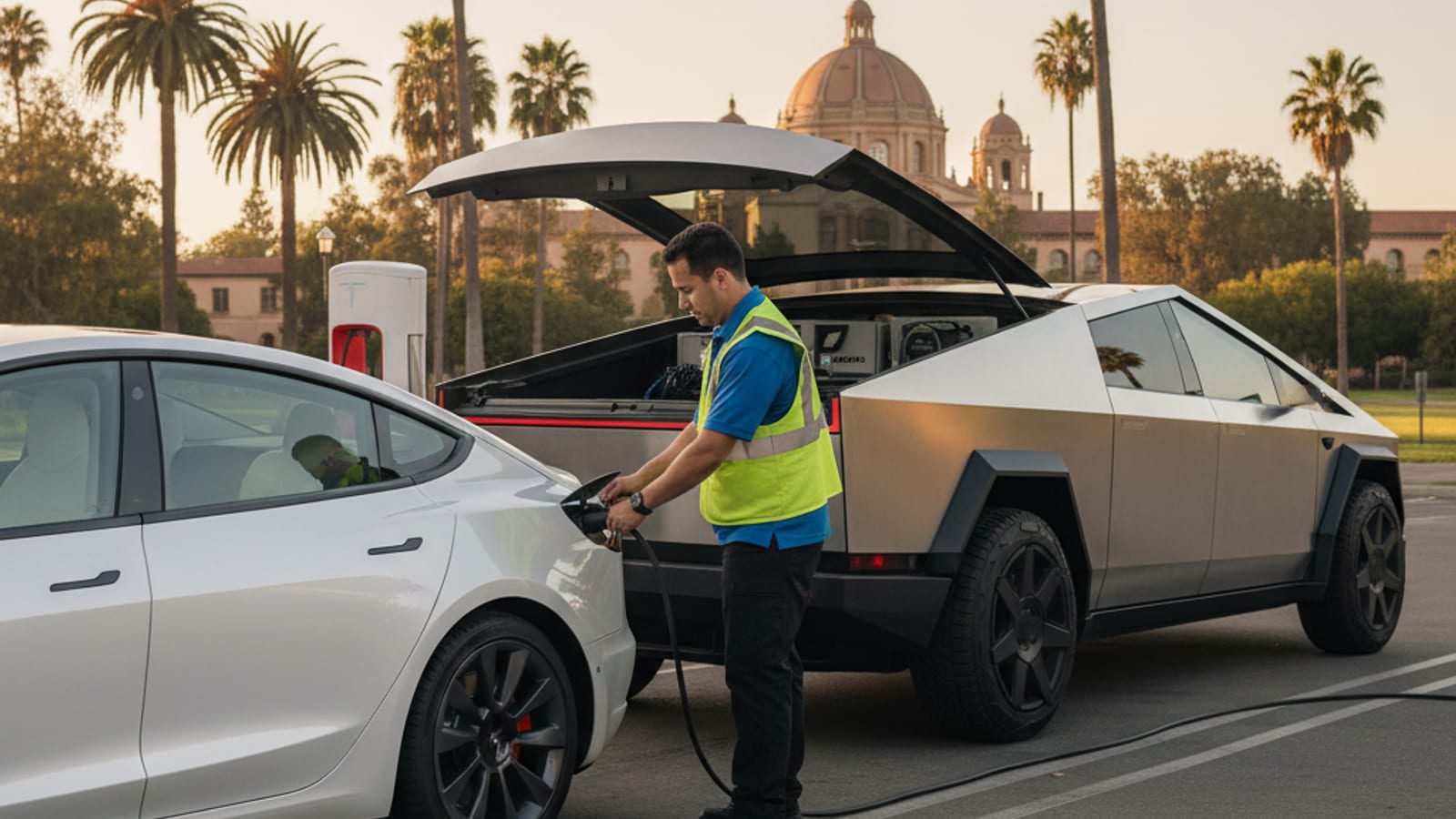
Those operators bring a 240V Level 2 source to the car. Tesla drivers get a native NACS plug. Other EVs get CCS or J1772 through an adapter. A typical top-up adds about 10 to 20 miles of range. That takes 15 to 30 minutes of charging. That’s charging time. It isn’t a promise of when someone arrives. Arrival depends on the operator, traffic, and lot access after a sellout. A blog page can’t lock that.
Ten to twenty miles is usually enough to leave the campus. It can reach a public plug you already trust. It can get you home if home is close. It isn’t a full charge. Mobile EV charging is the service page for that top-up.
A public DC fast stall can refill faster than a mobile Level 2 top-up. So can a Supercharger. This article can’t name a specific site. It can’t name a distance from the stadium. Station-level inventory couldn’t be verified. Use your car’s map and a charging app on the day. If a stall is down or queued, a mobile top-up in the lot is the backup. Don’t hunt across north county in a car that already died.
If you stall on the way out
Post-game traffic dumps toward I-95, 95 Express, and the Palmetto. If the car quits on a shoulder, get out of the travel lane.
Florida Statute 316.194 covers a vehicle stopped outside a municipality. Leave it off the main-traveled part where practicable. Leave room for passing traffic. Leave a clear view from 200 feet each way. 316.194(2) exempts a genuinely disabled vehicle that can’t practicably be moved off the road. Florida Statute 316.1945 lists other places where stopping is prohibited. Hazard lights on. People behind a barrier if you have one.
The Road Ranger Service Patrol is Florida’s free highway service patrol. FDOT runs it. Road Rangers jump-start vehicles and make minor repairs. They change flat tires. They provide gas, diesel, and water. They tow a disabled vehicle from the travel lanes to the nearest safe location. That work is free of charge. Dial *FHP, which is *347, from a mobile phone. Florida Highway Patrol takes disabled-motorist reports on the same short code.
District 6 covers Miami-Dade. It patrols I-95, 95 Express, I-195, I-395, I-75, 75 Express, and SR-826. Crews run through the night as well as the day. Published Road Ranger material doesn’t discuss EV charging. That’s an observed absence. It isn’t a claim that they refuse an EV. A dead EV may still need a 12-volt jump. It may need a pull to a safe spot. Both of those are in their listed work. A Level 2 charge isn’t something they list. A mobile EV operator brings that charge after you’re out of the lane.
Don’t sit in an express lane hoping a private truck can stop there. Get to a safe location first. Florida 511 at FL511.com is FDOT’s official traffic feed. It runs in English and Spanish. After a Dolphins or F1 exit, check it before you pick a ramp.
95 Express is a FDOT facility. So is 595 Express. The Turnpike, the Homestead Extension, and the Sawgrass Expressway are Florida’s Turnpike Enterprise. All of those roads are all-electronic. They use SunPass or toll-by-plate. None takes cash. No facility publishes a disabled-vehicle free-tow rule specific to its express lanes. Road Rangers still patrol those corridors. No F1-specific express-lane tow rule is published.
Heat spends the miles. Hills don’t
South Florida is flat. There’s no grade penalty on range in Miami-Dade or Broward. The highest natural point in Miami-Dade is the Atlantic Coastal Ridge. That ridge sits at roughly 23 to 24 feet. In Broward it’s Pine Island Ridge at about 29 feet. Leaving Hard Rock Stadium isn’t a mountain climb. Range here is heat, air conditioning, and dwell.
Recurrent Auto studied about 30,000 EVs. The fleet work finds about 5% range loss at 90F. It finds about 17 to 18% at 100F. Cooling a 95-degree cabin can take 3 to 5 kW at first. Holding it cool takes about 1 kW. The first minutes of climate are the expensive ones. AAA’s 2019 SAE-standard test found about a 17% range drop at 95F with the AC on. Those figures aren’t Tesla-specific.
A late-summer Dolphins kickoff sits right in that band. You preconditioned the cabin. You crawled in. You crawled out. Miles disappear without a hill. Plan the return with that cut already applied. Don’t use the happy number from a cool morning.
Hurricane season runs June 1 to November 30. That overlaps football and some tennis dates. FPL tells EV owners to keep the pack between 50 and 80% through the season. Unplug during the storm. Don’t charge or drive a flood-exposed EV until it’s inspected. NHTSA warns that residual salt in a flooded lithium pack can short later. Fires can start days to weeks after the water. About 36 EVs flooded by Hurricane Ian in 2022 later caught fire. A flood-exposed EV shouldn’t sit within 50 feet of a structure. King-tide streets on the beach flood more often than this campus. A storm-week game still follows that FPL and NHTSA guidance.
What to do in the lot, in order
Stay with the car if the lot is still emptying and you can do it safely. Note the lot color and the row. Note a landmark on the stadium side. Miami Gardens police and stadium staff will ask for that. “Near the highway” isn’t a pin.
Decide 12-volt versus pack using the checks above. If doors are dead, say it looks like a 12-volt. If the car drives a few feet and dies, say that. If the app still shows a percentage, read that number out loud.
Charge Pro MIA connects you with local mobile rescue operators. The pros those operators send handle Tesla and every major EV brand. They can jump or replace a dead 12-volt on site. They can add a short Level 2 top-up. They quote before they start.
Have your adapter story straight. Native NACS is simple. CCS and J1772 need the right adapter on the truck. Say the make and model in the first sentence. A Lucid, a Rivian, a Bolt, and a Model Y aren’t the same latch.
Don’t accept a flatbed as the first offer if the car only needs a 12-volt wake. Towing a dead EV has extra rules. The car may need transport mode. It may need dollies. Don’t pull a locked Tesla by the control arms. If the lot requires a removal and the car can’t roll, then a wrecker is the lot’s rule. That isn’t your first mechanical choice.
Florida is an all-party consent state under Florida Statute 934.03(2)(d). If you call a recorded line, you’ll hear that notice. Don’t record a lot attendant or a wrecker driver unless every person on the call has agreed.
Before the next packed Sunday
Charge the night before at a plug you already use. Don’t hunt a stall in the arrival queue. Older housing in parts of north Miami-Dade often can’t take a home Level 2 run. North Miami is 82.7% pre-1980 housing. Golden Glades is 83.6%. West Little River is 82.0%. If you live in that stock, you already lean on public plugs. Leave for the stadium with more buffer than a Doral garage. Doral’s housing is only 5.5% pre-1980. That’s a real split inside the same metro.
Watch the percentage at kickoff and at halftime. Watch it again when you stand up to leave. Climate while you wait in the car is paid in miles. After F1 sessions, exit traffic can last long enough to matter.
Load Florida 511. Save *347. Save the Miami Gardens city page linked above. Other long sits show the same 12-volt death. Airport garages do it. Cruise parking at PortMiami lists no EV charging at any facility. A week away is a 12-volt story more than a pack story. The stadium is a shorter version of that sit.
Keep the 12-volt healthy. In this heat, that battery is a wear part. A car that already needs two clicks of the fob on a Tuesday will fail after a January playoff. It’ll fail after a May Grand Prix too.
Frequently asked questions
Why did my EV die after a Dolphins or F1 day at Hard Rock Stadium?
Most often the 12-volt battery drained while the car sat in the heat. Cabin systems keep sipping power. Miami Gardens summer highs sit near 91F in July and August. That ages a lead-acid 12-volt fast. If you arrived already low, the high-voltage pack can be empty instead. Use the last range you remember. Use whether the doors still unlock. That sorts the two.
Can a mobile operator charge an EV in Hard Rock Stadium parking?
Independent operators can bring a 240V Level 2 source to the car when lot staff allow access. They typically add 10 to 20 miles in 15 to 30 minutes of charging. That’s enough to leave. It isn’t enough to skip your next real plug. A stall-by-stall map of campus chargers couldn’t be confirmed from public station data. Ask lot staff about marked EV spaces on the day. Don’t treat this page as an inventory.
What if I stall on I-95 or the Palmetto after I leave the stadium?
Get out of the travel lane if you can. Turn on hazards. Dial *FHP (*347) for Florida Highway Patrol and Road Rangers. Road Rangers can jump a 12-volt. They can tow you to a safe spot at no charge on the highways they patrol. They don’t list a Level 2 EV charge. Once you’re off the lane, a mobile operator can handle a top-up or a 12-volt job. Check FL511.com for the post-event backup.
Charge Pro MIA refers those lot and shoulder jobs across South Florida. It doesn’t perform the work. It doesn’t promise a clock. If you need a match with a local operator after a Hard Rock Stadium sit, call (786) 963-2995. The operator you get quotes you first, then starts.