Your EV died in a Hard Rock Stadium lot or on a Miami Gardens street. You need the charge brought to the car. EV roadside assistance means an independent operator comes to you. Charge Pro MIA is a referral line. We match you with a local pro. That operator brings a 240-volt Level 2 charge or a 12-volt jump. The operator quotes you before starting, and bills you directly.
Miami Gardens is a north Miami-Dade city of just over 18 square miles. Census ACS 2019-2023 counts 111,264 residents. The 2024 estimate is 116,173. Hard Rock Stadium sits in that grid. Event nights are how a sitting pack becomes a car that won’t roll.
Hard Rock Stadium is the Miami Gardens stranding pattern
Hard Rock Stadium is home to the Miami Dolphins and the Miami Hurricanes. It hosts the Miami Open and the Formula 1 Miami Grand Prix. It’s also a 2026 FIFA World Cup venue. FIFA uses the neutral name Miami Stadium for those matches. Calder sits in the same north-county pocket. So do Florida Memorial University and St. Thomas University.
You park early. The car sits through kickoff, heat, and a late exit. NWS Miami 1991-2020 normals put the July and August average high at 91F. A normal year sees about 64 days at or above 90F. Recurrent Auto studied about 30,000 EVs for heat loss. That work found about 5% range loss at 90F, and about 17 to 18% at 100F. Cooling a hot cabin can take 3 to 5 kW at first. Then the lot empties at once. You idle in the queue onto Miami Gardens Drive. The last miles go there, not on the field.
There’s a quieter failure in the same lot. The 12-volt battery kept modules alive while you were inside. South Florida heat ages lead-acid 12-volts. Battery University notes that every roughly 15F rise halves that battery’s life. Salt-laden humid air here is hard on that small battery too. An EV that sat through a game can look totally dead. The traction pack may still have range. Doors may not unlatch. The screen stays black. That’s a jump or an on-site 12-volt, not a flatbed by default.
If you’re in those lots, start with EV died at Hard Rock Stadium. It walks parking, the 12-volt, and a top-up. It keeps those two jobs separate.
Stadium lots are private property. Florida Statute 715.07 governs non-consent tows from posted lots. Miami-Dade Code Section 30-476 sets the county’s maximum nonconsent rates. We couldn’t confirm a Hard Rock posted figure. We won’t invent one. Confirm the tow-away signs at the entrance before you walk away from a dead EV. If a wrecker is already hooking up, stop it before the car leaves the lot. Florida Statute 715.07(2)(a)3 requires the operator to stop and return the vehicle if you appear before it’s fully removed. You pay no more than one-half the posted tow rate.
Carol City streets and a home plug many buildings never got
About 72% of Miami Gardens housing was built before 1980, per Census ACS 2019-2023. That’s older panels and a lot of apartment stock. A Level 2 home circuit often isn’t installable there. FPL is the utility. FPL EVolution Home is the utility’s residential Level 2 program. Confirm current terms with FPL. We don’t publish dollar figures for it. Renters in Carol City, Bunche Park, and Norland often can’t add a home plug, so a dead car is a street problem, not a garage problem. Andover, Scott Lake, and Lake Lucerne run on that same older stock.
That’s why a short hop on NW 27th Avenue still strands people. You left with what looked like enough. The AC ran, because it runs most of the year. Summer afternoons bring daily thunderstorms, roughly 2 p.m. to 6 p.m. per NWS Miami. Low-lying streets flood on king tides and heavy rain. There’s no grade penalty in this city. Miami-Dade’s highest natural point is the Atlantic Coastal Ridge at roughly 23 to 24 feet. Range here is heat, dwell, and air conditioning. It’s not hills.
Hurricane season is June 1 to November 30. Miami-Dade’s northbound evacuation routes are I-95, Florida’s Turnpike, and I-75. Miami Gardens sits on the I-95 and Turnpike junction where that backup begins. FPL tells EV owners to keep the pack between 50 and 80% through the season. Unplug during the storm. Don’t charge or drive a flood-exposed EV until it’s inspected. NHTSA warns that residual salt in a flooded lithium battery can short days to weeks later. A flood-exposed EV shouldn’t sit within 50 feet of a structure.
I-95, the Turnpike, and the Palmetto edge
The corridors that cut Miami Gardens are Florida’s Turnpike, the Palmetto Expressway (SR-826), I-95, NW 27th Avenue, and Miami Gardens Drive. Florida’s Turnpike Enterprise operates the Turnpike. FDOT owns 95 Express. Those roads are all-electronic. They take SunPass or toll-by-plate. None take cash.
If you’re stopped on a highway, Florida Statute 316.194 says leave the vehicle off the main-traveled part where practicable. Leave room for passing traffic. Keep a clear view from 200 feet each way. 316.194(2) exempts a genuinely disabled vehicle that can’t practicably be moved. Dial *FHP (*347) from your phone. That reaches Florida Highway Patrol and the Road Ranger Service Patrol. FDOT’s District 6 covers Miami-Dade. Rangers patrol I-95, 95 Express, and SR-826. They jump-start vehicles, make minor repairs, and change flat tires. They also tow a disabled vehicle from the travel lanes to the nearest safe location, free of charge. Published Road Ranger material doesn’t mention electric vehicles or EV charging. They still jump a 12-volt. They still move you out of a live lane. A Level 2 charge isn’t what they carry. That’s the job mobile EV charging operators take once you’re already in a safe spot.
From a Palmetto shoulder, get out of the travel lane first. Then decide if you need miles or a wrecker. Out of charge on the Palmetto Expressway covers that choice.
What the operator brings, and what a tow does not
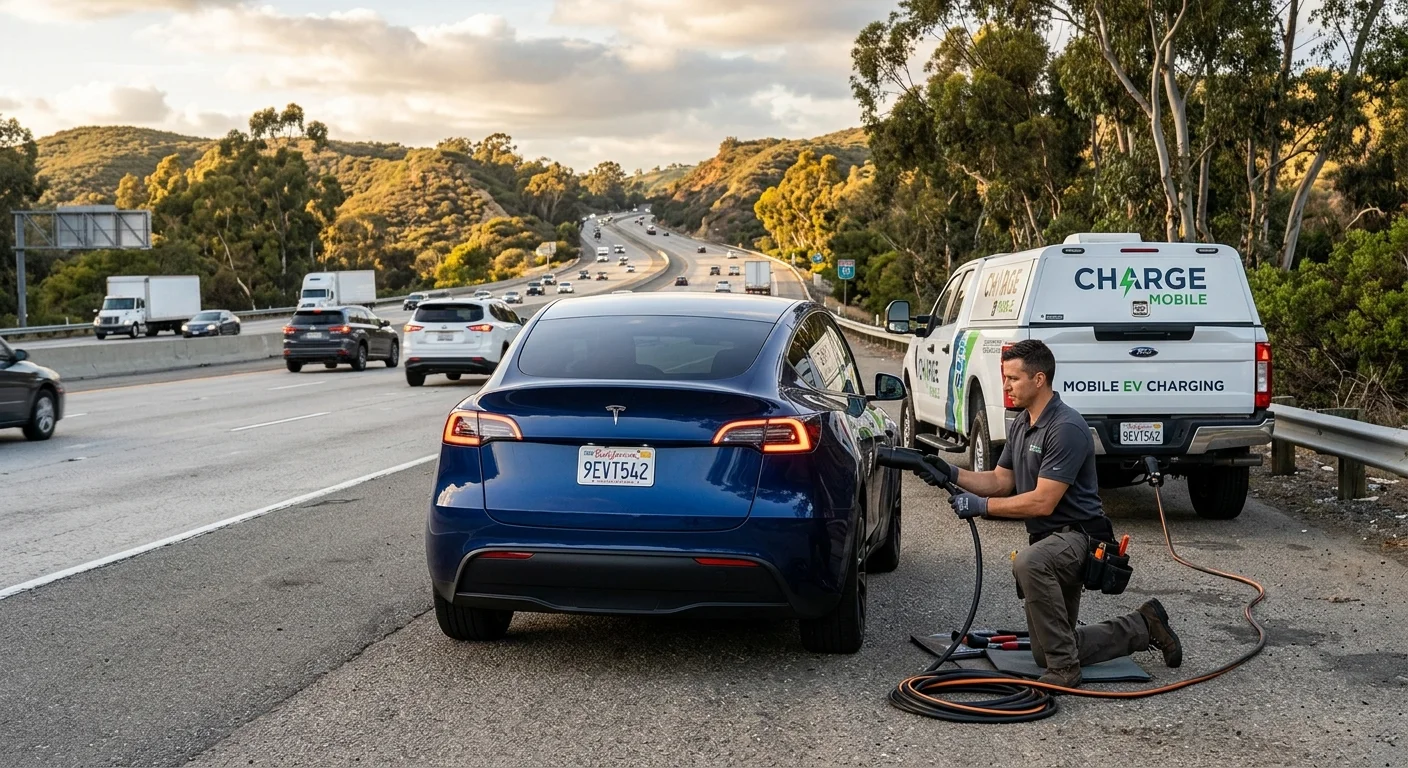
The operators we connect you with roll a 240-volt Level 2 source to the car. Tesla owners get a native NACS plug. Non-Tesla EVs get a CCS or J1772 adapter. Typical charging time is 15 to 30 minutes. That’s charging time, never an arrival time. It usually adds about 10 to 20 miles of range. That’s enough to leave the lot and clear Miami Gardens Drive. They also jump or replace a dead 12-volt on site. They handle Tesla and every major EV brand.
Charge Pro MIA doesn’t own trucks, yards, or parts. We don’t employ technicians. We don’t set prices. We don’t promise when someone arrives. We don’t publish business hours. The operator on the match quotes you, then bills you. The pros we connect you with are licensed and insured. We serve every city in Miami-Dade County.
A tow still matters when the car is blocking a lane. It also matters when the pack is at true zero and you need a long haul. Towing a silent EV gets messy if the 12-volt can’t release the parking pawl. On a stadium night, most people need those 10 to 20 miles, not a county-crossing flatbed.
Neighbors wrap this city: Opa-locka, Hialeah, North Miami, North Miami Beach, and Aventura. A thin pack after a class at Florida Memorial or St. Thomas doesn’t stay local for long.
When the car is already dead
Stay with the vehicle if it’s safe. Hazards on. Get off the travel lane if you can. On I-95, the Palmetto, or the Turnpike, *FHP is the live-lane call. In a lot or a driveway, you’re calling for a charge or a 12-volt.
Tell the operator what the car is doing. A silent cabin that won’t unlock is usually the 12-volt. Use a Tesla 12V battery jump path for that, even in another brand, because the symptoms rhyme. A car that drove until a zero-mile warning and then stopped is the pack. Those are different jobs on site.
For EV roadside assistance in Miami Gardens, call (786) 963-2995. We’ll connect you with a local operator. Have your exact lot, street, or ramp ready. The quote happens before any cable goes in.