Your EV just hit zero on the Palmetto Expressway. Get out of the travel lanes first. Report the stop next. A charge comes after you’re out of live traffic.
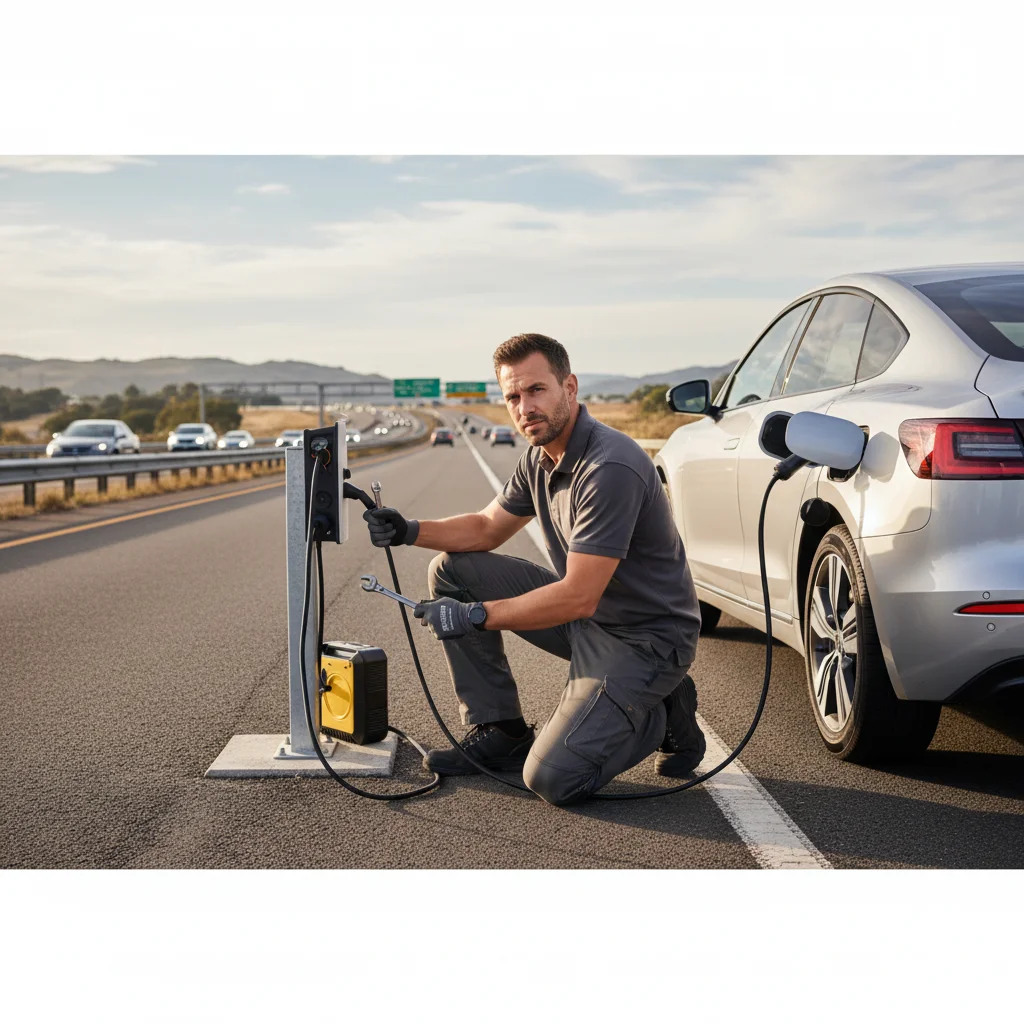
The Palmetto is SR-826, not a side street
Florida DOT District 6 covers Miami-Dade. That district patrols SR-826, the Palmetto. It also patrols I-95, 95 Express, I-195, I-395, I-75, and 75 Express. The Palmetto is the west-county loop in that system. Airport traffic from Miami International Airport feeds it. West-metro heat sits on the same pavement. When the pack hits empty, you’re dealing with both.
Charge Pro MIA doesn’t drive the truck. We’re a referral line. We match stranded EV drivers with independent local operators. We don’t employ technicians. We don’t stock parts. We don’t set a price. The operator who takes the job quotes you before any work starts. That operator bills you directly.
The pros we connect you with are licensed and insured. They bring a 240V Level 2 source to the car. Tesla uses a native NACS plug. Other EVs use a CCS or J1772 adapter. Typical charging time adds about 10 to 20 miles of range. That takes 15 to 30 minutes of plug time. It isn’t an arrival claim. They can also jump or replace a dead 12-volt on site. They handle Tesla and every major EV brand.
Why this loop drains a pack
South Florida is flat. There’s no grade penalty on range in Miami-Dade. The highest natural point in the county is the Atlantic Coastal Ridge at about 23 to 24 feet. Hills aren’t eating your miles here. Heat is.
NWS Miami 1991-2020 normals put the July and August average high at 91F. A normal year sees about 64 days at or above 90F. Recurrent Auto studied about 30,000 EVs. That work finds about 5% range loss at 90F. It finds about 17 to 18% at 100F. Cooling a 95-degree cabin can take 3 to 5 kW in the first minutes. Holding it cool takes about 1 kW. AAA’s 2019 SAE-standard test found about a 17% range drop at 95F with the AC on.
West-metro traffic on SR-826 means stop-and-go with the AC running. The first blast of cooling is the expensive part. Then you sit. Then the gauge falls faster than a cool morning run. Then you’re looking at the shoulder.
The 12-volt battery has its own heat problem. Every roughly 15F rise in temperature halves the life of a lead-acid battery. It ages about twice as fast at 93F versus 77F. It ages about four times as fast at 111F. Heat damage doesn’t reverse. That’s why a car that sat in west-metro sun can look totally dead even when the main pack still has energy.
Airport traffic on the same pavement
Miami International Airport sits on the west side of the metro. Public parking there includes the Dolphin Garage at the North Terminal. It includes the Flamingo Garage at the Central Terminal. The Ibis Garage is where the airport lists ChargePoint ports. Park 6 is the new long-term garage, opened summer 2026, with charging on site. There’s also the off-airport Park and Ride economy lot.
A week in long-term parking is a 12-volt drain, not an empty pack, for most drivers. The small battery kept modules alive. You return, the car won’t wake, and you still have to join Palmetto traffic. Miami Springs sits in that airport pattern. Doral sits on the airport belt and warehouse grid. Both share the same heat as SR-826.
If the screens are black and the handles won’t pop, treat it as a 12-volt first. If the car still drives and the range is gone, treat it as a pack. Those two jobs aren’t the same visit every time. Say which one you’re looking at when you call.
Law on the shoulder
Florida Statute 316.194 covers stopping, standing, or parking on a highway outside a municipality. Leave the vehicle off the main-traveled part where practicable. Leave room for passing traffic. Keep a clear view from 200 feet each way. Section 316.194(2) exempts a genuinely disabled vehicle that can’t practicably be moved off the road. Florida Statute 316.1945 covers stopping in specified prohibited places.
The Palmetto runs through cities and unincorporated county. Don’t argue the section number on the pavement. The practical rule is the same. Get out of the through lanes if the car can still roll.
Start moving right as soon as the warning is real. Don’t wait for a shutdown in the left or center lane. Turn hazards on before you’re fully stopped. Get as far onto the right shoulder as the surface allows. Hug a barrier rather than sitting on the line.
Leave through the passenger door if you can. The driver’s door opens toward traffic. Stay on the barrier side of the car. Don’t walk the shoulder toward an exit. Stay with the vehicle, well behind the rear tire.
Then dial *FHP, which is *347. Florida Highway Patrol takes disabled-motorist reports on that short code. The Road Ranger Service Patrol is Florida’s free highway service patrol. FDOT runs it. Rangers jump-start vehicles. They make minor repairs. They change flat tires. They provide gas, diesel, and water. They tow a disabled vehicle from the travel lanes to the nearest safe location, all free of charge.
District 6 includes the Palmetto on that patrol list. Road Ranger materials don’t mention electric vehicles or EV charging. Don’t read that as a refusal to help. They can still jump a 12-volt. They can still pull you out of a live lane. They don’t bring a Level 2 charge. Independent operators fill that part.
Florida 511 is FDOT’s official traffic and travel system. It’s at FL511.com, in English and Spanish. Use it for backups and lane closures. It won’t dispatch a charger.
Charge on site, or accept a move
If you’re still in a travel lane, take the Road Ranger tow to a safe spot. That’s the free highway move. Ask about a plug after you’re out of the lane.
If the car is intact and only empty, a mobile charge is the cleaner next step. Operators plug in where you sit, once you’re legal and safe. About 10 to 20 miles of range is usually enough to leave the loop. Confirm that destination yourself. We couldn’t build a station-level inventory for this corridor. The federal AFDC station API host didn’t resolve when this was researched on 2026-09-18. Electrify America’s API returned 403. Tesla’s site blocks automated access. So this page won’t name a plug down the ramp. Open your charging app. If you can’t reach an exit, stay put.
A flatbed still leaves you with an empty pack at a lot. Miami-Dade caps non-consent tow rates under County Code Section 30-476. This page won’t print those dollar caps. They go stale, and the schedules weren’t loadable when checked. Confirm current figures with the county if a private-property tow is in play. Florida Statute 715.07 is the private-property towing statute. It isn’t the Palmetto rulebook. On SR-826 you’re in a highway stop.
EVs generally need a flatbed when they must be towed. All-wheel-drive layouts and regenerative braking don’t love a wheel-lift drag. That’s equipment, not a sales pitch.
Compare the two paths in when you need a charge, not a tow.
What a mobile operator actually brings
The mobile EV charging call is a 240V Level 2 source at the car. It isn’t a DC fast pedestal. It’s enough range to get off the loop. Out-of-charge recovery is the empty-pack version of that visit. EV roadside assistance is the wider stall, including a 12-volt jump.
Tell the person who matches you your direction on SR-826. Give the last exit you passed. Give year, make, model, and color. Say whether the car still wakes. Give the percent on the display if you have one. Say whether this feels like a silent 12-volt or a zero pack.
We’ll connect you with a local independent operator. That operator confirms the connector. That operator quotes the job. That operator bills you. Charge Pro MIA doesn’t set the price.
If you still have a sliver of range, peel off at the next exit you can actually reach. A surface street is a calmer meet than a live shoulder. Don’t gamble on an exit that’s farther than the gauge.
Roads that dump traffic onto the Palmetto
The former Miami-Dade Expressway roads are now run by the Greater Miami Expressway Agency. GMX took over in 2023. That list includes the Airport Expressway, the Dolphin, the Don Shula, Snapper Creek, and the Gratigny. All of those facilities are all-electronic. SunPass or toll-by-plate. They don’t take cash.
The Dolphin Expressway is the east-west pair people mix with Palmetto trips. Airport Expressway traffic is the MIA pair. No GMX facility publishes a disabled-vehicle or free-tow provision unique to its express lanes. That’s an observed absence, not a secret perk. Road Rangers still work the connected FDOT corridors, including SR-826.
Florida’s Turnpike Enterprise operates the Turnpike, the Homestead Extension, and the Sawgrass Expressway. 95 Express and 595 Express are owned and maintained by FDOT. None of that changes your first two minutes on the Palmetto. Leave the travel lane. Call *FHP.
West-metro housing, plugs, and who’s on this loop
The City of Miami is one of 34 municipalities in Miami-Dade County. Most of what people call Miami is another city or unincorporated county. Hialeah has 221,901 residents. Miami Gardens has 111,264.
Hialeah is about 95.2% Hispanic or Latino. Doral is about 85.3%. Sweetwater is about 96.2%. That’s the west-metro Spanish-speaking market on this belt.
Older housing is where a home charger is often not installable. Miami Springs is about 89.5% pre-1980. Hialeah is about 60.1% pre-1980. Doral is the other end of that scale, about 5.5% pre-1980. Drivers without a reliable home plug run thinner buffers. When work or a mall plug doesn’t line up, SR-826 is where the math ends.
Dolphin Mall sits near Doral. That’s errand traffic back onto the west loop. FPL serves essentially all of Miami-Dade. Homestead is the confirmed municipal-electric exception, south of this belt. FPL EVolution is FPL’s public charging network brand. FPL EVolution Home is the residential Level 2 program. Neither one helps you on the shoulder tonight.
Doral EV rescue covers the airport belt and warehouse grid. Miami Springs EV rescue covers the MIA parking stall. Both sit in the same heat as the Palmetto.
If the car took on water, skip the plug
Hurricane season is June 1 to November 30. FPL tells EV owners to keep the pack between 50 and 80% through the season. Unplug during the storm. Don’t charge or drive a flood-exposed EV until it’s inspected. NHTSA warns that residual salt in a flooded lithium battery can bridge and short. Fires can start days to weeks later. About 36 EVs flooded by Hurricane Ian in 2022 later caught fire. Don’t park a flood-exposed EV within 50 feet of a structure.
Summer afternoon thunderstorms here run roughly 2pm to 6pm. Wet spray and low sun make a shoulder car harder to see. Keep the hazards on.
If the car sat in saltwater, don’t ask for a plug. Ask for a safe move and an inspection. A charge into a flooded pack is the wrong kind of help.
What not to do while you wait
Don’t stand between the car and the travel lane. Don’t send someone on foot down the shoulder. Don’t pop the charge port and hope a passerby has a usable cord.
Don’t assume the next exit has a working fast plug. This page couldn’t verify station-level inventory. Use the app you already trust, then decide.
Don’t call a random wrecker and guess at Miami-Dade tow rates. If it’s a highway disable, start with *FHP. Private-property tows are a different statute, 715.07, and County Code Section 30-476. Look those up if a lot hook is in play. They aren’t the Palmetto first step.
Frequently asked questions
What should I do first if my EV dies on the Palmetto Expressway?
Get out of the travel lanes if the car can still roll. Hazards on. Call *FHP at *347 and report direction, last exit, and a description of the car. Then call for a mobile charge or a 12-volt jump, based on what actually failed.
Will a Road Ranger put energy in my pack on SR-826?
Their published materials don’t mention EV charging. They’ll jump a 12-volt. They’ll tow you from a travel lane to a safe spot, free of charge. A Level 2 top-up comes from an independent mobile operator.
Can a non-Tesla get a charge on this loop?
Yes. The operators we connect you with bring 240V and the adapters. Tesla, Ford, Hyundai, Kia, GM, Rivian, and other common EVs are in scope.
If you’re already on the Palmetto shoulder, call Charge Pro MIA at (786) 963-2995. We’ll connect you with an independent operator who can quote a charge or a 12-volt jump on site.