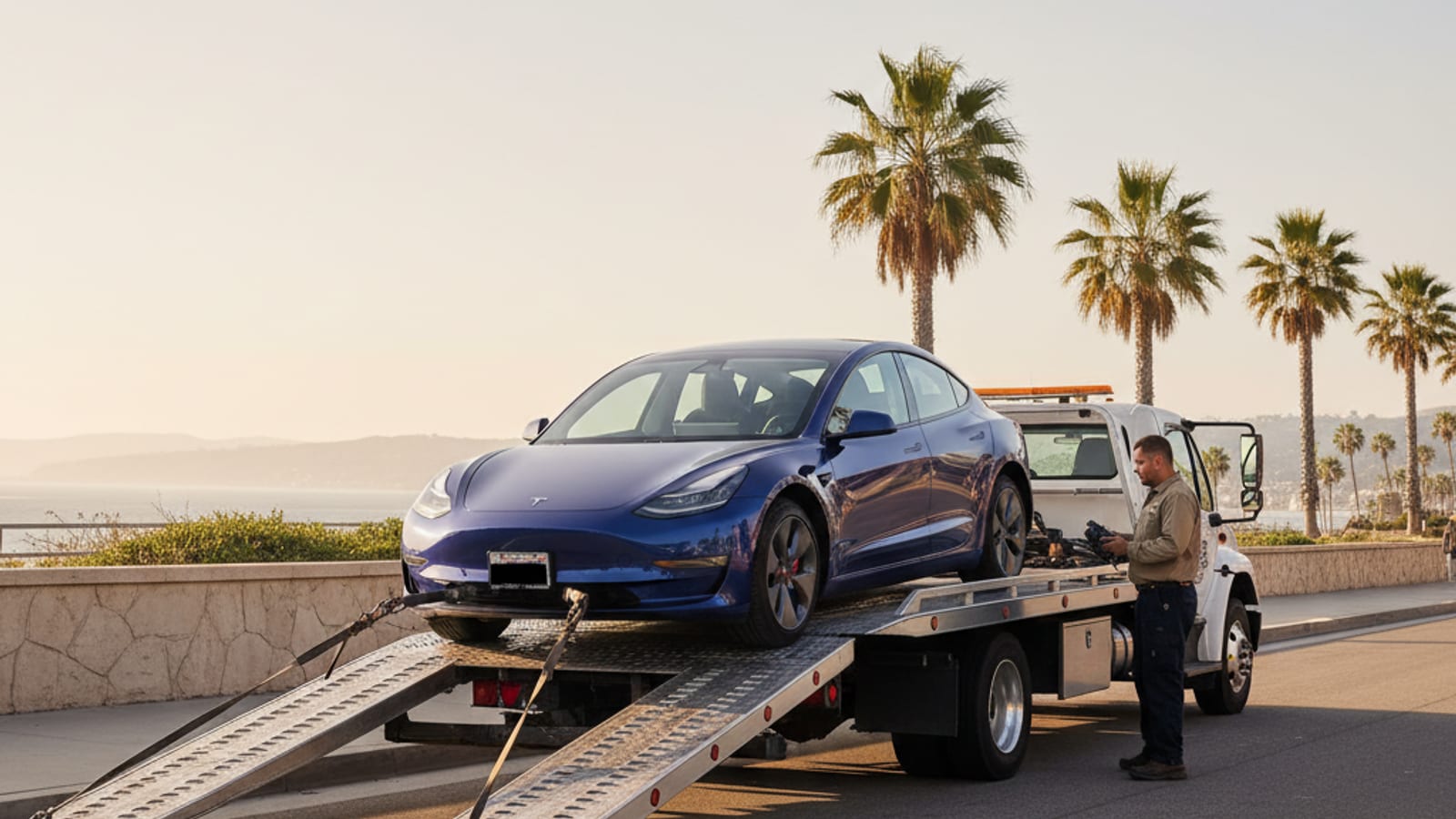
The car is on the shoulder of I-95, the Palmetto, or the Dolphin Expressway. Hazards are blinking. You’re already opening a tow app. Stop for one minute. An empty high-voltage pack wants a Level 2 charge where you sit. A dead 12-volt battery wants a jump. A flatbed is for cars that still can’t move after they have power.
Two failures, two different calls
South Florida heat doesn’t climb hills. The two counties are flat. Miami-Dade’s high point is the Atlantic Coastal Ridge at roughly 23 to 24 feet. Broward’s is Pine Island Ridge at about 29 feet. Range here is air conditioning, dwell, and a thinner pack than you planned.
Recurrent Auto studied about 30,000 EVs. They found about 5% range loss at 90F. At 100F the loss is about 17 to 18%. AAA’s 2019 SAE-standard test found about a 17% drop at 95F. That test ran with the AC on. NWS Miami 1991-2020 normals put July and August highs at 91F. A typical year sees about 64 days at or above 90F. That’s why a pack hits zero on the Homestead Extension or the Sawgrass. It isn’t a mountain grade.
The 12-volt is a different failure. It runs the computers, locks, and contactors that wake the big pack. Heat ages a lead-acid 12-volt fast. Battery University notes that every roughly 15F rise halves lead-acid life. It ages about twice as fast at 93F versus 77F. At 111F it ages about four times as fast. After a week in an MIA garage, many cars look totally dead. The pack is often fine. The 12-volt isn’t. If you mix those two up, you call a wrecker you don’t need.
When the pack is empty and the car still rolls
The dash says to charge. There’s no crash. No smoke. No high-voltage warning triangle. You coasted out of the travel lane. Once the car has 10 to 20 miles, you can drive it.
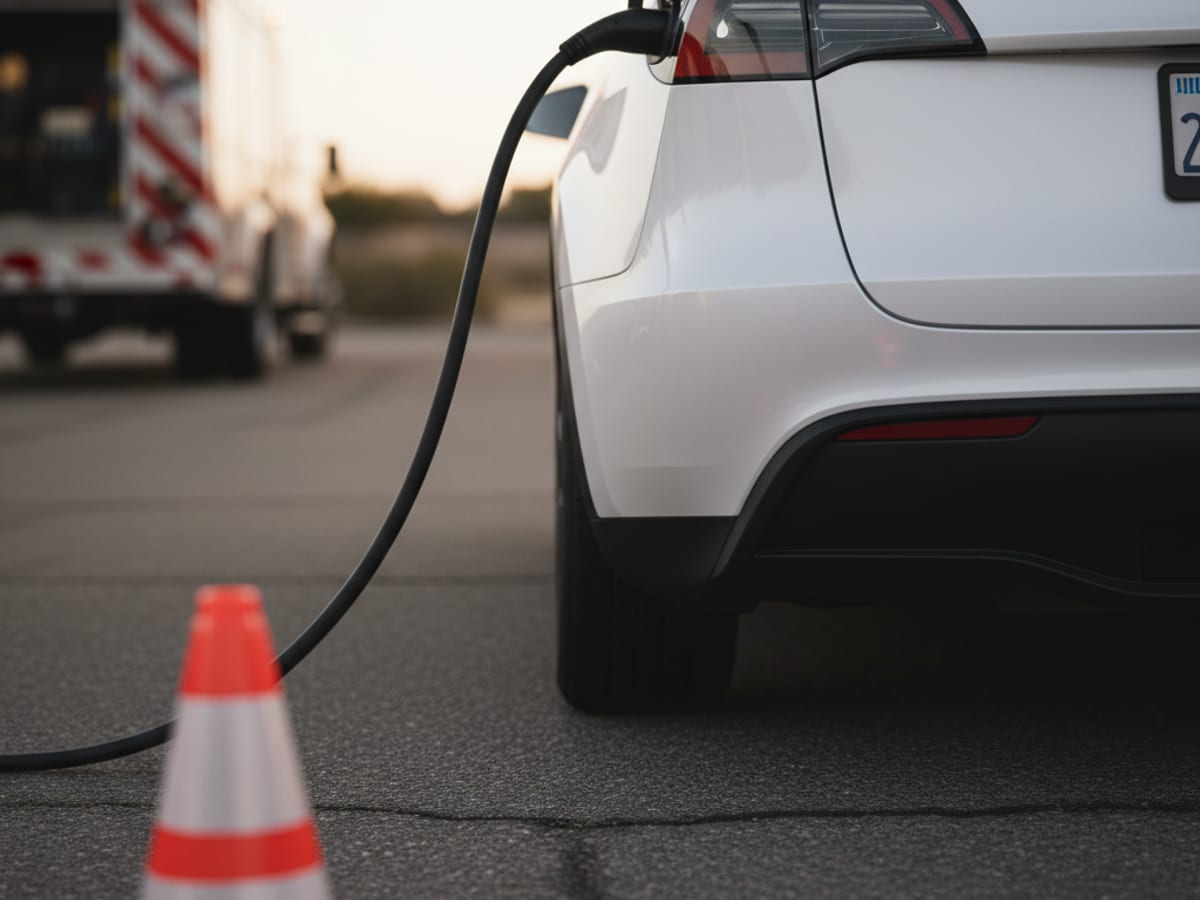
That’s a mobile EV charging call. The referral line matches you with an independent operator. That operator brings a 240-volt Level 2 source to the car. Teslas take a native NACS plug. Other brands take CCS or J1772 through an adapter. Typical charging time is 15 to 30 minutes. That window is time on the plug. It isn’t a promise of when anyone arrives. You get enough range to leave the shoulder. Then you finish at a working public station or at home.
Florida had about 450,400 registered EVs in 2025. Traffic on I-95 through Fort Lauderdale drains a thin pack. A late Dolphin run toward Doral does the same. The car is healthy. It’s just empty.
A tow still moves the car. It also loads a disabled EV onto a flatbed. Read why towing a dead EV in South Florida gets messy. Do that before you request a hook you don’t need.
When the car is silent and won’t wake
You parked at Miami International. Maybe the Dolphin Garage or the Flamingo Garage. Maybe the Ibis Garage or the new Park 6 lot. Or you left the car for a cruise. You come back. The screens are black. The handles won’t present. The app says the car is offline.
That’s usually the 12-volt, not an empty pack. Long dwell keeps modules alive. Heat in those garages cooks a weak 12-volt. The Ibis Garage holds ChargePoint ports across its levels. Park 6 has charging on site. A car that sat for a week still often needs a jump. The same pattern shows up after parking near PortMiami or Port Everglades.
Ask for a Tesla 12V battery jump if the car is a Tesla. Operators do the same on-site 12-volt work on every major EV brand. Jump first. Then see if the pack even needs a top-off. Don’t start with a wrecker.
When a tow is the honest answer
Some cars shouldn’t be charged in place. Call for a flatbed if any of this is true.
Collision damage, deployed airbags, or a bent suspension. A high-voltage warning triangle on the dash. Smoke, a burning smell, or fluid on the pavement. A flood-exposed pack. NHTSA warns residual salt in a flooded lithium battery can short later. About 36 EVs flooded by Hurricane Ian in 2022 later caught fire. Don’t charge or drive a flood-exposed EV until it’s inspected. Don’t park it within 50 feet of a structure.
A motor or drive-unit fault can block motion even with a full pack. That needs a shop, not a plug. A tire you can’t change on the shoulder needs a shop tow. If jumps get no response, check the high-voltage pack too. When both are dead, it may not be a roadside charge job.
Charge Pro MIA is a referral line. It matches you with independent local operators. It doesn’t own trucks. It doesn’t perform the work. If the operator tells you this needs a wrecker, listen. They quote you before they start. They bill you directly.
First, get off the travel lane
Florida Statute 316.194 covers stopping on a highway outside a municipality. Leave the vehicle off the main-traveled part where practicable. Leave room for passing traffic. Keep a clear view from 200 feet each way. A genuinely disabled vehicle that can’t move off the road is exempt. That’s 316.194(2). That’s the law. It isn’t a suggestion.
On limited-access roads, start with Road Rangers. They’re Florida’s free highway service patrol, run by FDOT. Dial *FHP, which is *347, from your phone. They jump-start vehicles, handle minor repairs, and change flats. They also tow a disabled vehicle from the travel lanes to the nearest safe location. District 6 covers Miami-Dade. That patrol includes I-95, 95 Express, I-195, and I-395. It also includes I-75, 75 Express, and SR-826, the Palmetto. District 4 covers Broward’s I-95 from the Miami-Dade line north. It also covers portions of I-595 and I-75. Florida Highway Patrol takes the same short code.
Road Rangers will move you out of the travel lane. They can jump a 12-volt. They don’t bring a Level 2 charge. Once you’re on the shoulder or a gore, out-of-charge recovery is the next call. Use it if the pack is empty. See what Florida law says when your EV dies on the freeway.
The Turnpike, the Homestead Extension, and the Sawgrass Expressway are Turnpike Enterprise roads. If you’re in an express lane, get to a safe stop. Do that as the statute requires, then call *347.
A public plug that never took
You rolled into a station with a thin pack. The session never started. The handshake failed. The stall is occupied, or the unit won’t talk to the car. You can’t leave on what you have left.
Don’t guess how far the next working plug is. An operator can plug into the car itself and add 10 to 20 miles. That’s enough to reach a working plug. Or to get home if you live nearby in Miami, Hialeah, or Fort Lauderdale.
FPL serves essentially all of Miami-Dade and Broward. Homestead is the exception, with HPS Energy on some streets. If the car can drive after a top-up, charge it where it sits.
Long roads, and whether the car can still roll
Alligator Alley on I-75 isn’t a city street. Neither is the Homestead park road into Everglades National Park. Tamiami Trail toward Shark Valley isn’t either. The park’s Homestead entrance on SR-9336 is a dead-end. There are no services once you’re on that road. Florida City is the last built-up stop before the Keys Stretch. The Keys are out of this service area. Weston and Sunrise sit on the last suburban miles before the Alley opens up.
If the car will drive with 10 to 20 miles, charge it on site. If it won’t roll, a tow is the honest path. Same if a Level 2 van can’t reach you safely. Say where you are. The operator will tell you which job they can do.
King tides run mainly September through November. If saltwater reached the pack, that isn’t a charge call. That’s an inspection and a tow.
Three checks before you request a hook
Will the car drive if it had 10 to 20 miles of range. If yes, you want a mobile charge, not a wrecker.
Do the screens wake, or is the whole car silent. Silent usually means the 12-volt. Ask for a jump before anyone brings a flatbed.
Is there damage, smoke, a high-voltage warning, or flood water. If yes, tow. Don’t plug it.
Those three checks cover most stalls. For a fuller walkthrough, read electric car died: charge it, jump the 12V, or tow.
Who to call, and what they actually do
Charge Pro MIA connects stranded EV drivers with independent local mobile rescue operators. The operator quotes before starting. They bill you. The brand doesn’t set prices, doesn’t publish hours, and doesn’t promise an arrival. Typical on-site charging adds 10 to 20 miles. That takes 15 to 30 minutes on the plug.
Call (786) 963-2995 when the pack is empty and the car is otherwise fine. Use it for a dead 12-volt or a failed public session too. If the situation needs a wrecker, say so on the phone. They’ll tell you.