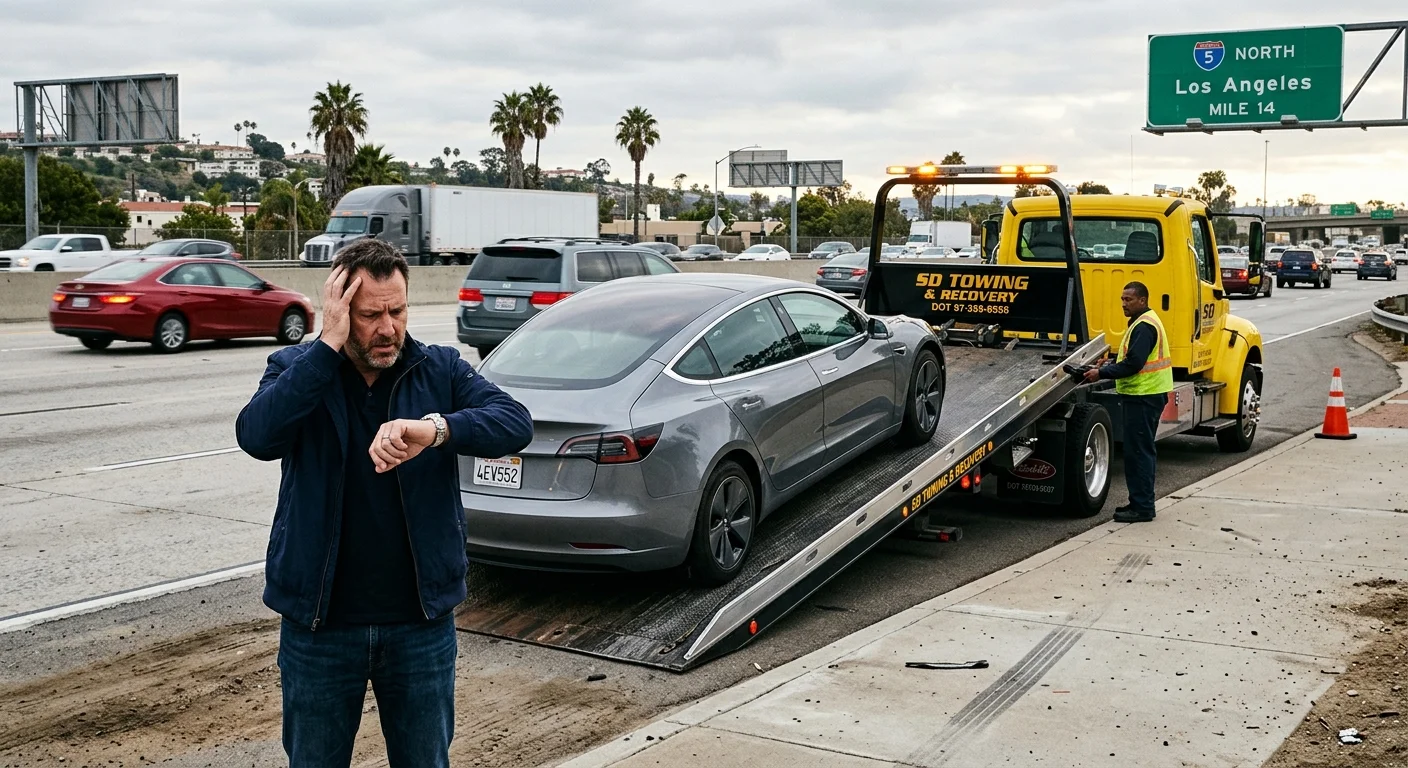
You’re watching a wrecker back up to a silent EV in a Hialeah garage. The cost to tow an EV isn’t the hook you see. Florida already set a 10-mile storage rule. Miami-Dade and Broward both meet it.
The statute that decides where your car sits
Florida Statute 715.07 is the private-property tow law. It’s the rule when a lot, garage, or shopping center calls a wrecker.
The towed vehicle must be stored within a 10-mile radius. That radius applies in a county of 500,000 people or more. Miami-Dade and Broward both qualify.
The yard also has to release the car within one hour of your request. That clock is in 715.07(2)(a)9. It’s not a promise that the pack will charge there.
If you reach the vehicle before it’s fully removed, the operator must stop. They must return it. You pay no more than one-half the posted tow rate. That’s 715.07(2)(a)3. Posted means the schedule they file with local law enforcement. It also means the copy at the storage site, under 715.07(2)(a)6.
The property needs a permanent, reflective tow-away zone sign at each access. It has to be posted at least 24 hours ahead. Single-family homes and personal notice are the exceptions, under 715.07(2)(a)5.
Non-consent rates are capped by county ordinance. Miami-Dade uses Code Section 30-476. Broward uses Code Section 20-176.22. Those citations are public. The dollar caps sat behind pages that wouldn’t load on September 18, 2026. Don’t guess a number from memory. Confirm the current schedule with the yard before you pay. Miami-Dade Consumer Protection and Broward Consumer Protection publish the rules.
Charge Pro MIA doesn’t set those rates. The operator quotes you before starting and bills you directly.
A Palmetto shoulder is not a garage tow
A stall on a highway is a different statute. Florida Statute 316.194 covers stopping outside a municipality. Leave the vehicle off the main-traveled part where that’s practicable. Leave room for passing traffic. Keep a clear view from 200 feet each way. 316.194(2) exempts a genuinely disabled vehicle that can’t practicably be moved.
Dial *FHP, which is *347, from your phone. That short code reaches Florida Highway Patrol. It also reaches FDOT’s Road Ranger Service Patrol. Rangers jump-start vehicles and change flats. They make minor repairs and provide gas, diesel, and water. They tow a disabled vehicle from the travel lanes to the nearest safe location. That patrol help is free of charge.
Their published materials don’t mention electric vehicles or EV charging. A dead EV can still need a 12V jump. It can still need a move off a live lane. Rangers already do both. A 240V Level 2 top-up isn’t on that list.
District 6 covers Miami-Dade. It patrols I-95, 95 Express, I-195, and I-395. It also covers I-75, 75 Express, and SR-826, the Palmetto. District 4 covers Broward. It patrols the I-95 corridor from the Miami-Dade line north. It also covers portions of I-595. On I-75 it runs from the Miami-Dade line to mile marker 50.
Florida’s Turnpike Enterprise runs the Turnpike, the Homestead Extension, and the Sawgrass Expressway. GMX runs SR-112, SR-836, SR-874, SR-878, and SR-924. 95 Express and 595 Express sit with FDOT. All of those roads are all-electronic. They use SunPass or toll-by-plate. None takes cash. None of them publishes a disabled-vehicle rule unique to its express lanes. Road Rangers still patrol those corridors. Don’t wait for a special GMX exception.
Florida 511 at FL511.com is FDOT’s traffic feed in English and Spanish. The freeway steps, including 316.194, sit in your EV died on the freeway.
Dark screens are often a 12V, not a pack
A car that won’t wake after a trip is a classic mix-up. Long-term parking at Miami International Airport drains the 12-volt battery. The high-voltage pack is usually still sitting there.
MIA’s public parking includes the Dolphin Garage at the North Terminal. The Flamingo Garage sits at the Central Terminal. The airport page lists ChargePoint ports in the Ibis Garage. Park 6 is the new long-term garage, opened summer 2026. The airport lists EV charging on site there.
Heat is why this happens so often here. South Florida is flat. Miami-Dade’s highest natural point is the Atlantic Coastal Ridge. That’s roughly 23 to 24 feet. Broward’s Pine Island Ridge is about 29 feet. Range is heat, air conditioning, and dwell. It’s not grade. NWS Miami 1991-2020 normals put July and August average highs at 91F.
Battery University notes that every roughly 15F rise halves lead-acid 12V life. Heat damage doesn’t reverse.
Operators in the network jump or replace a dead 12V on site. That’s often the whole job after a flight. It’s not a flatbed to a storage yard. More on that mix-up is in Tesla 12V failure after parking.
A flatbed is equipment, not a charging plan
If the high-voltage pack is empty, a wrecker still has to move the car correctly. Many EVs need all four wheels off the ground. A two-wheel lift can strain the motors. Regenerative hardware can take that load too. Tesla’s own transporter instructions live in that year’s owner’s manual. Charge Pro MIA doesn’t reprint a universal Transport Mode path. The model-specific checklist is in how to tow a Tesla with no power.
A flatbed is a different truck than a wheel-lift. Don’t treat an EV tow as a gas-car hook with a new name.
Charge Pro MIA is a referral line. It doesn’t own wreckers. It doesn’t own charging vans. It holds no trade licence. The operator you’re matched with quotes before starting.
Ten miles of storage is not a plug
The 10-mile rule answers where the car may be stored after a private-property tow. It doesn’t answer whether that yard can charge your pack. Station-level charger inventories couldn’t be confirmed. The AFDC API host didn’t resolve on September 18, 2026. Don’t pick a destination from a map guess.
A storage lot is a hold. It’s not a charge stop. You can still need a second move. You can still need a mobile Level 2 source at the yard. That second move is where the cost to tow an EV stacks. Confirm storage and any later hook with the yard before you pay.
Home may not finish the job either. North Miami’s housing stock is 82.7% pre-1980. Miami Springs is 89.5%. Hollywood is 74.7%. Hialeah is 60.1%. Older buildings often can’t take a home Level 2 install. Towing a dead EV home only helps if home can take a plug tonight.
Kendall, The Hammocks, Tamiami, and Westchester are census-designated places. They aren’t cities. They have no city hall to call about a tow complaint. The City of Miami is one of 34 municipalities in Miami-Dade. Miami Beach is its own city. You reach it only by causeway. South Beach is a neighborhood of Miami Beach, not a separate city.
Hialeah counted 221,901 people in the ACS figures. If you’re calling from those streets, say Hialeah. There’s a local write-up for EV roadside assistance in Hialeah. Florida had about 450,400 registered EVs in 2025. That’s a DOE AFDC state figure. It’s not a county charger count.
A charge on site skips the yard
The operators we connect you with bring a 240V Level 2 source to the car. Tesla cars take a native NACS plug. Other makes use a CCS or J1772 adapter. Typical charging time adds 10 to 20 miles of range. That takes 15 to 30 minutes of charging. That’s plug time. It’s not a travel promise.
Ten to twenty miles is enough to leave a legal stop. It’s not a full pack. The car doesn’t need a 715.07 yard for that first range.
Compare the two paths in charge on site or tow. The shorter version is when you need a charge, not a tow. Mobile EV charging is the service page for that Level 2 visit.
FPL serves essentially all of Miami-Dade and all of Broward. Homestead is the confirmed exception. Parts of Homestead sit on Homestead Public Services Energy. Other Homestead streets are still FPL. Confirm that line at homesteadfl.gov. FPL EVolution is the utility’s public charging brand.
Pick the path that matches the stall
If you’re in a travel lane, move off it if the car still rolls. Then call *FHP.
If the car is dark and the app is dead, treat it as a 12V first. A wrecker is the wrong first call after a week in the Ibis Garage.
If the pack is empty, ask for a mobile charge. Do that from a legal stop. Give year, make, model, and a pin. A Tesla wants NACS. A Hyundai, Kia, Ford, Rivian, or Chevy may need CCS or J1772.
If a wrecker is already on private property, check whether the car is fully removed. If it isn’t, use 715.07. Appear, pay no more than half the posted rate, and get the car back. Then decide if you still need range or a 12V.
If the car already sits in a storage yard, ask where it is. The 10-mile rule is your map. Ask when they can release it. Confirm the posted schedule before you pay. Then request a mobile operator at that yard. Or plan a second, correct flatbed. Confirm a destination that can accept the car first.
Charge Pro MIA matches stranded EV drivers with independent local operators. The network covers South Florida. Call (786) 963-2995 when you need a quote from an operator. That number doesn’t promise when someone arrives.