The Tesla is silent on the Palmetto shoulder. The first job is Florida law, not the hook. Statute 316.194 covers a stop outside a municipality. A disabled Tesla sits off the main-traveled part when you can move it. Leave room for passing traffic. Keep a clear view from 200 feet each way. If the car truly won’t roll, 316.194(2) exempts a vehicle you can’t shift. Put the hazards on and stay out of the live lanes. Then sort the real failure. It might be a dead 12V. It might be an empty pack. Or it might be a car that has to ride a flatbed.
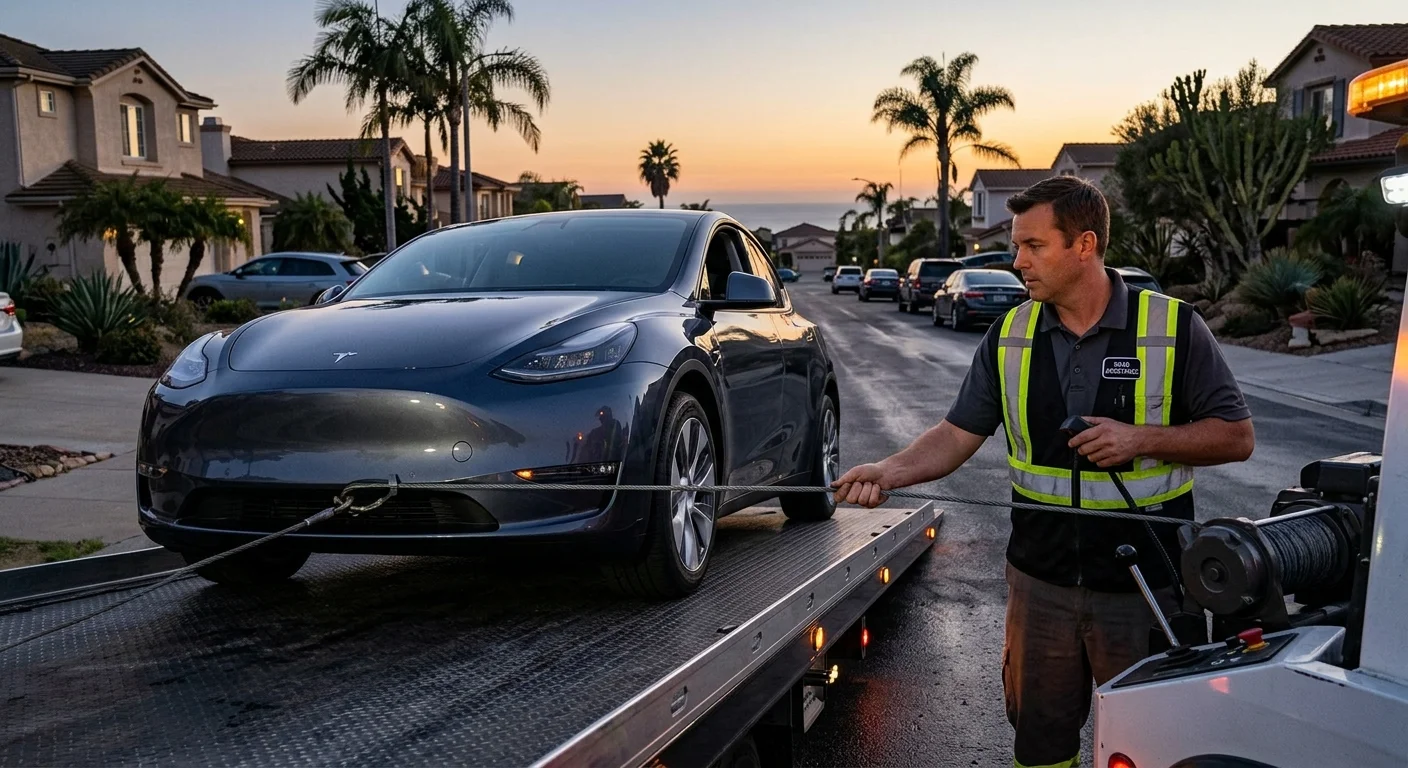
Get off the travel lane before anyone tows
FDOT’s Road Ranger Service Patrol is the state’s free highway help. Crews jump-start vehicles and change flats. They also tow a disabled car from the travel lanes to the nearest safe spot. Dial *FHP, which is *347, from your phone. Florida Highway Patrol takes disabled-motorist reports on that same short code.
District 6 covers Miami-Dade. It patrols I-95, 95 Express, I-195, and I-395. It also covers I-75, 75 Express, and SR-826, the Palmetto. District 4 covers Broward. It patrols I-95 from the Miami-Dade line north. It also covers stretches of I-595 and I-75. Road Ranger pages don’t mention EV charging. They can still jump a 12V or pull you out of a live lane. A Level 2 charge is a later call to a mobile operator.
Check Florida 511 at FL511.com if the expressway is stopped. It runs in English and Spanish. GMX now operates the old MDX roads, including the Dolphin on SR-836. Florida’s Turnpike Enterprise runs the Turnpike, the Homestead Extension, and the Sawgrass Expressway. 95 Express and 595 Express belong to FDOT. Those roads are all-electronic with SunPass or toll-by-plate. No operator publishes a disabled-vehicle rule unique to express lanes. Road Rangers still work those corridors. Call *FHP. Stay as far right as you can.
There’s a longer legal walk-through in Your EV died on the freeway: what Florida law says. Miami Beach is its own city, reached only by causeway. Wait for a flatbed if the car has to move off the island.
Private lots follow 715.07, not highway rules
A stall at Aventura Mall, Brickell City Centre, or Dadeland is a different statute. Florida 715.07 governs towing from private property. That’s the rule for condo garages, shopping lots, and posted tow-away zones.
If you reach the Tesla before it’s fully removed, the operator has to stop. They must return the vehicle. You pay no more than one-half the posted tow rate. That’s 715.07(2)(a)3, not a blog estimate. The lot needs a permanent, reflective “tow-away zone” sign at each access. The sign has to be up at least 24 hours ahead. Single-family homes and personal notice are the listed exceptions.
Once the car is gone, storage has to sit within a 10-mile radius. Miami-Dade and Broward both exceed 500,000 people, so that radius applies. They have to release the vehicle within one hour of your request. The operator files its rate schedule with local law enforcement. It also posts that schedule at the yard.
Miami-Dade sets maximum nonconsent rates in Code Section 30-476. Broward does the same in Code Section 20-176.22. A current dollar schedule wasn’t confirmed when those county pages were checked. Don’t guess a number from an old sign in your head. Read the posted schedule at the storage site. Confirm the current rate with the yard before you pay. The counties cap nonconsent tows. This page doesn’t print those caps.
Long-term parking at Miami International adds a twist. Public garages there include the Dolphin, Flamingo, Ibis, and Park 6. A week in that heat often kills the 12V. The high-voltage pack can still hold charge. Ibis lists ChargePoint ports across its levels. Park 6 opened with charging on site. A black screen after a flight is still usually a jump, not a wrecker. A lot in Doral, Hialeah, or unincorporated Kendall still follows 715.07 if it’s private property.
A Tesla can’t be dragged like a gas car
Gas cars can sometimes roll with a transmission in neutral. A Tesla’s motors sit on the drive axles. If those wheels spin while the car is asleep, the motors generate current. That current has nowhere safe to go. The hardware overheats. Regen can snatch the hubs when you don’t expect it. A dolly that leaves drive wheels on the pavement is the damage path. So is a hook-and-chain drag on a surface street.
Tesla’s published method is a flatbed. All four wheels leave the road. AWD models drive every corner, so a two-wheel lift still spins a motor. Short hops still count. The motor doesn’t care that you’re only going to the next Palmetto exit. If the truck on scene is a wheel-lift, wait for a bed.
There’s more on why this goes wrong in Why towing a dead EV in South Florida gets messy.
Jump the 12V before anyone winches
A dark touchscreen is often the small 12-volt battery. That battery runs the computers, locks, and screen. South Florida heat is hard on it. NWS Miami 1991-2020 normals put July and August average highs at 91F. A typical year sees about 64 days at or above 90F. Battery University notes that every roughly 15F rise halves lead-acid life. Heat damage doesn’t reverse. That’s why cars fail to wake after MIA parking. The same thing happens on a Homestead driveway. A week in a Broward garage can do it too.
A 12V jump on the low-voltage posts can restore the screen. On many Teslas those posts sit behind the front tow-eye cover. The jump doesn’t fill the high-voltage pack. It only wakes the low-voltage system. From there you can enable Transport Mode. You may also drive if the pack still has range.
If you’re locked out, use Tesla battery dead and locked out. The operators we connect you with can do a Tesla 12V battery jump on site.
Transport Mode, then the bed
Transport Mode releases the parking brake. It lets the wheels roll without driving the motors. With a live screen, open Controls, then Service. Turn it on before the cable tightens. Point the wheels straight. Use Tesla’s tow eyes. Don’t wrap chains around control arms or the pack tray.
If the 12V won’t hold a jump, say that before the bed tilts. Don’t let anyone drag the Tesla into motion. The operator should confirm recovery steps for your Model 3, Y, S, or X. Model S has extra notes in Towing a Model S with no power.
Never flat-tow with all four wheels on the road. Never ride two wheels on a dolly. Those aren’t Tesla’s method, and they aren’t a shortcut.
When a charge replaces the wrecker
A dead 12V and an empty pack are different jobs. After a jump, some cars just drive. If the pack is at zero, you still may not need a wrecker. A mobile Level 2 source can add range where you sit. Operators in this network bring a 240V plug. Teslas use a native NACS connector. They typically add 10 to 20 miles in 15 to 30 minutes of charging. That’s charging time. It isn’t an arrival time.
That range can get you off a Fort Lauderdale street. It can also cover a Kendall lot or a Miami Beach causeway approach. You can then drive to a charger yourself. It also skips winching a silent car. Read Do you need a mobile charge, or a tow. For Tesla dispatch, start with Tesla roadside rescue.
Charge Pro MIA is a referral line. It matches stranded drivers with independent local operators. It owns no trucks and employs no technicians. It sets no prices and holds no trade license. The operator quotes you before starting and bills you directly.
South Florida is flat, so range here is heat and dwell, not hills. Get out of the lane first. Then choose jump, charge, or flatbed.
What to tell the operator before a chain goes on
Say it in one breath. It’s a Tesla, and it has to ride on a flatbed. Tell them if the screen is dark. Tell them if Transport Mode is on. If it isn’t, say you need a 12V jump first. Show the front tow eye. Don’t let them hook the suspension.
If this is a lot tow, ask for the posted rate schedule. Ask which yard they’ll use. 715.07 keeps that yard inside ten miles in this county. Ask for release within the hour once you arrive. If they started the pull and you showed up in time, stop them. The half-rate return rule still applies. Confirm every figure at the yard. Don’t take a number from this page.
On a public road, *FHP can be the first call, not a private wrecker. Once you’re on a safe shoulder, you can refuse a bad method. That includes any plan that rolls the drive wheels.
Frequently asked questions
How do you tow a Tesla with no power?
Use a flatbed with all four wheels off the pavement. Enable Transport Mode if the screen can wake. Don’t let the drive wheels roll while the car is asleep.
What if Transport Mode won’t turn on?
Don’t drag the car. Jump the 12V if you can reach the posts. If it still won’t wake, pause the winch. The operator confirms that model’s recovery steps first.
Does a black Tesla screen mean you need a wrecker?
Often no. Heat-killed 12V batteries are common after parking here. A jump may restore the screen. An empty pack is a separate job. A mobile charge can replace the tow.
Call (786) 963-2995 if you still need a jump, a charge, or a flatbed. We’ll connect you with an independent local operator. That operator quotes before work starts and bills you directly.