The pack is at zero on the Palmetto Expressway. Or the car won’t wake in a Brickell garage. You’re choosing a charge at the bumper or a wrecker that takes the car. That isn’t a guess about which invoice looks smaller. Florida Statute 715.07 already limits private-lot tows in Miami-Dade and Broward. A mobile operator also has to quote you before any charge starts. Use both facts before anyone hooks the car.
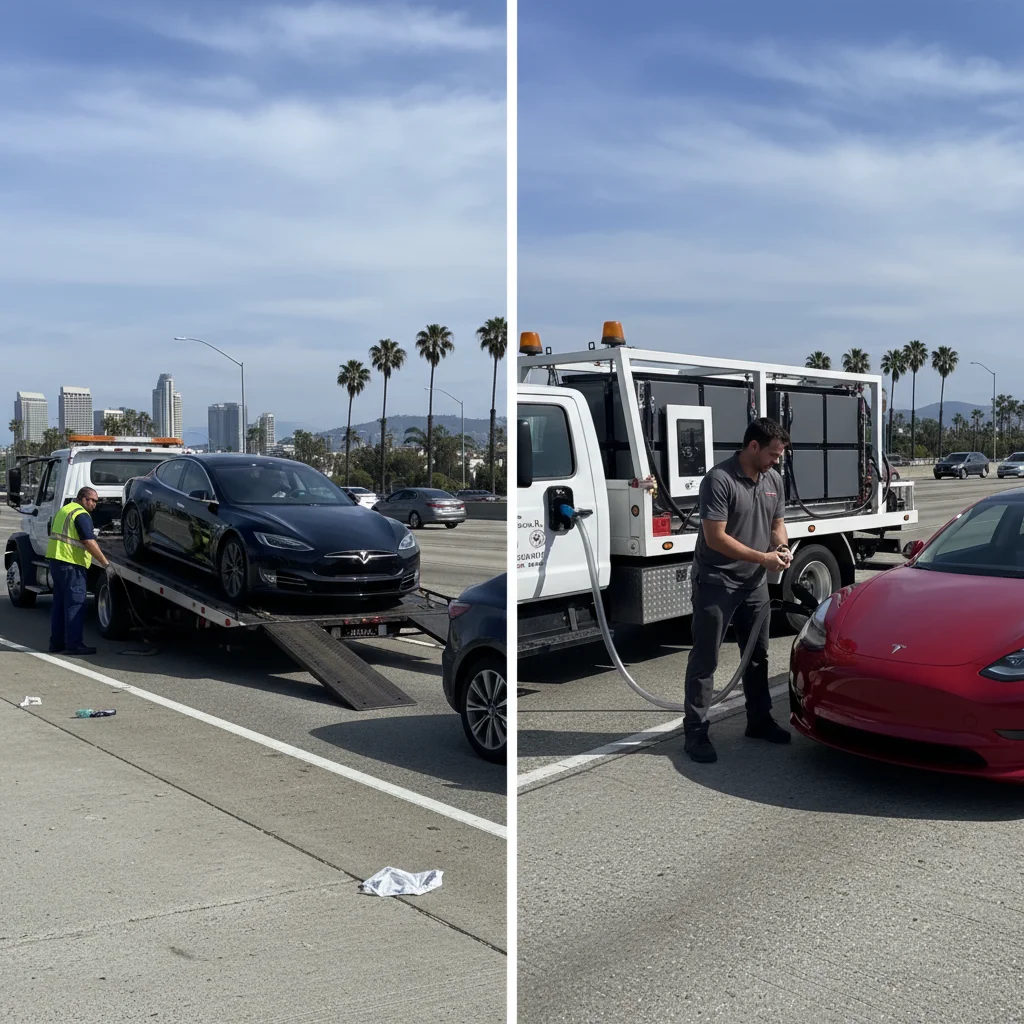
Empty pack versus a car that won’t wake
An EV that rolled to a stop at zero percent is usually a fuel problem. The high-voltage pack is empty, and the drivetrain is fine. A mobile EV charging truck can put 10 to 20 miles back. That’s a 240-volt Level 2 source at the bumper. Charging time is 15 to 30 minutes, never an arrival time. Teslas take a native NACS plug. Other brands use a CCS or J1772 adapter.
A silent car after a week in airport parking is often a different failure. Miami International’s Dolphin, Flamingo, Ibis, and Park 6 garages see this constantly. So do the cruise lots at PortMiami and Port Everglades. The 12-volt battery kept the computers alive in the heat, then it died. The main pack may still hold plenty of energy.
Heat is the range story here, not hills. The Atlantic Coastal Ridge in Miami-Dade tops out around 23 to 24 feet. Pine Island Ridge in Broward sits at about 29 feet. Recurrent Auto studied about 30,000 EVs and found about 5% range loss at 90F. The same study found about 17 to 18% loss at 100F. Lead-acid 12-volt packs age about twice as fast at 93F as at 77F. That’s why so many EVs look totally dead after a long sit.
If the screen is dark and the doors won’t open, start with the 12-volt. Skip the flatbed until you know the small battery isn’t the whole problem. If the dash shows a powertrain or high-voltage fault, stop and don’t add energy. That car needs a shop, on a flatbed, with the wheels off the ground.
Florida private-lot tows aren’t a blank check
Plenty of tow calls start in a garage, not on I-95. They start at Dadeland Mall in Kendall, Aventura Mall, and Brickell City Centre. Sawgrass Mills in Sunrise is the same story. So are condo decks in Miami Beach, Surfside, and Sunny Isles Beach. Those lots run contracted wreckers under Florida Statute 715.07.
Reach the car before it’s fully removed and the operator has to stop. They have to return the car. You pay no more than one-half the posted tow rate. That’s 715.07(2)(a)3, and it’s the statute, not a courtesy. The lot also has to show a permanent, reflective, correctly sized tow-away sign at each access. That sign has to be posted at least 24 hours ahead. The exceptions are a single-family home and personal notice under 715.07(2)(a)5.
Once the car is gone, storage isn’t open-ended in these two counties. Miami-Dade and Broward both top 500,000 people, so the yard has to sit within a 10-mile radius. They have to release the vehicle within one hour of your request. That’s 715.07(2)(a)1 and (2)(a)9. The operator must file its rate schedule with local law enforcement. It also has to post that schedule at the storage site under 715.07(2)(a)6.
Counties cap nonconsent rates on top of the statute. Miami-Dade does it in Code Section 30-476. Broward does it in Code Section 20-176.22, reviewed each year. Don’t trust a number you saw on a forum. Confirm the posted schedule at the yard before you pay. Check Miami-Dade Consumer Protection or Broward Consumer Protection if the board doesn’t match. Those caps change, and a stale figure helps nobody.
A mobile charge never puts you in that chain. The independent operator quotes you first, and you accept or you don’t. They bill you directly, because Charge Pro MIA is a referral line. It doesn’t own trucks, set prices, or perform the work. The quote before a charge starts is the whole point here. That’s the mobile ev charging cost vs tow comparison that matters.
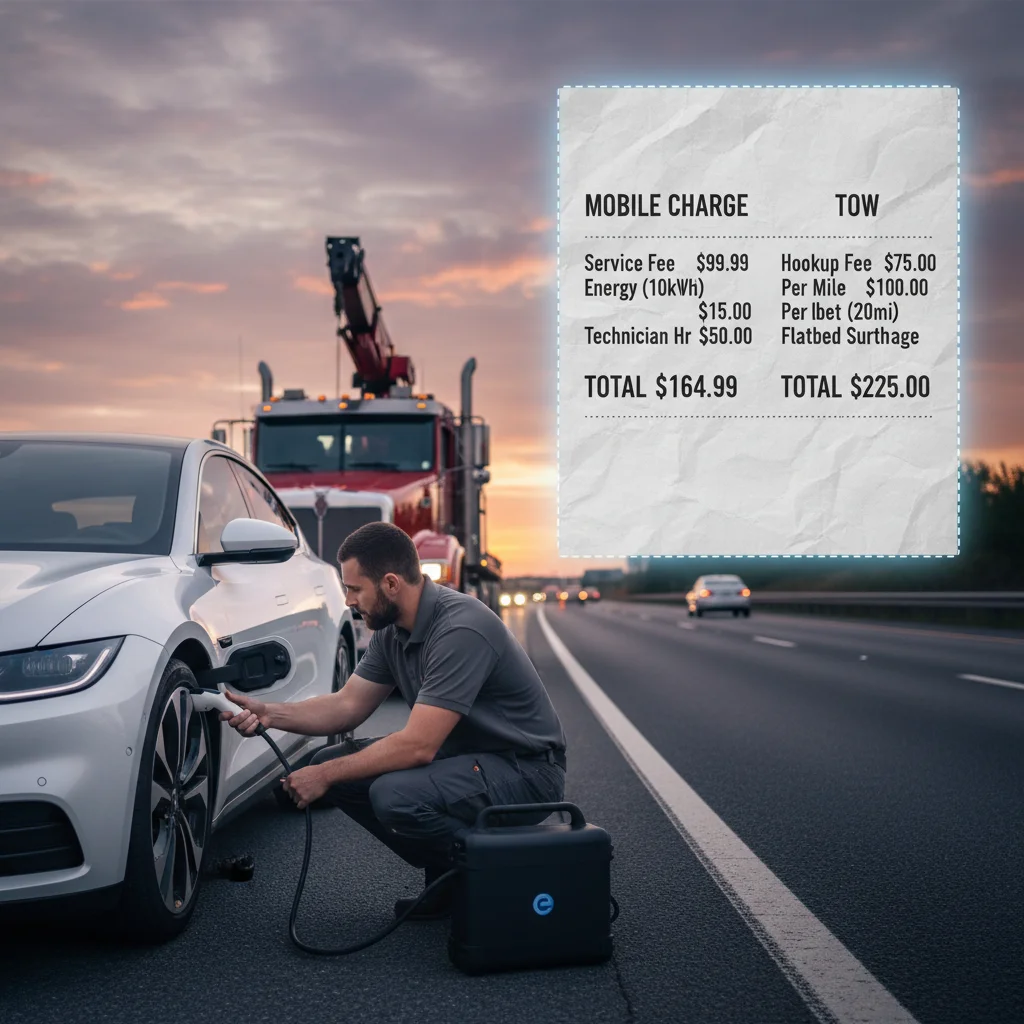
On the highway, a wrecker is a different tool
Florida Statute 316.194 covers a disabled vehicle on a highway outside a city. Get off the main-traveled part when that’s practicable. Leave room for passing traffic and a clear view from 200 feet each way. 316.194(2) exempts a car that truly can’t be moved. If you’re in a travel lane, safety comes first. That includes I-95, the Palmetto, I-75, the Dolphin, and the Turnpike.
FDOT’s Road Ranger Service Patrol is the free highway help. Dial *FHP, which is *347, for that patrol. Rangers jump-start vehicles and handle minor repairs and flats. They tow a disabled car from the travel lanes to the nearest safe location. District 6 covers Miami-Dade on I-95, 95 Express, I-195, I-395, I-75, 75 Express, and SR-826. District 4 covers Broward’s I-95 from the county line north. It also covers portions of I-595 and I-75. Florida 511 at FL511.com is the official traffic feed, in English and Spanish.
Road Rangers don’t publish an EV charging service. A dead EV can still need a 12-volt jump. It can still need a shove off the travel lane. Rangers do both of those jobs. A Level 2 top-up is what a mobile rescue operator brings. That’s after you’re out of the lane. That split is the real charge versus tow decision on an expressway.
Express lanes on 95 Express, 595 Express, the Sawgrass, and Greater Miami Expressway Agency roads are all-electronic. They take SunPass or toll-by-plate, not cash. None of those operators publish a special free-tow rule for express lanes. Road Rangers still patrol those corridors every day. Don’t sit in a live lane waiting for a charger.
Why a flatbed is the wrong default for an empty pack
Tesla, Rivian, Ford, and most other makers want a flatbed. They don’t want a hook-and-chain or a wheel-lift that lets drive wheels spin. That’s about protecting the motors, not your empty pack. Towing a dead EV here gets messy for other reasons too. Tight garage ramps and condo height bars slow the hook. A wrecker may have to winch off a tower deck. Then you drop at a public plug and still wait for a stall. Then you still sit while the car drinks.
A mobile charge solves the empty tank where you already are. The operator brings 240 volts to the bumper. You drive away on your own power. You aren’t burning a club’s long-haul tow benefit on a short hop. You aren’t waiting on a 715.07 release at a yard. You aren’t paying storage because the car sat overnight after a private-lot hook.
Distance is what inflates a tow bill. Per-mile charges keep running until the car is unstrapped. A charge is priced on the work in front of you. The operator tells you that number before the cable goes in. After-hours, weekends, and holidays can tighten availability for every trade. So can stadium nights at Hard Rock Stadium in Miami Gardens. Same for Kaseya Center downtown. The quote still comes first, and you decide after you hear it.
What clubs and Tesla actually send
AAA and similar clubs are built around tows and jumps. Some members get a wrecker when they asked for a charge. A long-distance tow benefit is the wrong tool for a short plug run. Save it for a real breakdown far from home. For what those clubs actually dispatch here, read AAA versus mobile EV charging.
Tesla roadside assistance, on Tesla’s own support page, treats an empty pack as the driver’s job. They may cover a tow to a nearby public charger or Supercharger. They may not cover a ride home. Repeat empty-pack calls can fall outside complimentary help. A third-party mobile charger is possible only where Tesla has a local partner. That partner isn’t a promise in this metro.
Basic insurance roadside add-ons often stop at a hook-up. Mileage, storage, after-hours, and winching land on you. Confirm your policy before you assume a wrecker is covered.
When the wrecker is the only honest answer
Call for a flatbed when the car is unsafe to energize. Powertrain failure and high-voltage battery errors are tow problems. So is flood exposure after a king tide on Miami Beach, Hollywood, or the Las Olas Isles. NHTSA warns that residual salt in a flooded lithium pack can short days to weeks later. A flood-exposed EV shouldn’t be driven or charged until it’s inspected. It shouldn’t sit within 50 feet of a structure. About 36 EVs flooded by Hurricane Ian in 2022 later caught fire. That’s a tow to a qualified shop, not a roadside top-up.
A 12-volt that won’t hold a jump also needs more than a charge. If the car dies again after it wakes, the small battery is done. Replacement on site beats a wrecker if the pack itself is healthy. If the car can’t be shifted into the right mode for a flatbed, say so. The out-of-charge recovery path is for an empty, healthy pack. It isn’t a repair shop on wheels.
How to choose in the first two minutes
Stay out of the travel lane with hazards on. Call *FHP if you’re on a patrol route, including the Homestead Extension, I-595, or Tamiami Trail.
If the display says zero with no fault light, you want a charge at the bumper. If the car is mute after MIA or a cruise port, start with the 12-volt. If a private-lot wrecker is already on scene, 715.07 may still let you stop the hook. That’s only before the car is fully removed. If the dash is in a fault, you want a flatbed to a shop.
Charge Pro MIA matches you with an independent local operator. The operator quotes before any charge starts, and they bill you directly. No one here owns the truck or sets the price. For the empty-pack case, charge, jump, or tow is the same three-way split you just walked.
Call (786) 963-2995 when you want that quote routed to an operator. They can bring 240 volts, or jump a 12-volt, on site.