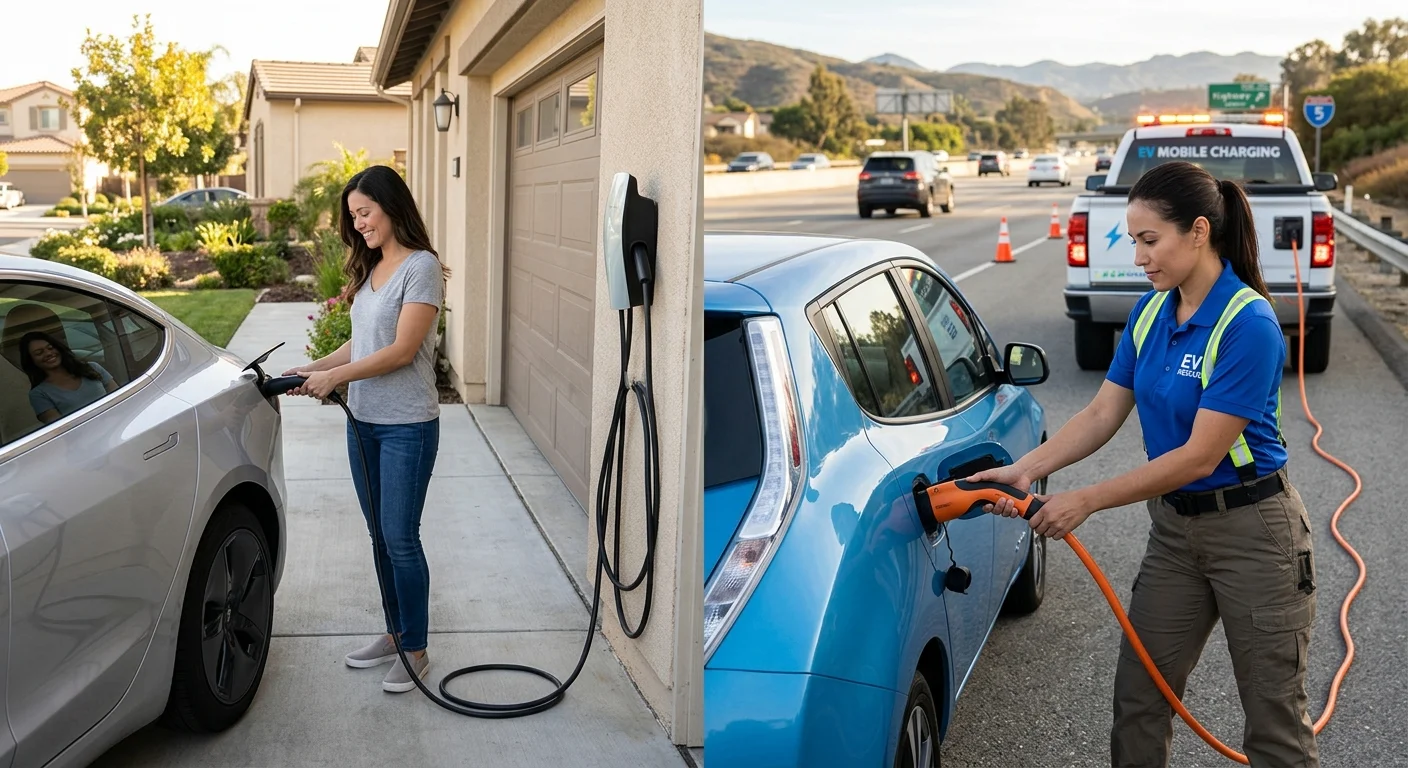
A 240 volt EV charging station is your home Level 2 plug. It stays on the building. It doesn’t follow you onto I-95 or the Palmetto. Many condo stalls in Miami Beach and Sunny Isles Beach never get that 240-volt circuit. When the car is already stopped, a mobile Level 2 source is the backup.
What 240 volts means on an EV
The US Department of Energy describes Level 2 as 240-volt service at home. Voltage alone doesn’t set the charge rate.
Level 1 is a regular 120-volt household outlet, and it adds range slowly. Our guide to what a Level 1 charger is for condo drivers covers that option. A 120-volt outlet can still be the only plug in an older building. That doesn’t make it a 240-volt station.
Operators we connect you with bring a 240-volt Level 2 source to the car. They use a native NACS plug. Non-Tesla EVs get a CCS or J1772 adapter. Typical charging adds 10 to 20 miles of range in 15 to 30 minutes of charging. That’s charging time, never an arrival time. It’s enough to move, not a full overnight fill.
Our explainer on EV charging levels when you’re already stranded walks through those categories at the curb.
Why so many stalls here never see 240 volts
South Florida parking isn’t one pattern. A driveway in Weston isn’t a garage in North Miami. A tower stall on Miami Beach isn’t a new house in Doral.
Census ACS 2019-2023 figures show how old the housing is. North Miami is 82.7% pre-1980, and Miami Springs is 89.5%. Hialeah is 60.1% pre-1980. Those older buildings often can’t take a home charger. Doral is only 5.5% pre-1980, and Weston is 7.0%. Newer west-side stock is where a 240-volt wall unit is far more common.
The City of Miami is one of 34 municipalities in Miami-Dade County. Miami Beach is a separate city, reached only by causeway. Sunny Isles Beach, Surfside, and Hallandale Beach stack parking in towers. Kendall is a census-designated place, not a city.
Florida Power and Light serves essentially all of Miami-Dade and all of Broward. Homestead is the confirmed exception. Parts of Homestead use Homestead Public Services Energy. Confirm that street boundary with the city at homesteadfl.gov. FPL EVolution Home is the residential Level 2 install-and-maintain program. FPL also has a Time-of-Use rate for home charging, so confirm current terms with FPL. FPL’s EVolution Make-Ready Credit is the commercial and multifamily infrastructure program. A condo board can ask FPL about that. Charge Pro MIA doesn’t run those programs, and we don’t install wall stations.
Home charging in Kendall and South Miami is the suburban version of this question.
Home Level 2 and a roadside stop are different jobs
Routine charging needs a regular space, time, and a fixed circuit. A licensed electrician has to judge the panel, the load, and the proposed equipment. We don’t do that inspection or pull permits.
A roadside need starts with mobility. The car can’t reach a usable fixed charger. Then you need to know whether it can take compatible energy where it sits. Read home charger versus a mobile rescue if you’re choosing a wall install or a mobile rescue.
A failed wall unit at home is still a property problem. Call the electrician or the charger maker. If the car is away from home and can’t reach charging, out-of-charge recovery is the service path.
Confirm the car, the plug, and the actual power
Start with the exact make, model, and year. Then read the owner’s manual for compatible charging. Level 2 gear commonly uses J1772 or J3400, and the manufacturer is still the authority for your EV.
“There is a 240-volt outlet in the garage” isn’t a plan. The circuit, the breaker, and household demand still need an electrician. Charge Pro MIA doesn’t assess your panel.
We couldn’t confirm a single countywide EV-charger permit form for Miami-Dade or Broward. Each city and the unincorporated county set their own building process. Confirm the current forms with the building department that serves that address. Homestead drivers should also confirm the utility on that street. No EV-specific program turned up on HPS Energy’s pages when we checked. That’s an observed gap on the site, not proof that none exists.
For a roadside request, tell the operator the vehicle and the screen warnings. Share remaining charge, connector type, and the exact pin. Say whether the car can shift, steer, or accept a charge. The matched operator quotes you before starting, and bills you directly.
Heat, range, and why the pack runs down first
South Florida is flat. Miami-Dade’s highest natural point is the Atlantic Coastal Ridge at roughly 23 to 24 feet. Broward’s is Pine Island Ridge at about 29 feet. There’s no hill penalty on range in these two counties. Range here is heat, air conditioning, and time sitting in traffic.
NWS Miami 1991-2020 normals put July and August average highs at 91F. Recurrent Auto studied about 30,000 EVs and found about 5% range loss at 90F, and about 17 to 18% at 100F. AAA’s 2019 SAE-standard test used 95F with the AC on, and range dropped about 17%.
That’s why a planned public stop can still leave you short. Don’t treat an app pin as a promise the car will arrive with enough energy. Confirm the site is open, and that it takes your connector.
Miami International Airport is a different failure. The Dolphin, Flamingo, and Ibis garages, plus the new Park 6 long-term garage, hold cars after long trips. The Ibis Garage has ChargePoint EV ports across its levels. Park 6 has EV charging on site. After a long trip, the 12-volt battery often drained, and the traction pack usually isn’t empty. A jump or an on-site 12V swap is the usual fix. A home 240-volt station doesn’t help a silent car in that garage.
FPL deploys mobile EV charging trailers before planned outages and during storms. FPL tells EV owners to keep the pack between 50 and 80% through hurricane season, unplug during the storm, and not charge a flood-exposed EV until it’s inspected.
When a building plug can’t finish the stop
A fixed outlet only helps if the car can reach it and use it. A cord on a loading dock isn’t yours to claim. The property owner, the circuit, and the vehicle all have to match.
The same limit applies on I-95, the Palmetto Expressway, and the Dolphin Expressway. GMX now runs the Dolphin as SR-836. It also applies on Florida’s Turnpike and the Homestead Extension. Your home station stays on the house. It can’t reach a shoulder in Fort Lauderdale or a stall in Sunny Isles Beach.
Florida Statute 316.194 covers a stop outside a municipality. Leave the vehicle off the main-traveled part where practicable. 316.194(2) exempts a genuinely disabled vehicle that can’t be moved off the road. If you’re in the travel lane, get to a safe spot first. Dial *FHP (*347) for Florida Highway Patrol and the Road Ranger Service Patrol.
Road Rangers jump-start vehicles, change flats, and tow a disabled vehicle from the travel lanes to the nearest safe location, free of charge. FDOT District 6 covers Miami-Dade. District 4 covers Broward, including I-95 and portions of I-595 and I-75. Road Ranger materials don’t mention EV charging. They can still jump a 12V or move you off the lane. A Level 2 charge is what the operators we refer bring.
A low traction battery isn’t the only reason an EV sits still. The car may reject charging or show a fault. Adding 240 volts won’t clear every fault. Smoke, fire, a crash, or live traffic is an emergency call first.
Mobile Level 2, a 12-volt jump, or a tow
Mobile charging can fit when an empty EV can accept compatible power where it sits. The goal is enough range to move, not a full home session. The operator assesses the vehicle, access, the connector, and the scene.
Mobile EV charging is how we connect you with licensed, independent local operators. The pros we connect you with are licensed and insured. Charge Pro MIA makes the referral. The matched operator does the physical work, explains the option, and sets terms with you. We don’t set prices, promise an arrival window, or publish hours. We own no trucks.
Transport may be better if the car won’t take power. It may also fit if the location can’t support a charge, or a separate fault blocks movement. The operator can discuss a compatible charging site, a shop, or another destination you choose. Don’t lock onto the nearest pin in an app. Confirm the connector and whether that site is actually available.
Ask what equipment they will use, what outcome they expect, and what they will charge. Confirm those details with the operator before they start.
When to call
Call when the EV can’t reach a usable charger. You need a mobile rescue operator to assess a charge or a tow. We match stranded drivers with independent local operators across South Florida. Call (786) 963-2995 and we’ll connect you with a local EV rescue operator.