A failed wall box in South Florida splits into two jobs. A licensed electrician handles ev charger installation and any repair on the building. If the car is already low, that permit calendar doesn’t get you moving. Charge Pro MIA is a referral line. We match stranded drivers with independent mobile operators. We don’t run conduit, and we hold no trade license. Condo unit owners have a written path under Florida Statute 718.113(8). HOA lots and rentals don’t get that same statutory right.
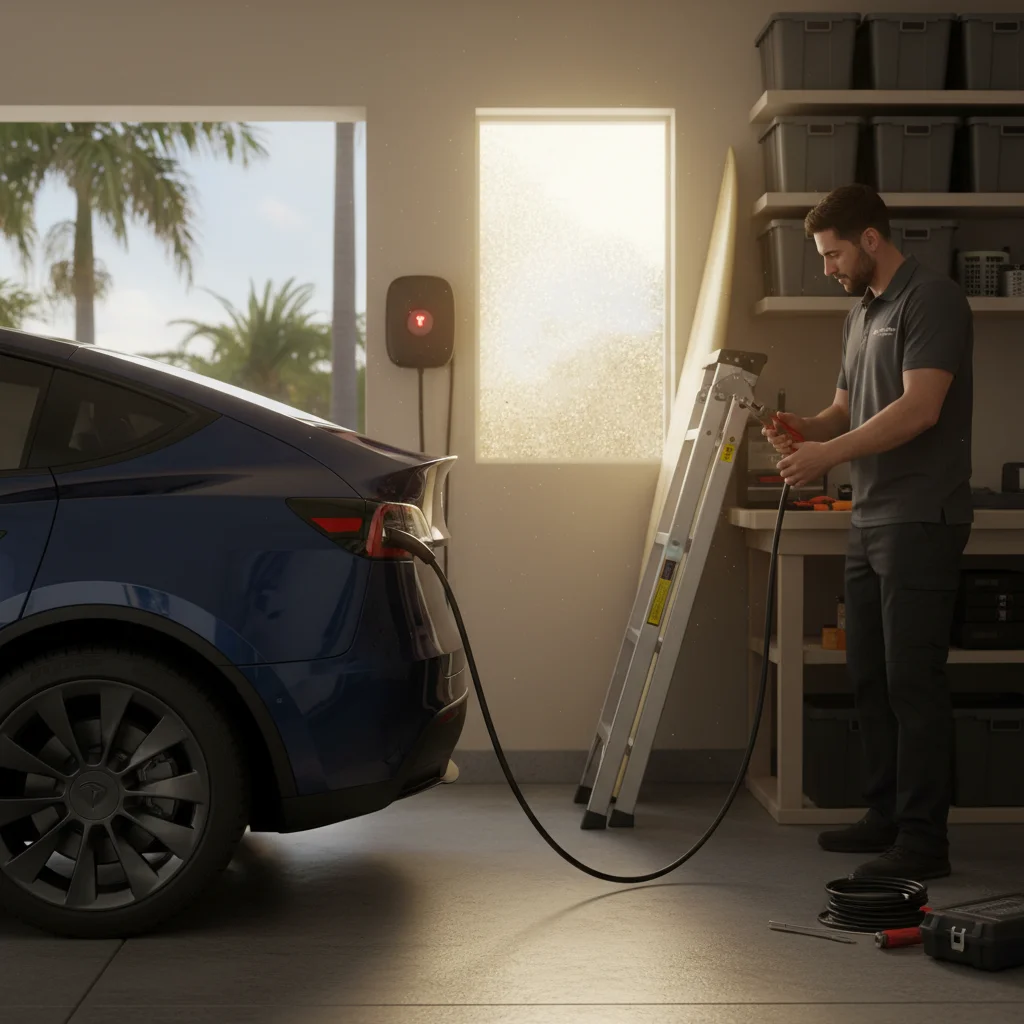
Who actually installs a charger on this side of the state
The operators we connect you with bring a charge to a stranded EV. They don’t assess a house panel or pull a city permit. A hardwired Level 2 unit is electrical work. Hire a licensed Florida electrician for the circuit, the permit, and the inspection. Confirm that license with Florida’s Department of Business and Professional Regulation before anyone opens the panel. Charge Pro MIA doesn’t keep a published installer list. Search your own city, then verify the license yourself.
Florida Power and Light serves essentially all of Miami-Dade and all of Broward. Homestead is the confirmed exception. Parts of that city sit on Homestead Public Services Energy. Other Homestead blocks stay on FPL. Confirm the street at homesteadfl.gov, or call (305) 224-4800. No EV-specific program showed on HPS Energy’s pages when those pages were read. Treat that as an observed absence, not proof that none exists.
FPL EVolution Home is the residential Level 2 install-and-maintain program. Read the live terms on FPL’s site. This page doesn’t publish FPL’s dollar figures. FPL also lists a residential Time-of-Use rate for home charging. Ask FPL for the current tariff. FPL EVolution Make-Ready Credit is the commercial and multifamily infrastructure program. A condo board can ask FPL about that path. Charge Pro MIA doesn’t run those programs. Florida has no state EV purchase rebate.
The City of Miami is one of 34 municipalities in Miami-Dade County. Unincorporated neighborhoods use county building review, not city hall. Broward cities issue their own electrical permits. We couldn’t confirm a single countywide EV-charger form for either county. The building department for that address is who sets the packet.
Condo owners have a statute. HOA lots and rentals don’t
A Coral Gables driveway isn’t a Sunny Isles Beach tower stall. Florida Statute 718.113(8) gives a condominium unit owner a right to add a charging station. The station has to sit inside that owner’s limited common element parking space. The declaration or the board may not prohibit it. The owner pays every cost. The electricity has to sit on a separate or embedded meter in the owner’s name. The work can’t cause irreparable damage. The owner has to provide insurance that names the association. The board may set reasonable architectural and safety standards. The board may also require a licensed installer.
Subsection (9) lets the association install stations on common elements without a unit-owner vote.
There’s no matching statutory right for HOA homeowners under Chapter 720. There’s no matching statutory right for renters under Chapter 83. Those installs depend on the declaration or the lease. If you rent in Hialeah, that condo statute doesn’t copy over. The same limit applies to an HOA lot in Weston. Read 718.113 on flsenate.gov. Then put the request in writing to the association. Confirm the current text with a Florida attorney before you pay a deposit.
Miami Beach is a separate city from Miami, reached only by a causeway. Surfside, Aventura, and Hallandale Beach stack a lot of parking in towers. Hollywood and Fort Lauderdale do the same on the Broward coast. Those stalls are often limited common elements. The statute is about the unit owner’s space, not a random guest stall. Kendall is a census-designated place, not a city. A house there still needs a permit from the jurisdiction that serves that street.
If you’re still on a 120-volt outlet in a tower, start with what a Level 1 EV charger is, and why condo drivers outgrow it.
Older streets and newer west-side houses are different jobs
Census ACS 2019-2023 figures show how old the housing is. North Miami is 82.7% pre-1980. Miami Springs is 89.5%. Hollywood is 74.7%, and Lauderhill is 67.3%. Hialeah is 60.1% pre-1980. Those decades often mean a tight panel and a shared garage feed. Doral is only 5.5% pre-1980. Parkland is 1.7%, and Weston is 7.0%. Newer west-side stock is where a 240-volt wall unit is more common. Age is a hint, not a permit.
A licensed electrician still has to run the load calculation for that address. NEC Article 625 calls for a dedicated circuit on a Level 2 install. Only that electrician can say whether your panel has room. If the panel is short, read panel upgrade for a home charger, or call a mobile plug. Charge Pro MIA doesn’t do that electrical work.
South Florida is flat. Range here is heat, air conditioning, and dwell, not hills. NWS Miami 1991-2020 normals put the July and August average high at 91F. Recurrent Auto’s fleet study of about 30,000 EVs found about 5% range loss at 90F, and about 17 to 18% at 100F. That’s why a dead overnight session can leave you short on a weekday.
What you do tonight when the wall box failed
Start with the car, not a contractor search. Open the charging app and read the last session. Look at the wall unit’s lights. A fault color is a clue, and the manual decodes it. Then look at the breaker that feeds that circuit. A single reset can restore a session. A breaker that trips again is an electrician problem, not a DIY loop. Our note on why your EV charger keeps popping the circuit breaker walks that path.
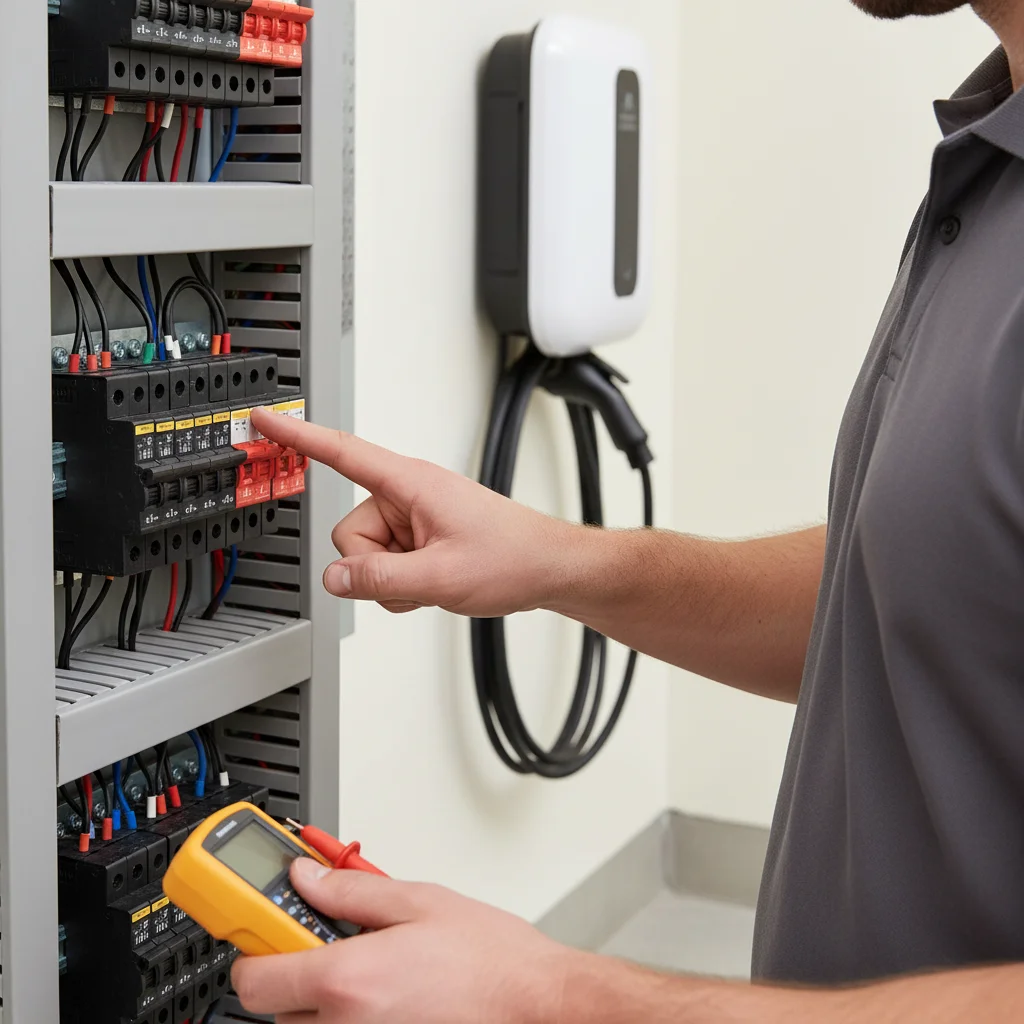
Sometimes the wall box is fine and the car refused the session. The onboard charger can stop a charge to protect the pack. A worn cable, a bent pin, or a wet port can do the same. After a king tide on Miami Beach, water in the port is a stop-and-dry problem first. If you plugged in and woke up empty, read you plugged in overnight and the car still didn’t charge.
A silent car after a long sit may not be an empty pack at all. Heat ages a 12-volt battery. Every roughly 15F rise halves the life of a lead-acid 12V. That’s why a week in a Miami International Airport garage so often looks like a dead EV. The Dolphin, Flamingo, Ibis, and Park 6 garages hold cars after long trips. A jump or an on-site 12V swap is the usual fix there. A new wall connector at home doesn’t wake that car.
If the pack is truly low and you have to leave, a tow is one path. The other path is a charge at the bumper. Mobile EV charging is how we connect you with an independent operator. The operators bring a 240-volt Level 2 source. Tesla takes a native NACS plug. Other EVs take a CCS or J1772 adapter. They typically add 10 to 20 miles of range in 15 to 30 minutes of charging. That’s charging time, never an arrival time. They handle Tesla and every major EV brand. They can also jump or replace a dead 12V on site. The operator quotes you before starting and bills you directly. We don’t set that price. We don’t promise when someone arrives.
Compare that curb plug with a house circuit in 240-volt charging: your home plug versus a mobile rescue. For tower parking in Sunny Isles Beach, the same split applies. The stall is a building problem, and the empty car is a rescue problem.
What to ask an installer before you sign
Ask for the Florida electrical license number, then look it up. DBPR is the state check, not a flyer. Ask who pulls the permit for that exact city or unincorporated street. A quote that skips the permit is a warning. Ask whether they have installed your specific wall unit. A Tesla Wall Connector and a ChargePoint Home Flex aren’t identical. Ask for a written scope that names the circuit, permit, and inspection. Ask what labor warranty they put in writing. This page doesn’t invent a standard term. Ask what insurance they carry, and get proof before work starts. We couldn’t confirm a single statewide bonding rule for this job in the sources used here.
If you own a condo stall, ask how they will meter the electricity in your name. Statute 718.113(8) makes that a condition. Ask how they will avoid damage to common elements. If you rent, or you live under a Chapter 720 HOA, ask in writing first. The electrician can’t create a right the lease doesn’t give.
While you wait for the permanent circuit
A failed wall box is often more than one morning. The electrician’s calendar is theirs, and this page won’t guess it. Some drivers use a mobile top-up at home or at work during that wait. That scope is between you and the operator. Charge Pro MIA only makes the match. The operators we connect you with are licensed and insured. They don’t replace a house panel or sign a building permit.
Who to call for which job
Call a licensed Florida electrician when you want a wall unit installed or repaired. Verify the license, then let that contractor talk to the building department. Call the association in writing when the stall is a condo limited common element. Read 718.113(8) first if you own the unit. If you rent or you sit under an HOA, start with the lease or the declaration. Charge Pro MIA doesn’t do that legal work.
Call us when the car is already low and you need a mobile Level 2 match. We serve South Florida. The matched operator does the physical work. Call (786) 963-2995 and we’ll connect you. The operator quotes you before starting and bills you directly.