EV charging levels only matter once the car is already sitting still. On a South Florida shoulder, the spec sheet is not the decision. The decision is what power can actually reach your port. Then it’s whether that’s enough to roll again.
The chart isn’t the roadside problem
Most explainers start with three boxes: Level 1, Level 2, and DC fast. That’s useful homework before a long drive. It’s less useful when the traction pack is already empty. You’re asking what can plug in where you sit.
South Florida makes that question local. The two counties are flat, so hills don’t steal range. Miami-Dade’s highest natural ground sits around 23 to 24 feet on the Atlantic Coastal Ridge. Broward’s Pine Island Ridge is about 29 feet. Range here is heat, air conditioning, and sitting in traffic.
July and August average highs hit 91F, per NWS Miami normals. A normal year brings about 64 days at or above 90F. Recurrent Auto studied about 30,000 EVs and found about 5% range loss at 90F. The same study found about 17 to 18% loss at 100F. Those figures change how much a short charge actually buys you.
Level 1 is a wall outlet, not a rescue plan
Level 1 is 120-volt AC, the same voltage as a household receptacle. SAE lists about 1.9 kW at the J1772 connector. In round figures it adds about five miles of range per hour. Eight hours can put roughly 40 miles into a midsize EV. Those are planning numbers, not a promise for your car.
A stranded driver rarely has eight quiet hours on a dedicated circuit. Older housing in North Miami, Miami Springs, Hollywood, and Hialeah often predates a 240-volt run. Census figures put pre-1980 stock at 82.7% in North Miami and 89.5% in Miami Springs. Hollywood sits at 74.7%, and Hialeah sits at 60.1%. A travel cord in the frunk does not make a random outlet safe.
Condo drivers who only have Level 1 should read what a Level 1 EV charger is. Don’t treat an unknown receptacle as approved because the prongs fit. Check the manual and confirm the circuit is dedicated.
Level 2 is the charge that comes to you
Level 2 is 240-volt AC at a house. Many commercial buildings supply 208-volt AC instead. The verified power band runs from 2.9 to 19.2 kW. The Department of Energy treats 7.2 kW as the residential standard. That figure is associated with about 25 miles of range per charging hour. Connectors are J1772 for most brands and J3400, also called NACS, on Teslas.
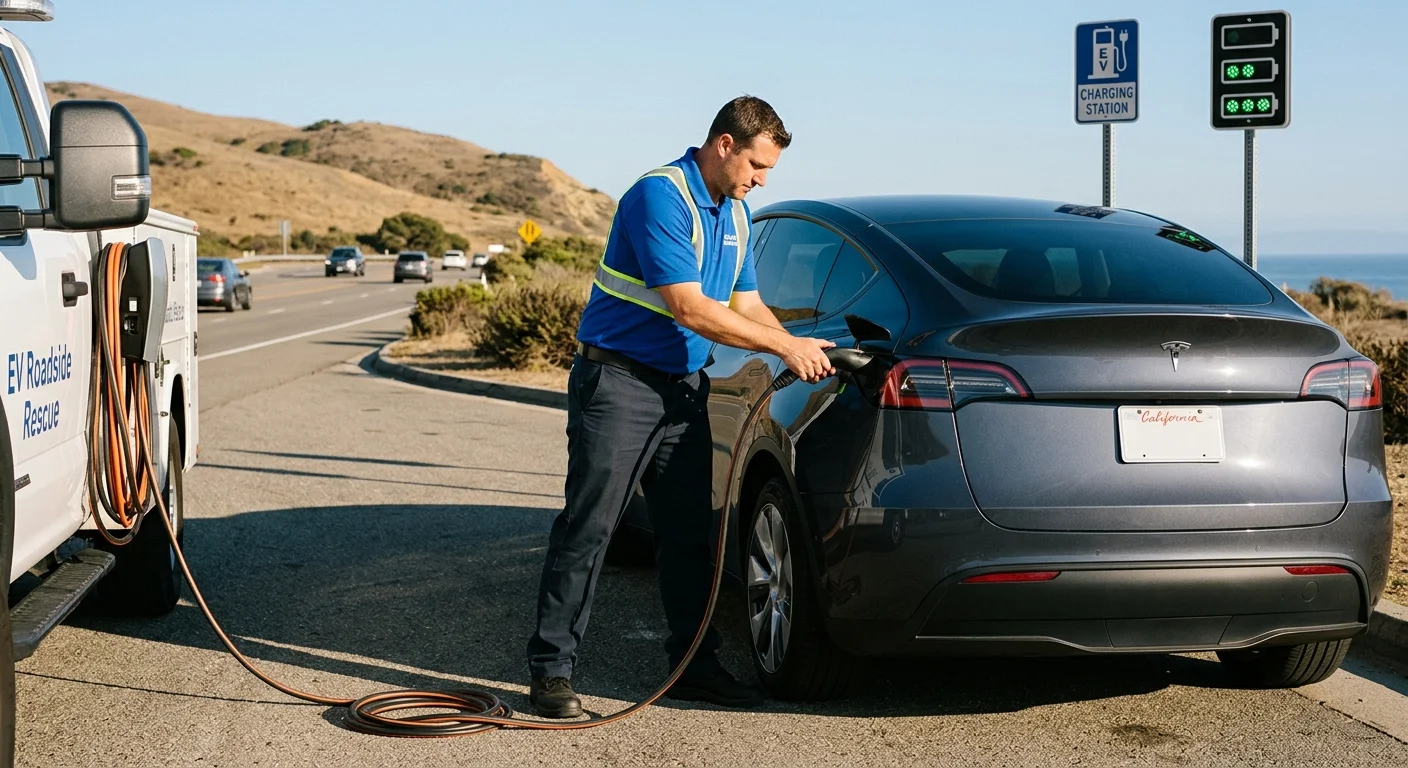
That is also the class of power a mobile rescue typically brings. Charge Pro MIA matches stranded drivers with independent local operators. Those operators bring a 240-volt Level 2 source to the car. They use a native NACS plug on Teslas. They use a CCS or J1772 adapter for other EVs. The typical result is 10 to 20 miles of added range. That takes 15 to 30 minutes of charging time. That clock is time on the plug, not an arrival time.
The goal of that session is not a full battery. It’s enough range to leave the shoulder, the garage, or the lot. From there you drive to a plug you already know. FPL’s EVolution brand is the utility’s public charging network. It covers most of Miami-Dade and Broward. Homestead is the confirmed exception. Homestead Public Services Energy serves parts of that city.
See how a mobile EV charging truck works for that roadside Level 2 visit. Ask the operator to confirm the method and connector before work starts. You pay that operator directly. Charge Pro MIA does not set the price. It does not run the truck.
DC fast charging stays at a site
Drivers often call DC fast charging Level 3. Verified equipment can deliver up to 500 kW. In good conditions it may add 100 to 200-plus miles in 30 minutes. Supported plugs include CCS, CHAdeMO, and J3400. Your car decides how much current it will take.
Fast hardware lives at a fixed site. It does not ride in a van to an I-95 shoulder. It does not set up on a Dolphin Expressway ramp. It also does not set up on a Miami Beach causeway. If the pack is already at zero, you cannot drive there. A mobile EV charging visit is the Level 2 top-up. That’s what makes the next plug reachable. A public DC stall is where you finish. It is not the first move when you’re already stuck.
The DOE Alternative Fuels Data Center keeps the primary specs for these levels. Heat changes the math here more than a hill ever would.
Tell the operator the plug, not just the level
A charging level does not prove the plug will fit. J1772 covers most Level 1 and Level 2 AC ports. J3400 is Tesla’s NACS connector, and it also appears on some DC fast equipment. CCS adds DC pins to an AC inlet. CHAdeMO is a separate DC standard still on some older cars.
Adapters and vehicle support vary by year and trim. Read the manual instead of guessing from a photo. When you request help, name the make and model. Name the port if you know it. An empty traction pack is one problem. A car that will not wake is often the 12-volt battery. That is common after a week in an airport garage.
Miami International’s Dolphin, Flamingo, Ibis, and Park 6 garages are classic 12-volt scenes. So are long-stay lots at PortMiami and Port Everglades. Heat ages a lead-acid 12-volt about twice as fast at 93F versus 77F, per Battery University. A silent car after a cruise or a flight is often a jump. Operators in this metro handle Tesla and every major EV brand. They can jump or replace a dead 12-volt on site.
Where you’re sitting changes what’s practical
Florida Statute 316.194 covers a disabled vehicle on a highway outside a municipality. Leave it off the main-traveled part when that’s practicable. Keep a clear view from 200 feet each way. The statute exempts a genuinely disabled vehicle that cannot be moved. Get out of the travel lane first, then make the call.
FDOT’s Road Ranger Service Patrol can jump-start a vehicle on I-95 and the Palmetto. The same patrol covers I-75, I-195, I-395, and SR-826. They tow a disabled vehicle from the travel lanes to a safe spot. That move is free of charge. Reach them by dialing *FHP (*347) from a mobile phone. Published Road Ranger material does not mention EV charging. A Level 2 charge is not what they bring. A 12-volt jump or a move off the lanes still is.
The Turnpike, the Homestead Extension, and the Sawgrass Expressway are Florida’s Turnpike Enterprise roads. The Greater Miami Expressway Agency now runs the Dolphin and the Don Shula. All of them are all-electronic, SunPass or toll-by-plate only. If you’re on a shoulder there, stay out of live lanes. Do not drag charging gear across traffic.
A Brickell garage is a different access problem. The operator needs the floor and the gate code. Out-of-charge recovery is the path when the car cannot take the operator’s plug. It’s also the path when the scene is not a safe working position. The matched operator decides whether a charge, a 12-volt jump, or a tow fits. Charge Pro MIA does not own trucks. It does not perform the work.
When a charge is the wrong first move
A high kW number does not fix a port that will not latch. It does not wake a car whose 12-volt is dead. It does not help if the vehicle sits where equipment cannot set up. If charging does not start, stop guessing and use the manual. Let the operator compare the car to the gear on the truck.
Towing an EV is model-specific. Don’t invent a loading method from a gas-car habit. Confirm the procedure with the operator who will move the car. For the choice between a plug and a hook, read charge on site or tow. EV charging levels on a chart cannot wake a dead 12-volt.
What to say when you request a match
Give the operator the make, model, year, port, and dash message. Pin the location: city, road, garage name, or mile marker. Mention a gate, standing water, or live traffic. King tides from September through November flood Miami Beach, Hollywood, and Fort Lauderdale’s Las Olas Isles. Do not stand in a flooded lane to wait for a plug.
Start at the Miami-area EV charging hub for the local map. Charge Pro MIA is a referral line. Independent local operators quote you before they start. They bill you directly. Call (786) 963-2995 and we’ll connect you with a local EV rescue operator.