An EV charging truck brings 240-volt Level 2 power to your bumper. You get enough range to move, not a full pack. In South Florida, Charge Pro MIA matches you with an independent operator. That pro shows up with a native NACS plug. A CCS or J1772 adapter covers non-Tesla EVs. They quote you before the cable goes in. Then they bill you directly.
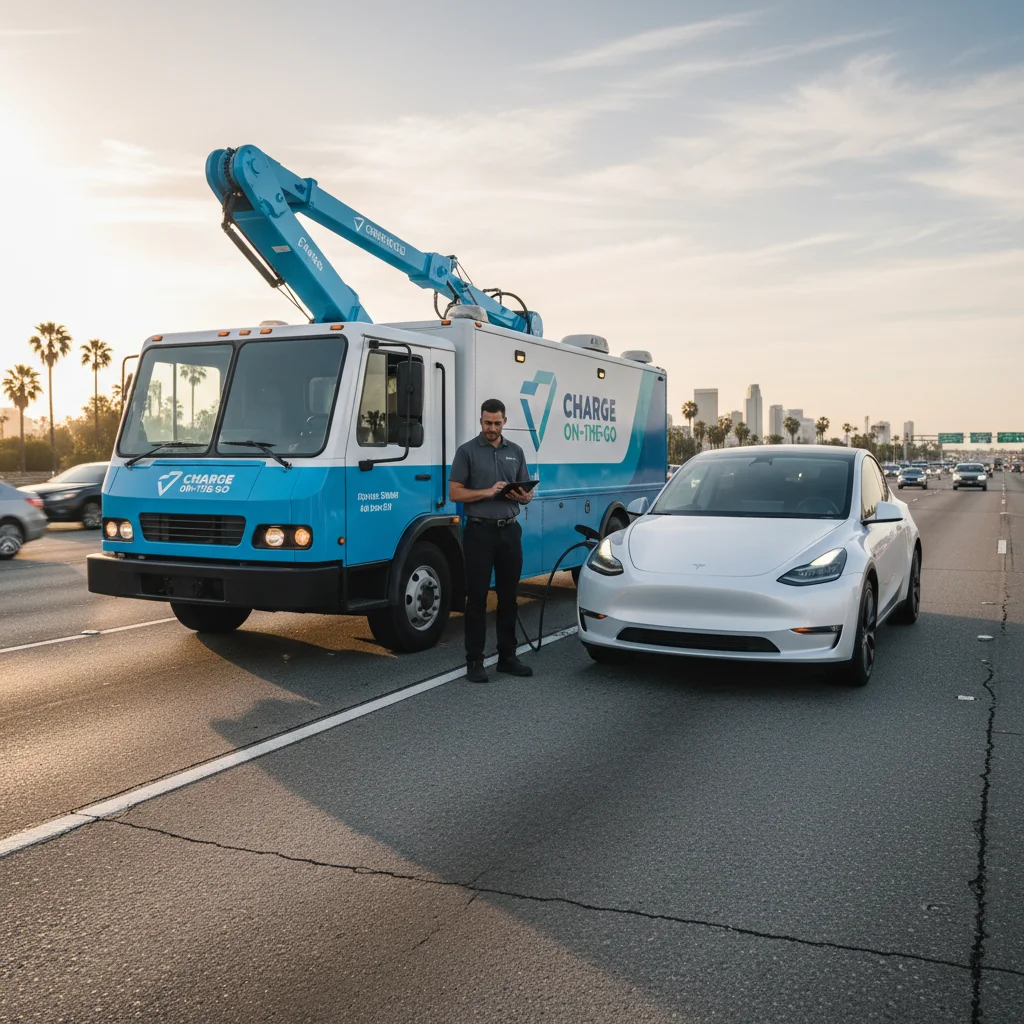
What the truck is doing at your bumper
The truck isn’t a Supercharger on wheels. It’s a 240-volt Level 2 source brought to your car. The operator parks, then opens your charge port. A Tesla takes the native NACS cable. Most other EVs take a CCS or J1772 adapter. Power then flows into the high-voltage pack for a short session.
That session is charging time, never travel time. Operators in this network typically add 10 to 20 miles of range. The charge itself usually runs 15 to 30 minutes. You’re buying an exit, not a refill. Home, a public plug, or a work stall can finish later.
Charge Pro MIA doesn’t own the truck. It doesn’t employ the technician. It’s a referral line for stranded EV drivers. The pros it connects you with are licensed and insured. They hold the gear, and they set the quote.
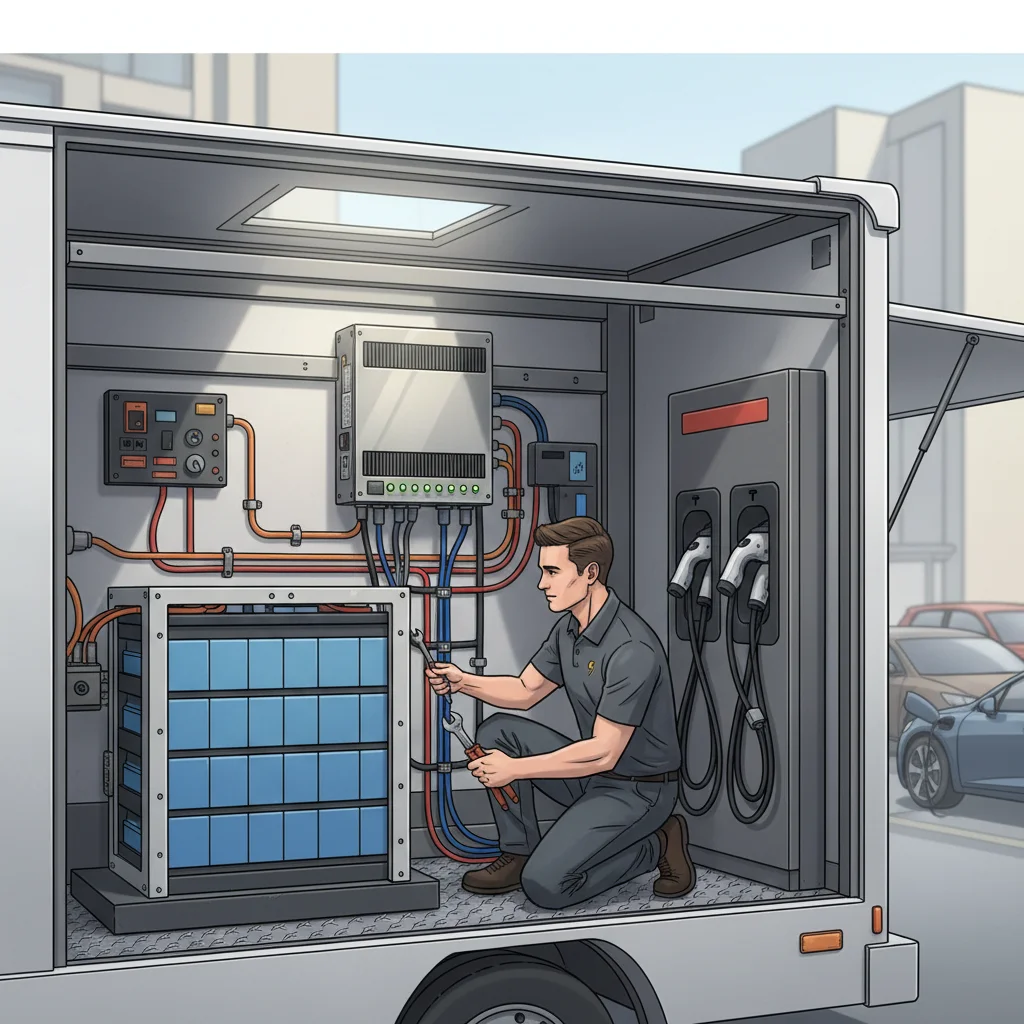
For a closer look at the hardware, see what’s actually on a mobile EV rescue truck.
Why this call is so common in Miami-Dade and Broward
South Florida is flat. Miami-Dade’s Atlantic Coastal Ridge tops out around 23 to 24 feet. Broward’s Pine Island Ridge is about 29 feet. There’s no grade penalty on range in either county. Heat and air conditioning do the damage instead.
NWS Miami normals put July and August highs at 91F. A normal year sees about 64 days at or above 90F. Recurrent Auto studied about 30,000 EVs and found about 5% range loss at 90F. The same work found about 17 to 18% loss at 100F. Cooling a 95-degree cabin can take 3 to 5 kW at first. Holding it cool takes about 1 kW. AAA’s 2019 SAE test found about a 17% range drop at 95F with the AC on.
That’s how a Hialeah errand or a Hard Rock Stadium exit in Miami Gardens goes thin. You still had miles this morning. The cabin soak spent them.
Housing stock matters too. North Miami’s housing is 82.7% pre-1980. Miami Springs sits at 89.5%. Hollywood is 74.7%. Hialeah is 60.1%. Older buildings often can’t take a home Level 2 panel. Those drivers live on public plugs and workplace stalls. Doral, Parkland, and Weston are newer. Their pre-1980 shares are 5.5%, 1.7%, and 7.0%. Even there, a dead pack on I-95 is still a roadside problem.
Florida had about 450,400 registered EVs in 2025, per DOE AFDC data. That’s a state figure, not a county count. Plenty of those cars sit in Miami-Dade and Broward condos. The nightly plug is often a shared garage stall.
Level 2 on the curb, not a full DC fill
If you want the voltage story, read EV charging levels when you’re already stranded. Level 1 is a wall outlet. Level 2 is 240 volts. DC fast charging is a different class of hardware. The operators in this network bring Level 2.
That’s enough for the job. You don’t need 80% to leave a shoulder on the Palmetto Expressway. You need a legal exit and a working car. Florida Statute 316.194 covers a vehicle stopped outside a municipality. Leave it off the main-traveled part where you can. Leave room for passing traffic. Keep a clear view from 200 feet each way. A genuinely disabled vehicle that can’t move is exempt under 316.194(2). A short charge is how you stop being that vehicle.
The plugs operators actually carry
NACS is Tesla’s connector. Ford, GM, Rivian, and others now use it on newer models. Operators bring a native NACS cable for those ports.
CCS is still common on Hyundai, Kia, Volkswagen, Porsche, BMW, and Chevrolet. J1772 is the North American AC inlet on those same cars. Operators bring a CCS or J1772 adapter. A Bolt, Ioniq 5, or Mach-E can take the same 240-volt feed.
You don’t need to pick the adapter. You need to say what you drive. The operator matches the port. Mobile EV charging is the name for that visit. Out of charge recovery is the same idea when the pack is already at zero.
Who quotes you, and what a Road Ranger still does
Charge Pro MIA doesn’t set the rate. The operator quotes you before work starts. You accept, or you don’t. They bill you directly.
That quote isn’t published here, because it isn’t a brand fee. For the process in plain words, see who sets the price when you need a mobile EV charge.
A Road Ranger is a different call. FDOT’s Road Ranger Service Patrol is free on the highways they cover. They jump-start vehicles and handle minor repairs. They change flats and provide gas, diesel, and water. They also tow a disabled vehicle from the travel lanes to the nearest safe spot. Dial *FHP, which is *347, from a mobile phone. Florida Highway Patrol takes the same short code for disabled-motorist reports.
District 6 covers Miami-Dade on I-95 and 95 Express. It also covers I-195, I-395, I-75, 75 Express, and SR-826, the Palmetto. District 4 covers Broward’s I-95 from the Miami-Dade line north. It also covers portions of I-595 and I-75. Road Ranger pages don’t mention EV charging. They still help a dead car that needs a 12-volt jump. They still pull you off a travel lane. The Level 2 top-up is what the mobile operator adds once you’re out of traffic.
Florida 511 at FL511.com is FDOT’s traffic feed in English and Spanish. Use it if the Turnpike, the Homestead Extension, or the Sawgrass Expressway is stacked. GMX now runs the old MDX roads. Those are SR-112, the Dolphin (SR-836), the Don Shula (SR-874), Snapper Creek (SR-878), and the Gratigny (SR-924). Those roads are all-electronic. SunPass or toll-by-plate is the only way through. None of them takes cash.
Shoulder, garage, airport, and cruise lot
A stall on I-95 through Fort Lauderdale isn’t the same as a stall in a Brickell garage. On a limited-access road, get off the travel lane if you can. Put the hazards on, then call. Don’t walk the corridor looking for a plug.
In a condo or mall garage, stay with the car if the lot is safe. Give a mall name if that’s where you sat. Aventura Mall, Dadeland Mall in Kendall, Sawgrass Mills in Sunrise, and Dolphin Mall near Doral all work. So does Brickell City Centre. Kendall is a census-designated place, not a city. Say the garage level and the nearest ramp.
Miami International Airport is a 12-volt story as often as a pack story. The Dolphin Garage serves the North Terminal. The Flamingo Garage serves the Central Terminal. The Ibis Garage is the one the airport page lists with ChargePoint EV ports. Park 6 is the new long-term garage, opened summer 2026, with EV charging on site. After a week in those structures, many EVs won’t wake. Heat aged the 12-volt battery that keeps modules alive. Battery University notes that every roughly 15F rise halves lead-acid life. It ages about twice as fast at 93F versus 77F. At 111F it ages about four times as fast. The main pack can still hold range. The car just won’t boot.
PortMiami and Port Everglades see the same sit-and-drain pattern after a cruise. Northside and southside PortMiami garages hold cars for days. So do the Heron and Palm garages at Port Everglades. Confirm current parking rules with the port before you leave. If the dash is dark, ask for a 12-volt check first.
FPL serves essentially all of Miami-Dade and all of Broward. Homestead is the exception. Homestead Public Services Energy serves some streets, and FPL serves others. Confirm your utility at homesteadfl.gov or (305) 224-4800. FPL EVolution is the utility’s public charging brand. FPL EVolution Home is the residential Level 2 program. Neither one replaces a truck at your bumper tonight.
When a truck is the wrong tool
If the car is silent and the doors won’t release, start with the 12-volt. A charge cable won’t wake a module that has no low-voltage power. If floodwater reached the pack, stop. NHTSA warns residual salt can short a lithium battery days later. Don’t drive or charge a flood-exposed EV until it’s inspected. Keep it at least 50 feet from a structure. Hurricane season runs June 1 to November 30. FPL tells owners to hold the pack between 50 and 80 percent. Unplug during the storm. Skip charging after a flood.
King tides run mainly September through November. They last about three hours. Miami Beach, the Las Olas Isles in Fort Lauderdale, and Hollywood’s low streets take the water. A wet charge port is a dry-and-inspect job. Don’t force the plug.
If you need the tow-versus-charge split, read do you need a mobile charge, or a tow. Private-property tows follow Florida Statute 715.07. Miami-Dade caps non-consent rates under Code Section 30-476. Broward uses Code Section 20-176.22. Don’t guess the dollar cap. Ask the yard and the county page before you pay.
The University of Miami’s main campus is in Coral Gables, not the City of Miami. FIU’s Modesto Maidique Campus sits in the Sweetwater and Tamiami area. Nova Southeastern’s main campus is in Davie. Campus lots fill on class days. A dead EV there is a parking problem first. Tell the line the garage name, not just the school.
How to get an operator on the way
Say where you are. A cross-street in Coral Gables works. So does an I-95 exit in Hollywood. So does a pin from your phone. Name the car. A Tesla, a Rivian, an Ioniq, or a delivery van in Doral can each need a different adapter. Leave a callback number.
Charge Pro MIA matches that request to an independent local operator. The operator calls you, quotes the job, and bills you if you agree. This site doesn’t publish an arrival window. Traffic on the Palmetto can change the clock. So can a summer cell from about 2pm to 6pm. So can a stadium let-out at Hard Rock Stadium.
Coverage runs across Miami-Dade and Broward. That includes the City of Miami and the other municipalities. It also includes CDPs like Tamiami, Westchester, and The Hammocks. It doesn’t include Monroe County or Palm Beach County. Deerfield Beach and Parkland sit on that northern line. Stay inside it.
For the metro map, start at EV charging across Miami and South Florida.
If you’re already stuck, call (786) 963-2995. Tell the line your location, your car, and a number that rings. An operator quotes you before any cable goes in.