A dead EV on a South Florida shoulder is two different jobs. One is an empty traction pack. July heat and cabin AC can drain it on a slow I-95 crawl. The other is a 12-volt battery that gave up in a long-term garage. Operators in this network roll with a mobile EV charger truck built for both. The truck brings a 240V Level 2 source to the car. It carries a native NACS plug, plus CCS or J1772 adapters for everyone else. It also carries the gear to jump or replace a dead 12V on site.
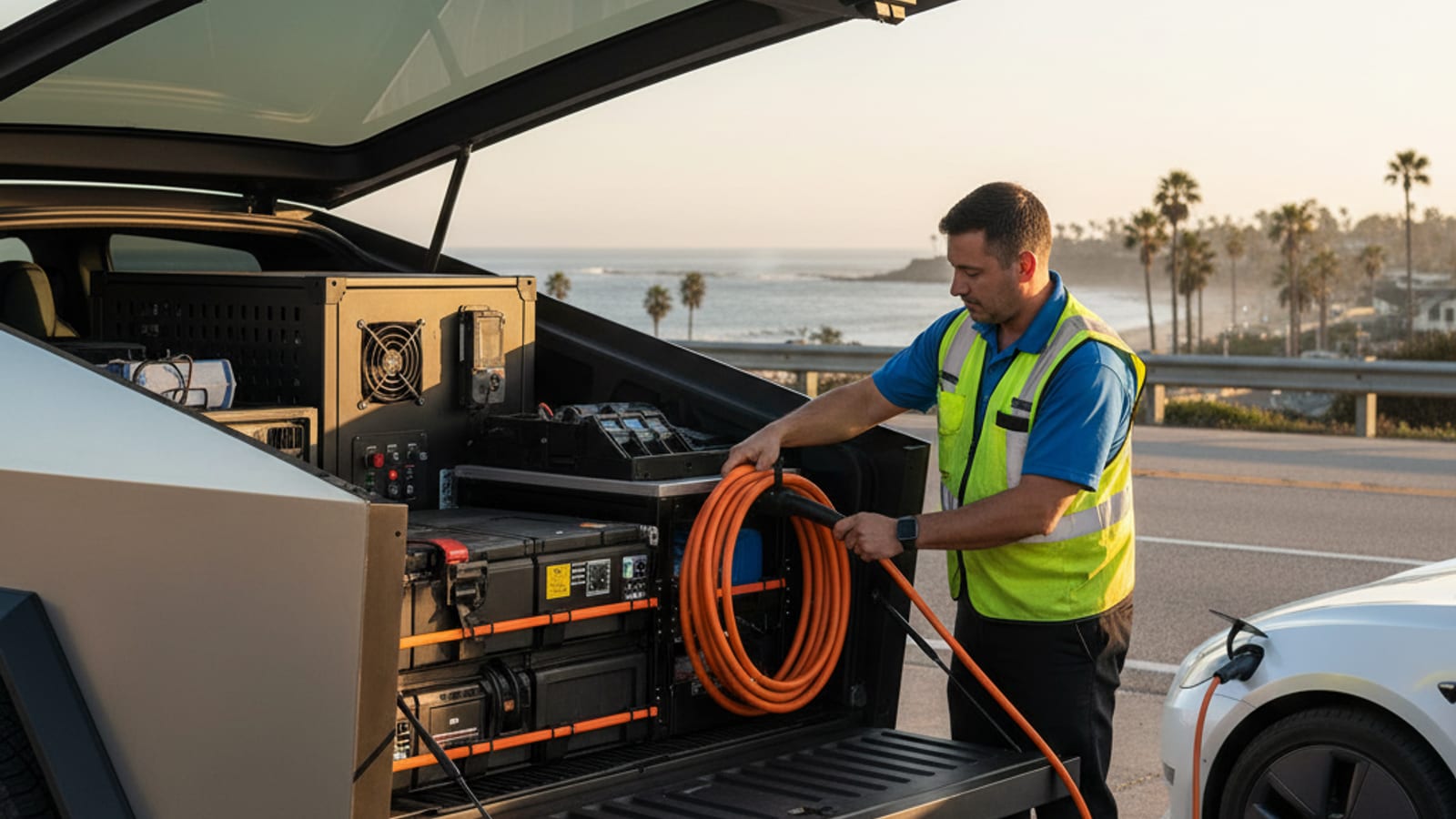
The kit on a mobile EV charger truck
People picture a wrecker. That’s the wrong picture. A mobile EV charger truck is a service vehicle with its own power. The hook isn’t the main tool. Independent operators bring that power to you. Charge Pro MIA doesn’t own the trucks, the inverters, or the adapters. It’s a referral line. It matches a stranded driver with a local operator. That operator quotes before any work starts, then bills you directly.
What matters is the bed, not the badge on the door. You want a 240-volt Level 2 feed. You want the right plug for your port. You want a 12-volt jump if the car won’t even wake. That’s the whole job in plain terms. The rest of this page walks through each piece.
The operators we connect you with handle Tesla and every major EV brand. A Model 3 in Brickell uses NACS. A Hyundai Ioniq 5 in Hialeah doesn’t. They aren’t different kinds of rescue. The same truck can serve both if the adapters are on board.
A 240V Level 2 source, not a wall outlet from home
Level 2 is the language of a real home charger. It’s 240 volts. It isn’t the 120-volt trickle from a household outlet. A mobile EV charger truck brings that 240V feed to wherever you stopped. The point isn’t a full pack. The point is enough range to drive.
Operators typically add 10 to 20 miles of range. That takes 15 to 30 minutes of charging. That window is charging time. It isn’t an arrival time. Nobody can promise when the truck gets there. Traffic on I-95, the Dolphin Expressway, or the Turnpike changes every hour. The operator can tell you how long the plug stays in. That’s after they’re already hooked up.
Ten to twenty miles is usually enough to leave a shoulder. It’s enough to get off Florida’s Turnpike or the Homestead Extension. Then you can sit somewhere and finish a real charge. It’s enough to get home on many inner-metro trips. It isn’t a fill-up. If you want the levels spelled out in more detail, read EV charging levels when you’re already stranded.
South Florida doesn’t steal range with hills. The two counties are flat. Miami-Dade’s highest natural point is the Atlantic Coastal Ridge, about 23 to 24 feet. Broward’s is Pine Island Ridge, about 29 feet. Range here is heat, air conditioning, and time sitting in traffic. NWS Miami normals put July and August average highs at 91F. A normal year sees about 64 days at or above 90F. Recurrent Auto’s fleet study of about 30,000 EVs finds about 5% range loss at 90F. It finds about 17 to 18% at 100F. AAA’s 2019 SAE-standard test found about a 17% range drop at 95F with the AC on. That’s why a short Level 2 top-up on a hot afternoon is a common call. The cabin cooling load is real. Recurrent Auto notes the first minutes of AC are the expensive ones.
Native NACS, then CCS or J1772 for everyone else
Tesla’s port is NACS. Operators bring a native NACS plug for those cars. Most other brands still show up with CCS. Some older cars, including many Nissan Leafs, use J1772 for AC charging. The truck is supposed to cover that spread. Native NACS for Tesla. A CCS or J1772 adapter for non-Tesla EVs. That’s the compatibility story, not a pile of mystery cables.
If you drive something other than a Tesla, say so on the call. A Kia EV6 and a Ford Mustang Mach-E don’t share one inlet. A Rivian and a Chevy Equinox EV don’t either. The operator still comes with the adapters. The non-Tesla EV rescue page is the right place if you want that path in one spot.
Don’t assume a public post will save you in the moment. A cable that won’t unlatch is a different problem than an empty pack. So is a car that won’t wake. The truck’s job is to bring a known 240V source and the plug that fits. For the service itself, see mobile EV charging.
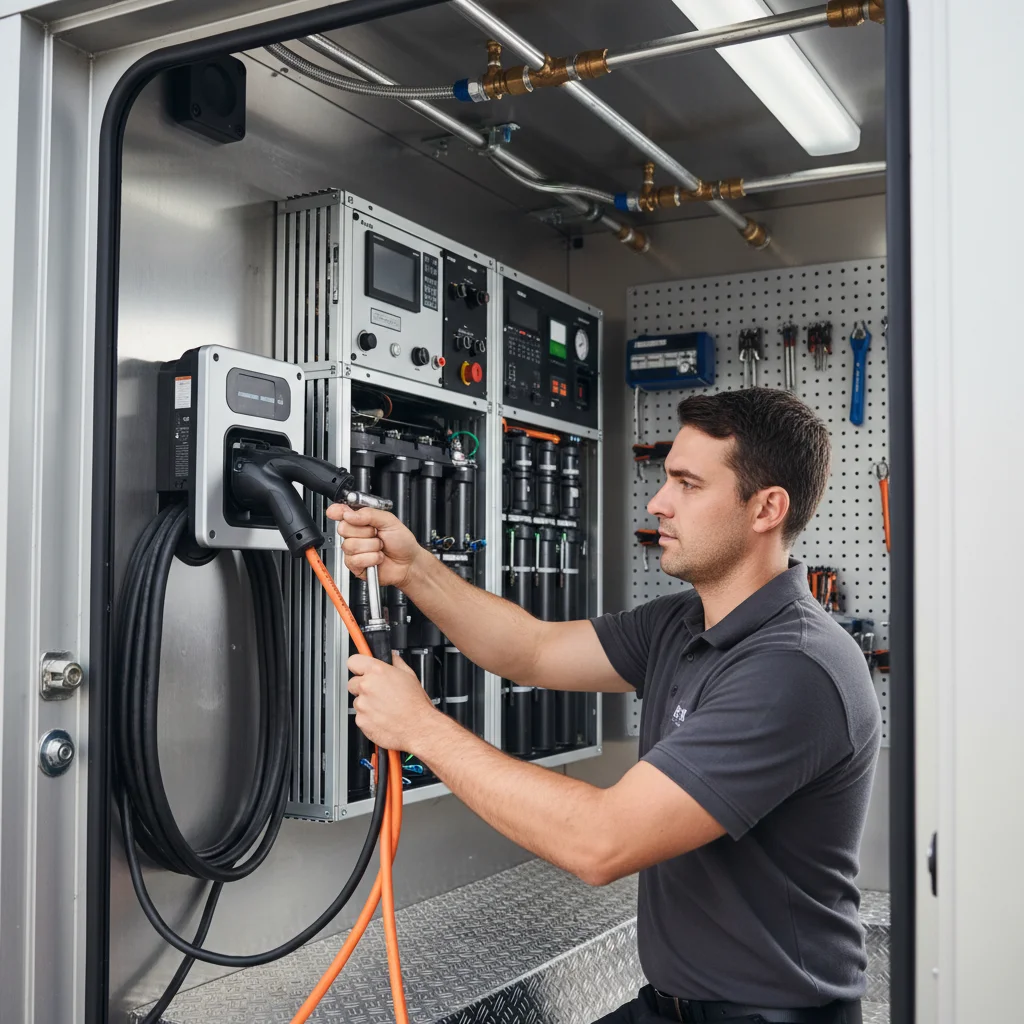
The 12V kit isn’t a side note
A lot of dead-EV calls in this metro aren’t empty packs. They’re 12-volt failures. Every EV still uses a small 12V battery to wake computers, locks, and contactors. When that battery dies, the car looks fully dead. Lights stay off. The app may not connect. The charge port may not open. The high-voltage pack can still have plenty of range.
Airport and cruise parking make this worse. A week in MIA parking is a long sit. The Dolphin Garage serves the North Terminal. The Flamingo Garage serves the Central Terminal. The Ibis Garage and the new Park 6 long-term garage are the other public options. Cars come back silent because the 12V kept systems alive. Heat finishes the job. Battery University notes that every roughly 15F rise in temperature halves the life of a lead-acid battery. It ages about twice as fast at 93F versus 77F. It ages about four times as fast at 111F. Heat damage doesn’t reverse. South Florida’s sustained heat is why so many EVs won’t wake after sitting.
The Ibis Garage page says it holds ChargePoint EV ports across its levels. Park 6, which opened in summer 2026, has EV charging on site. That doesn’t fix a 12V that already died in the stall. You can’t plug in a car that won’t wake. Operators jump or replace that 12V on site. That’s often the whole rescue. No flatbed. No Level 2 session. Just a wake-up so you can drive out of the garage.
The same pattern shows up after a cruise. PortMiami parking includes the northside and southside garages, plus surface Lot E. Port Everglades uses the Heron and Palm garages and surface lots. A week at the dock is a long sit in heat. If the car is silent when you get back, think 12V first.
For Tesla-specific 12V work, the Tesla 12V battery jump service is the matching page. The truck still matters. The operator still has to reach you in a garage, a condo deck, or a surface lot.
How an on-site stop actually runs
You call. You give a location and a model. It might be Brickell City Centre or a condo on Miami Beach. It might be a shoulder on I-595. It might be a lot at Hard Rock Stadium in Miami Gardens. Dadeland Mall, Aventura Mall, and Sawgrass Mills in Sunrise are the same idea. The more precise you are, the less time the operator spends hunting a garage level.
Charge Pro MIA passes the request to an independent operator. That operator confirms the work and the quote with you. Nothing starts until you agree. Florida is an all-party consent state under Florida Statute 934.03. Recorded-line notices matter on the phone. That’s a legal fact, not a slogan.
If you’re on a highway, move off the travel lane when you can. Florida Statute 316.194 says a vehicle outside a municipality should sit off the main-traveled part where practicable. Leave room for passing traffic. Leave a clear view from 200 feet each way. A genuinely disabled vehicle that can’t be moved is exempt under 316.194(2). Hazards on. Stay in the car if the shoulder is narrow. On I-95, 95 Express, I-195, I-395, I-75, 75 Express, or SR-826, dial *FHP. That’s *347. It reaches Florida Highway Patrol and Road Rangers.
Once the operator is with you, they check the pack against the 12V. If the car is awake and empty, they connect Level 2. Native NACS, or a CCS or J1772 adapter. Charging runs 15 to 30 minutes in a typical stop. You leave with 10 to 20 miles. If the car is dark, they treat the 12V first. A jump can be enough. A replacement on site is sometimes the cleaner fix. Then you decide whether you still need range.
If the better move is a tow instead of a charge, say so early. A separate comparison is here: Do you need a mobile charge, or a tow off the shoulder?.
Road Rangers bring a jump and a tow, not Level 2
Florida’s Road Ranger Service Patrol is free. FDOT runs it. Rangers jump-start vehicles, make minor repairs, and change flats. They provide gas, diesel, and water. They also tow a disabled vehicle from the travel lanes to the nearest safe location. Reach them at *FHP (*347). District 6 covers Miami-Dade and those core expressways. District 4 covers Broward’s I-95 corridor from the Miami-Dade line north. It also covers portions of I-595 and I-75.
No Road Ranger material we could verify mentions electric vehicles or EV charging. That’s an observed absence, not a claim they refuse EVs. A dead EV still needs a 12V jump or a tow off the travel lane. Rangers do both of those jobs. A 240V Level 2 charge isn’t in that published toolkit. That’s the job a mobile EV charger truck is for.
Toll roads here are all-electronic. Florida’s Turnpike, the Homestead Extension, and the Sawgrass Expressway sit under Florida’s Turnpike Enterprise. 95 Express and 595 Express are FDOT. The Greater Miami Expressway Agency runs SR-112 and SR-836, the Dolphin, plus SR-874, SR-878, and SR-924. SunPass or toll-by-plate. No cash. Get to a safe spot first. Then the truck can add range.
Why this kit matches driving here
Florida had about 450,400 registered EVs in 2025, per DOE AFDC vehicle-registration data. Miami Beach is its own city, reached only by causeway. Key Biscayne, Surfside, and Sunny Isles Beach share that geography. You don’t casually wander to another neighborhood when the car is dead. Hollywood, Florida is in Broward. Fort Lauderdale, Pembroke Pines, Miramar, and Coral Springs make up much of Broward’s EV traffic.
Many drivers never get a home Level 2. FPL serves essentially all of Miami-Dade and all of Broward. Homestead is the exception. Homestead Public Services Energy covers some streets there, and FPL covers others. Residents confirm the boundary with the city. None of that helps you on a shoulder tonight.
Game and event days add dwell. Hard Rock Stadium in Miami Gardens hosts the Dolphins, the Hurricanes, the Miami Open, and the F1 Miami Grand Prix. Kaseya Center is the downtown NBA arena. Don’t call it the American Airlines Arena or the FTX Arena. Those names are gone. loanDepot park in Little Havana, lowercase p, is the Marlins. A long sit in heat is a 12V candidate as much as a range candidate.
King tides run mainly September through November and last about three hours. They hit Miami Beach, Fort Lauderdale’s Las Olas Isles, and Hollywood. NHTSA warns that residual salt in a flooded lithium pack can cause fires days or weeks later. A flood-exposed EV shouldn’t be charged or driven until it’s inspected. Don’t ask a mobile EV charger truck to power a car that took on saltwater.
What you won’t find in the bed
The truck isn’t a Supercharger on wheels. It’s Level 2. It won’t match DC fast charging. It isn’t a mobile mechanic shop. It won’t diagnose a failed onboard charger or a high-voltage pack fault. It isn’t a guaranteed unlock service for every locked Tesla. A 12V jump often brings the systems back.
The operator doesn’t set Charge Pro MIA prices, because Charge Pro MIA doesn’t set prices. The operator quotes you. Ask what’s included before they unroll cable. Ask whether the stop is a Level 2 top-up, a 12V jump, a 12V replacement, or a recommendation to tow.
A small portable charger in your trunk also isn’t this truck. Those units are usually Level 1, 120 volts. They drip range over hours. They need a working household outlet. A condo hallway, a highway shoulder, and a garage stairwell don’t offer that outlet. The mobile EV charger truck carries its own 240V source. That’s the difference.
If you want the near-me version of the same service question, use how to get mobile EV charging near you in South Florida.
When to call
If the car is awake and the range is gone, you want Level 2 on site. If the car is silent after parking, you want the 12V kit. If you’re in a travel lane, you want off that lane first, then the right truck. Charge Pro MIA matches you with an independent operator for that work. Call (786) 963-2995 when you’re ready to request the match.
Frequently asked questions
What does a mobile EV charger truck carry for Tesla and other brands?
A native NACS plug for Tesla, plus CCS or J1772 adapters for other EVs. The same 240V Level 2 source feeds whichever inlet fits.
How much range does the Level 2 stop add?
Operators typically add 10 to 20 miles in 15 to 30 minutes of charging. That’s plug time, not travel time to you.
Can the same truck fix a car that won’t wake?
Often, yes, if the 12V is the failure. Operators jump or replace that battery on site. An empty pack is a different job, and they charge it instead.