Searching “mobile EV charging near me” in South Florida is a request for a truck, not a map pin. You want 240V brought to the car you’re already sitting in. Charge Pro MIA is a referral line for that moment. We match stranded drivers with independent local operators. The operator quotes before starting and bills you directly.
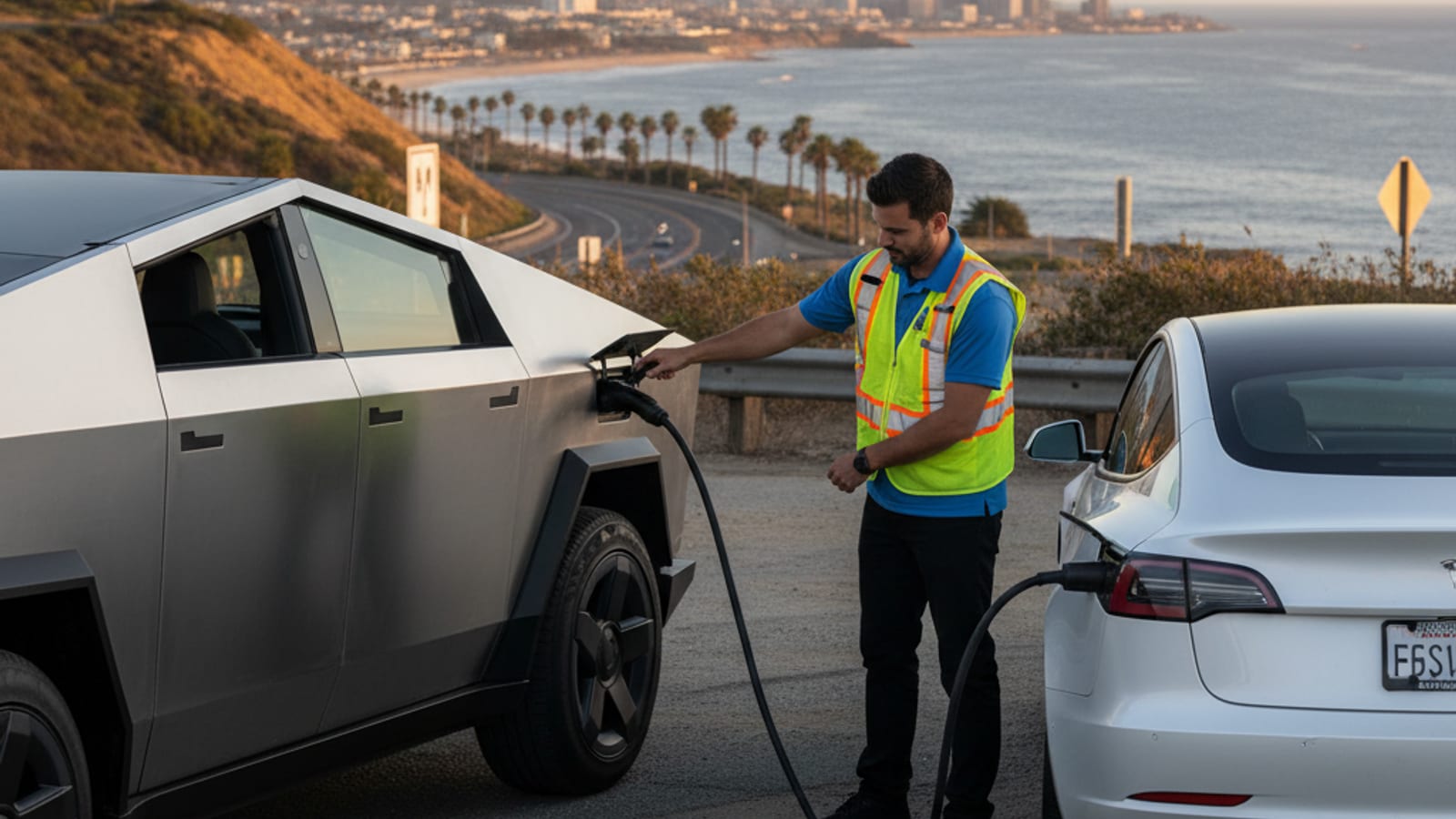
What that search is actually asking for
A public plug is a place you still have to reach. A mobile charge is the inverse. An independent operator drives a 240V Level 2 source to your pin. Teslas take a native NACS plug. Other EVs take a CCS or J1772 adapter. The job is a top-up, not a full pack. Fifteen to thirty minutes of charging typically adds 10 to 20 miles. That figure is time on the cable. It is never a promise of when someone arrives.
The line does not own trucks. It does not employ technicians. It does not set prices. The person who shows up is an independent operator. You hire that operator. We make the match. If you want the service page first, it’s mobile EV charging. City pages sit under EV charging across Miami-Dade and Broward.
Heat empties a pack here, not hills
This metro is flat. Miami-Dade’s Atlantic Coastal Ridge tops out around 23 to 24 feet. Broward’s Pine Island Ridge is about 29 feet. There is no grade penalty on range in either county. Heat does the work that mountains do elsewhere.
NWS Miami normals put July and August highs at 91F. A normal year sees about 64 days at or above 90F. Recurrent Auto’s study of about 30,000 EVs found about 5% range loss at 90F. At 100F the loss was about 17 to 18%. Cooling a 95-degree cabin can take 3 to 5 kW at first. Holding it cool takes about 1 kW. AAA’s 2019 SAE-standard test found about a 17% range drop at 95F with the AC on. The first minutes of air conditioning are the expensive ones. Summer storms from about 2pm to 6pm then add stop-and-go on I-95, the Palmetto, and the Dolphin.
Housing stock splits the metro in half. North Miami is 82.7% pre-1980. Miami Springs is 89.5%. Hollywood is 74.7%. Hialeah is 60.1%. Lauderhill is 67.3%. A lot of those buildings never got a 240V drop. Doral, Parkland, and Weston skew new, and home charging is common there. The Hialeah walk-up driver and the Weston driveway driver are not living the same charging life. Both still stall when a day runs long.
Causeways finish the trap. Miami Beach is its own city, reached only by causeway. South Beach is a neighborhood of that city, not a separate town. Key Biscayne sits in Storm Surge Zone A. Once you’re on the span, you finish the trip or you sit. You don’t wander off mid-causeway for a building outlet.
The stall that isn’t an empty pack
A lot of “dead EV” calls after a trip are the 12-volt battery. Miami International’s Dolphin, Flamingo, and Ibis garages hold cars for a week or two. So does the new Park 6 long-term garage, which opened in summer 2026. The Ibis Garage holds ChargePoint ports across its levels. Park 6 has EV charging on site. None of that helps a 12V that died keeping systems alive while you were gone. PortMiami’s northside Garages A through G and southside Garages J and K do the same job for cruise week. Port Everglades uses the Heron and Palm garages. You come back, the screens are dark, and the traction pack still has range.
Every roughly 15F rise halves lead-acid 12V life. It ages about twice as fast at 93F, and four times as fast at 111F, versus 77F. Heat damage does not reverse. That’s the airport and cruise pattern in this climate. Operators we match you with can jump or replace a dead 12V on site. They handle Tesla and every major EV brand. If the car is silent but you had range yesterday, read what happens when an EV’s 12-volt dies in this climate before you ask for a flatbed.
Secondary fields produce the same sitting-car problem. Miami Executive (TMB), Miami-Opa Locka Executive (OPF), Fort Lauderdale Executive (FXE), and North Perry (HWO) in Pembroke Pines all leave cars parked in heat. The mechanism is the same as MIA. It is a 12V, not a pack at zero.
Where the call usually comes from
It isn’t one kind of street.
Downtown after a night at Kaseya Center, the Heat’s current arena name. Don’t call it the old airline arena. Don’t call it FTX. Little Havana after a Marlins game at loanDepot park, lowercase p. Miami Gardens after the Dolphins, the Hurricanes, the Miami Open, or F1 at Hard Rock Stadium. FIFA will call that venue Miami Stadium in 2026. There is no Fort Lauderdale F1 race. Mall lots at Aventura Mall, Dadeland Mall in Kendall, Sawgrass Mills in Sunrise, Dolphin Mall near Doral, and Brickell City Centre. Warehouse and airport-belt streets in Doral. Campus loops around the University of Miami in Coral Gables, not in the City of Miami. FIU’s Modesto Maidique Campus sits in the Sweetwater and Tamiami area. Nova Southeastern’s main campus is in Davie.
Kendall, Tamiami, The Hammocks, Westchester, and Kendale Lakes are census-designated places. They have no mayor. Treat them as real streets with real pins, not as cities. The City of Miami is one of 34 municipalities in Miami-Dade. Most of what people call Miami is unincorporated county or another city.
Expressways are their own problem. Florida’s Turnpike, the Homestead Extension, and the Sawgrass Expressway are Florida’s Turnpike Enterprise roads. 95 Express and 595 Express are FDOT. The Greater Miami Expressway Agency now runs SR-112, SR-836 (the Dolphin), SR-874 (Don Shula), SR-878 (Snapper Creek), and SR-924 (the Gratigny). All of them are all-electronic. SunPass or toll-by-plate. No cash booth to idle in. If you stop, you stop on a shoulder or you make an exit.
Florida Statute 316.194 says a vehicle outside a municipality must sit off the main-traveled part where practicable. A genuinely disabled vehicle that can’t be moved is exempt. Hazards on. Stay out of the travel lane. If you’re already on the Palmetto, out of charge on the Palmetto Expressway is the shoulder walkthrough.
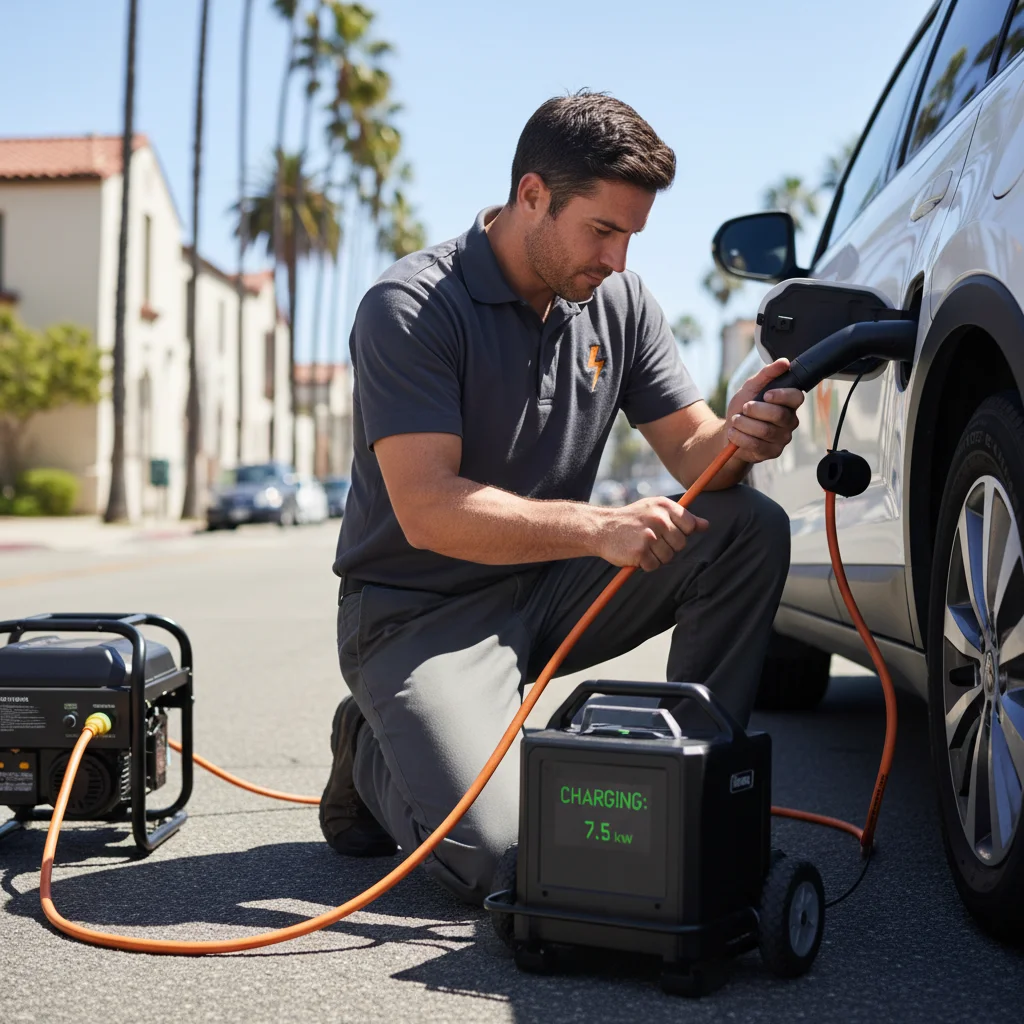
What to do before you call a charging truck
Get the car out of moving traffic if you can. Hazards on. Stay in the vehicle if that is the safer choice. Exit on the side away from traffic if you must get out.
On a limited-access road, Florida’s Road Ranger Service Patrol is the free highway patrol run by FDOT. They jump-start vehicles, do minor repairs, change flats, and tow a disabled vehicle from the travel lanes to the nearest safe spot. Dial *FHP (*347) from a mobile phone. District 6 covers Miami-Dade on I-95, 95 Express, I-195, I-395, I-75, 75 Express, and SR-826. District 4 covers Broward’s I-95 from the county line north, plus portions of I-595 and I-75. Road Ranger materials don’t describe EV charging. A 12V jump or a move off the lane is still in their toolkit. A Level 2 charge is not. That last piece is what a mobile operator handles.
Florida Highway Patrol takes disabled-motorist reports on the same *FHP short code. Florida 511 at FL511.com is the state’s traffic feed, in English and Spanish. Use it if you stalled because of a backup.
Private lots are a different risk. Florida Statute 715.07 governs non-consent tows. If you appear before the car is fully removed, the operator must stop and return it on payment of no more than half the posted tow rate. The lot needs a proper tow-away sign at each access, posted at least 24 hours ahead, with exceptions for a single-family home or personal notice. The car must be stored within a 10-mile radius in a county of 500,000 or more. Both of our counties qualify. Miami-Dade caps those rates in Code Section 30-476. Broward caps them in Code Section 20-176.22. Don’t wait in a marked tow-away stall hoping the next garage level solves it. If the car is silent, treat it as disabled and get help on the spot.
What the operator actually does
The truck is not a Supercharger on wheels. It’s a 240V Level 2 source. Native NACS for Tesla. CCS or J1772 for almost everything else. The operator connects, adds enough range to reach a charger you choose or to get home, then disconnects. You stay with the car. They quote first. If you don’t like the number, you don’t start.
A mobile EV charging truck is built for that short boost. It is not a shop visit. It is not a pack diagnosis. If the 12V is the real failure, they can jump it. If the high-voltage pack is at zero, they charge. Mixing those two up is how people call the wrong truck.
Non-Tesla drivers are in the same match. Rivian, Ford, Hyundai, Kia, Chevy, BMW, Mercedes, Lucid, and the rest still take a CCS or J1772 connection. The operator brings the adapter. You still get a quote before the cable goes in.
Charge on the spot, or tow
Towing a dead EV in this climate gets messy. Many need a flatbed. Motors and packs don’t love a wheels-down drag. Loading on I-95 or the Dolphin takes space you may not have. A tow from a private garage also runs through 715.07 if you didn’t ask for it.
A mobile charge leaves the car on its wheels. You roll when there’s enough range. A tow still makes sense when Road Rangers need the travel lane cleared. It also makes sense when the pack and the 12V aren’t the problem. Water is the hard stop. NHTSA warns that residual salt in a flooded lithium pack can short days or weeks later. A flood-exposed EV shouldn’t sit within 50 feet of a structure. It shouldn’t be driven or charged until it’s inspected. About 36 EVs flooded by Hurricane Ian in 2022 later caught fire. King tides from September through November hit Miami Beach, the Las Olas Isles in Fort Lauderdale, Hollywood, and other low coastal streets. They last about three hours. If the stall is standing water, you don’t plug in.
For the ordinary empty-pack case, charge on site or tow walks the same choice without dressing it up.
Homestead’s park road is a special pin. Everglades National Park has three separate, non-connecting entrances. The main gate is on SR-9336 in Homestead. Shark Valley is on US-41, the Tamiami Trail. The Gulf Coast entrance is out of scope. A car that dies down the Homestead park road is on a dead-end with no services. Get a charge or a tow before you commit to that road.
Home power, FPL, and the nights you never leave
Florida Power and Light serves essentially all of Miami-Dade and all of Broward. Homestead is the exception in part of the city, where Homestead Public Services Energy runs municipal electric. Other parts of Homestead are still FPL. Confirm the street with the city or at (305) 224-4800. No EV-specific program turned up on HPS Energy’s pages. That is an observed absence, not a claim that none exists.
FPL’s public charging brand is FPL EVolution. EVolution Home is the residential Level 2 install-and-maintain program. There’s a residential time-of-use rate for home charging. EVolution Make-Ready Credit is the commercial and multifamily infrastructure program. None of those is a roadside rescue. They’re how you avoid the call if you have a house and a panel that can take a 240V circuit.
Hurricane season runs June 1 through November 30. Miami-Dade evacuations are ordered by the County Mayor using Storm Surge Planning Zones. Zone A includes Key Biscayne. Zone B includes Miami Beach and Brickell. Broward uses Plan A east of the Intracoastal for Category 1-2, and Plan B east of US-1 for Category 3 and up. Evacuation routes north are I-95, Florida’s Turnpike, and I-75. FPL tells EV owners to keep the pack between 50 and 80% through the season, unplug during the storm, and not charge or drive a flood-exposed EV until it’s inspected. FPL also deploys mobile EV charging trailers before planned outages and during storms. The Florida Division of Emergency Management has put temporary EV chargers on the I-75 evacuation corridor. That’s storm infrastructure. It isn’t your Tuesday errand in Pembroke Pines.
Florida had about 450,400 registered EVs in 2025. That’s statewide. You are not a rare car on these roads. You are still a car that can sit down on a causeway with no building outlet in reach.
How the match works when you call
You call with a location, a make and model, and whether the car is silent or just empty. We match you to an independent operator in South Florida. They quote before they start. They bill you. The line doesn’t publish a fee menu because it doesn’t set the price.
Have the cross streets, a mile marker, or a pin ready. Say if you’re in a garage with a height limit, a condo gate, or on a shoulder. Say if the screens are black. That last detail is how they know to bring a 12V jump, not only a Level 2 lead.
The service area is South Florida: Miami-Dade and Broward, from Florida City up through Deerfield Beach and Parkland. Hollywood, Florida is in Broward. It has nothing to do with California. Palm Beach County is out of scope. The Keys are out of scope. Naples and the Gulf end of Alligator Alley are out of scope.
Rail doesn’t charge the car either. Metrorail, Metromover, Tri-Rail, and Brightline at MiamiCentral, Aventura, and Fort Lauderdale get people home. They don’t put 240V into a stalled EV in a garage. If you left the car at a station lot, you’re still in the same 12V-or-pack problem.
Frequently asked questions
Does a mobile charge fill the pack?
No. The operator adds enough range to move. Ten to 20 miles in 15 to 30 minutes of charging is the typical on-site window. You pick the next stop: a public plug, a workplace, or home. A full pack is a station job.
What if I stalled on I-95, the Turnpike, or the Dolphin?
Hazards on. Get out of the travel lane if you can. *FHP (*347) reaches Road Rangers and Florida Highway Patrol. Once you’re on a shoulder or a safe lot, a mobile operator can connect. Don’t sit in an express lane hoping traffic parts.
Who do I pay, and who is coming?
An independent operator. They quote first and bill you directly. Charge Pro MIA is the match, not the crew. The operator handles Tesla and every major EV brand on the same visit.
When the pack is empty or the 12V won’t wake the car, you don’t need a directory. You need a match. Call (786) 963-2995 with your location and vehicle when you want that operator quote.