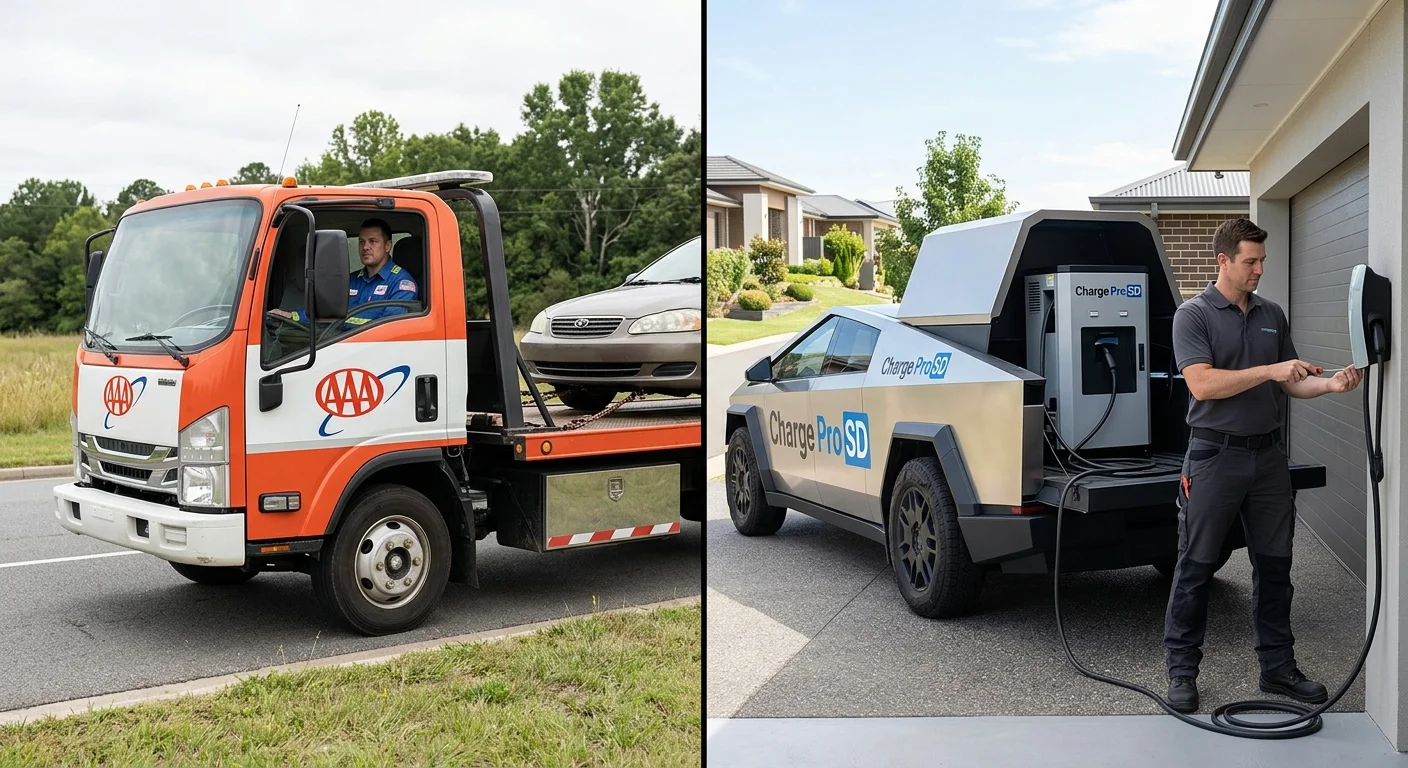
A dead Tesla in South Florida heat is two different jobs. AAA for Tesla South Florida is club dispatch for many vehicle types. A local Tesla rescue is a referral to an independent operator. That operator quotes you before work starts, then bills you directly. Confirm with AAA what your membership still covers. Don’t wait on a truck that can’t add range.
The climate is why those two calls diverge here. NWS Miami 1991-2020 normals put July and August average highs at 91F. A normal year sees about 64 days at or above 90F. Recurrent Auto studied about 30,000 EVs. They found about 5% range loss at 90F. The loss is about 17 to 18% at 100F. AAA’s 2019 SAE test found about a 17% range drop at 95F. It can take 3 to 5 kW to cool a 95-degree cabin. South Florida is flat, so there’s no grade penalty. Miami-Dade’s Atlantic Coastal Ridge sits around 23 to 24 feet. Broward’s Pine Island Ridge is about 29 feet. Range here is heat, air conditioning, and dwell, not terrain.
Club membership versus a quote for this stop
AAA sells an annual membership. You pay even in a year with no calls. Current dues weren’t verified for this page, so they’re not printed here. Call AAA for plan prices and for what EV work your card includes.
Club dispatch serves gas cars and EVs in one queue. Your silent Model Y can sit behind a flat tire. The unit they send is their choice. Ask whether that unit can jump a Tesla 12V. Ask whether they plan to tow, and to where. If the answer is only a wrecker, you know what you’re waiting for.
Charge Pro MIA is a referral line, not a shop. It matches stranded EV drivers with independent local operators. It owns no trucks and employs no technicians. It sets no prices and holds no trade license. The operator who takes the job quotes you first. They bill you directly, with no club card for that visit.
See When AAA is not a charge: mobile EV help compared when the pack is empty. See Tesla, AAA, or local mobile rescue: who actually shows up for that three-way split.
A dark Tesla after parking is often the 12V
A Tesla that won’t wake after a trip isn’t always out of pack. Long-term parking at Miami International Airport is the usual story. Cars sit in the Dolphin Garage, the Flamingo Garage, or the Ibis Garage. They also sit in Park 6, the long-term garage that opened in summer 2026. After a week or two, the screens stay black. The 12-volt battery drained keeping systems alive. Battery University reports that every roughly 15F rise halves lead-acid life. At 93F, that life ages about twice as fast as at 77F. At 111F it ages about four times as fast. The damage doesn’t reverse. The same pattern shows up after PortMiami cruise parking. It shows up after a day at Hard Rock Stadium in Miami Gardens.
If the car won’t wake, it may not take a public plug. The Ibis Garage page lists ChargePoint EV ports. Park 6 has EV charging on site. Neither helps a car that can’t close contactors. The roadside job is a 12V jump or a 12V replacement in place. See Tesla 12V failure after parking: why the car looks totally dead. The match for that work is a Tesla 12V battery jump.
An empty pack on I-95, the Palmetto, or a condo street
The other failure is a pack that actually hit zero. Air conditioning on I-95 will do it. So will a crawl on SR-826, or a wait on a Miami Beach causeway. North Miami stock is 82.7% pre-1980, and Miami Springs is 89.5%. Hollywood is 74.7% pre-1980, and Hialeah is 60.1%. A home charger is often not installable there. Doral is 5.5% pre-1980, Weston is 7.0%, and Parkland is 1.7%. Those streets are more likely to have a wall plug. A Tesla in Hialeah, Hollywood, or North Miami often lives on public charging. FPL EVolution is FPL’s public charging network brand.
FPL serves essentially all of Miami-Dade and all of Broward. Homestead is the confirmed exception. Parts of Homestead use Homestead Public Services Energy. Other parts stay on FPL. Confirm on the city’s HPS Energy page or at (305) 224-4800. No EV-specific program turned up on HPS Energy’s pages. That’s an observed absence, not a proof that none exists.
A club call for an empty pack may become a tow. Verify that with AAA. Don’t assume they carry a Level 2 source.
If you’re in a travel lane, move off it if you can. Florida Statute 316.194 covers stopping on a highway outside a municipality. Leave the vehicle off the main-traveled part where practicable. Leave room for passing traffic and a clear view from 200 feet each way. 316.194(2) exempts a genuinely disabled vehicle that can’t practicably be moved. Then call for help.
Florida’s Road Ranger Service Patrol, run by FDOT, is free on the highways they cover. They jump-start vehicles and tow a disabled car from the travel lanes to a safe spot. Dial *FHP (*347) from your phone. District 6 patrols Miami-Dade highways including I-95, I-75, and SR-826. District 4 patrols Broward’s I-95, plus portions of I-595 and I-75. Road Ranger material doesn’t mention electric vehicles or EV charging. A Level 2 charge isn’t in their published toolkit. A 12V jump or a move to a safe spot still is. Florida Highway Patrol takes disabled-motorist reports on the same *FHP short code.
The Turnpike, the Homestead Extension, and the Sawgrass Expressway sit with Florida’s Turnpike Enterprise. 95 Express and 595 Express are FDOT. GMX runs SR-112, the Dolphin (SR-836), SR-874, SR-878, and SR-924. They’re all-electronic, SunPass or toll-by-plate, with no cash. None of them publish a disabled-vehicle rule unique to their express lanes. Road Rangers still patrol those corridors.
Private property is separate. Florida Statute 715.07 governs nonconsent tows. Show up before the car is fully removed. The operator must stop and return it. You then pay no more than one-half the posted tow rate. Storage in Miami-Dade and Broward must be within a 10-mile radius. Miami-Dade Code Section 30-476 and Broward Code Section 20-176.22 cap those rates. The dollar schedules didn’t load for this page. Confirm the posted rate with the lot before you pay.
What the operator brings to a Tesla
Operators in this referral network bring a 240V Level 2 source to the car. Tesla uses a native NACS plug. CCS or J1772 adapters cover other EVs. Typical charging time adds 10 to 20 miles of range in 15 to 30 minutes. That clock starts when charging starts. It isn’t a promise of when someone arrives. They can also jump or replace a dead 12V on site. Tesla roadside rescue is the match for either job. The brand doesn’t perform the work.
Mapped city pages live under EV charging across Miami-Dade and Broward.
Who you pay, and when a club still fits
AAA dues weren’t verified for this page, so they’re not listed. A referral rescue has no membership. The operator quotes, and you accept or decline. Charge Pro MIA doesn’t set that number. Who sets the price when you need a mobile EV charge? explains the quote.
A club still fits a spare tire or a lockout if your card includes those. A Tesla that needs electrons or a 12V needs a different tool. Ask whether they can jump this 12V in place. Ask whether they can add range here without a tow.
If you need that match now, call (786) 963-2995. The line refers you to a local operator. They quote before they start. That call isn’t a promise of arrival.