The best roadside assistance for a Tesla depends on what failed. An empty pack isn’t a dead 12V. A flat on a causeway isn’t a silent car after a flight. Tesla, a motor club, and a local mobile rescue don’t send the same help. Call the one that can do the job in front of you.
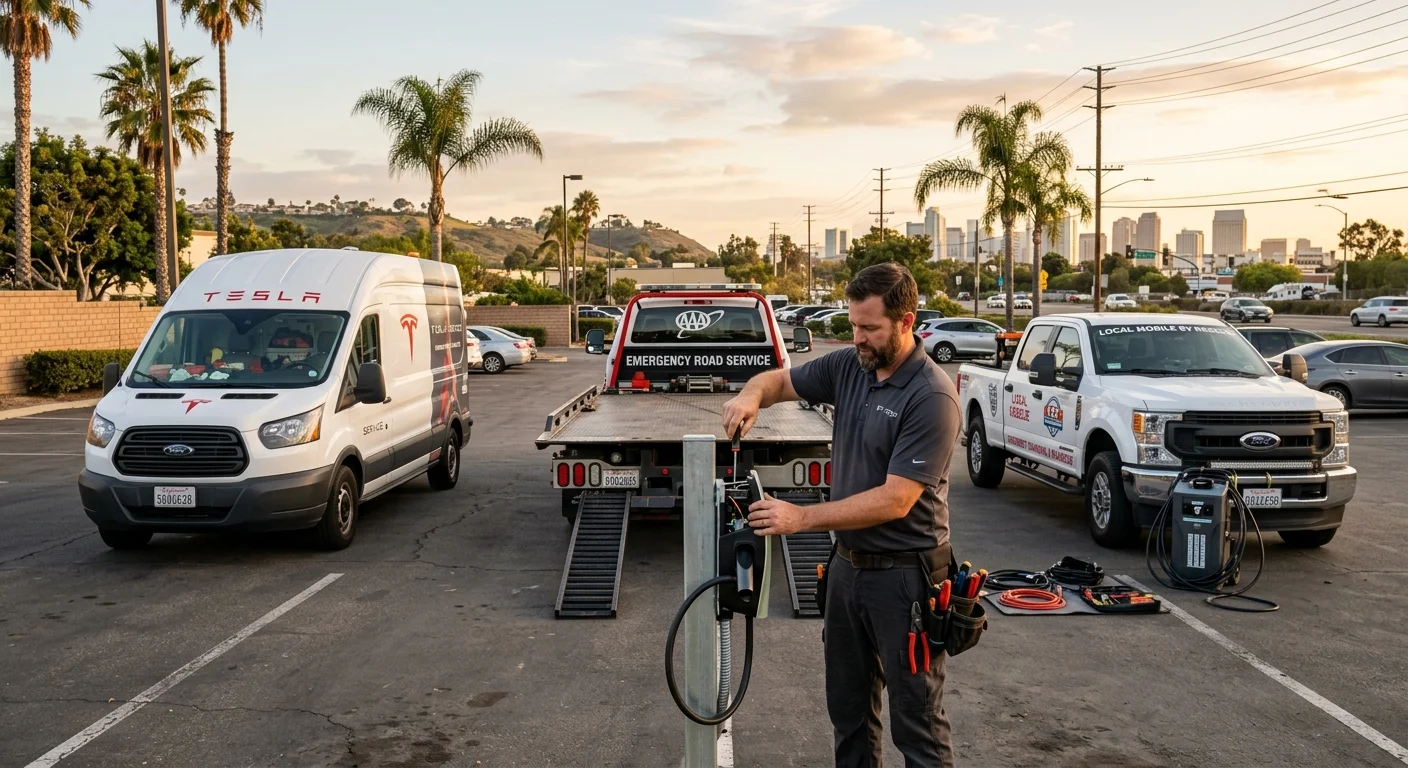
Two ways a Tesla dies, and one that isn’t a charge
A Tesla can look dead for two different reasons. The high-voltage pack can sit empty. The small 12V battery can also be drained. That 12V runs computers, locks, and the contactors that wake the pack. Heat in this metro ages that 12V fast. Battery University notes that every roughly 15F rise halves lead-acid life. Life drops about twice as fast at 93F as at 77F. NWS Miami puts the July and August normal high at 91F. A normal year sees about 64 days at or above 90F. A car that sat after a trip can refuse to wake. The pack can still hold range.
Dark screens and doors that won’t open usually point to 12V. A car that drove, then died on a low-charge warning, points to the pack. Those two jobs don’t share a truck. A flat or a lockout is a third job. Then you need a wrecker or a tire tech, not a charger.
Empty pack: heat, highways, and who brings miles
This metro’s flat. Miami-Dade’s Atlantic Coastal Ridge sits around 23 to 24 feet. Broward’s Pine Island Ridge sits at about 29 feet. Range here isn’t a hill problem. It’s heat, air conditioning, and time in traffic. Recurrent Auto’s fleet study of about 30,000 EVs found about 5% range loss at 90F. The same study found about 17 to 18% loss at 100F. Cooling a hot cabin can take 3 to 5 kW at first. Holding it cool takes about 1 kW. AAA’s 2019 SAE test found about a 17% range drop at 95F with AC on. A morning estimate can look fine. A run on the Turnpike or Alligator Alley can still come up short.
Tesla’s published roadside help can include a move toward charging. Many owners get a tow rather than a plug at the bumper. Confirm that in the Tesla app for your car. Don’t assume a van will show up with 240V.
A motor club may send a wrecker first. That’s useful on I-95 or the Homestead Extension when you need off the lane. It’s less useful if you only need miles. Ask the dispatcher whether anyone’s bringing a charge. If they only have a hook, get that said early.
A local operator through a referral line can bring 240V Level 2 to the car. Tesla uses a native NACS plug. Non-Tesla EVs use a CCS or J1772 adapter. Charging typically adds 10 to 20 miles of range. That takes 15 to 30 minutes on the plug. That’s plug time. It isn’t a promise about when someone shows up. Nobody on this page can promise that.
If you’re on a shoulder, get off the travel lane when you can. Florida Statute 316.194 says to leave the main-traveled part where practicable. Leave room for passing traffic. Keep a clear view from 200 feet each way. A genuinely disabled car that can’t be moved is exempt under 316.194(2). Put the hazards on. Stay out of the lanes. Toll roads here run all-electronic, SunPass or toll-by-plate. Get to a shoulder. Don’t sit in an express lane.
Silent after parking: the 12V everyone misreads
Long-term parking’s the classic trap. Miami International Airport’s public parking includes the Dolphin, Flamingo, and Ibis garages. Park 6 is the new long-term garage. A week in a stall keeps modules alive. The 12V takes that load. You come back from a flight and the car looks fully dead. It often isn’t. The pack’s fine. The 12V isn’t. Cruise parking follows the same pattern. Treat it as a jump first, not a flatbed.
Tesla roadside can send a jump or a tow. A motor club can often jump a 12V. Road Rangers jump-start vehicles on the highways they patrol. A local operator can jump or replace a dead 12V on site. In a garage, that’s usually the right call. Miami Beach and Sunny Isles Beach add a ramp problem. A wrecker can struggle in tower parking. A 12V service at the stall’s cleaner when someone can reach you.
For the parking-lot version of this failure, read Tesla 12V failure after parking: why the car looks totally dead.
Tesla’s own roadside: the OEM desk
Tesla’s factory program exists because the car’s the diagnostic. You open it in the Tesla app. Tesla also publishes a roadside number. The desk knows lockout steps and 12V procedures. The person who shows up is often a contractor, not a Tesla employee. For a newer car, that program’s often included for a limited period. We aren’t publishing years, miles, or fees. Tesla’s own terms remain the source. Open them in the app or on Tesla’s site before you need help.
It’s strong on Tesla-specific knowledge. That includes the Tesla flat-tire process and routing toward service. A contractor at least has Tesla’s playbook. What it doesn’t automatically mean: a Level 2 van at your bumper. Out-of-charge help’s often a tow. Older cars may fall outside included roadside. Confirm that too. Event days add load. Hard Rock Stadium in Miami Gardens hosts the Dolphins and the Hurricanes. It’s also the F1 Miami Grand Prix site. Kaseya Center’s the downtown Heat arena. None of that changes Tesla’s written policy.
For the policy in local wording, see Tesla roadside assistance policy in 2026, and what it means here.
AAA and other motor clubs: the contractor network
AAA’s a club, not a Tesla desk. The value’s the contractor list. The value’s also the towing distance your membership names. That’s the right tool when the car has to travel to a shop. It’s the right tool for a long wrecker move.
EV extras remain the part you have to verify. Some clubs advertise mobile charging. Some don’t. Some sell it as an add-on. Club rules aren’t uniform. We couldn’t confirm a 2026 South Florida EV add-on from a primary page. Call the number on your card. Ask whether they’ll send a charge to a Tesla, or only a wrecker. Ask whether their contractor will jump a Tesla 12V in a garage.
Teslas don’t carry a spare in the usual way. Jack points matter. A tech who hasn’t seen the car can damage a cover or a rocker. Tesla’s program’s built around that process. A motor club wrecker may or may not know the lift points. Ask before anyone lifts.
If you want the club-versus-local split, read AAA or a local Tesla rescue: what you actually get.
Local mobile rescue: a referral, not a fleet
Charge Pro MIA’s a referral line for South Florida. It serves Miami-Dade and Broward. It doesn’t own trucks. It doesn’t perform the work. It matches stranded EV drivers with independent operators. The operator quotes you before starting. The operator bills you directly.
Typical work’s a 240V Level 2 top-up at the car. Native NACS for Tesla. Adapters for CCS and J1772. Ten to 20 miles of range in 15 to 30 minutes of charging. A 12V jump or replacement if the car won’t wake. Tesla and every major EV brand.
Limits stay honest. This isn’t a long-haul tow club. It isn’t Tesla Service. The operator sets the price on the call. If you need a wrecker across the county, use the club or Tesla’s tow.
The on-site charge path’s Tesla roadside rescue. The plug itself’s explained on mobile EV charging. The 12V path’s Tesla 12V battery jump.
The City of Miami’s one of 34 municipalities in Miami-Dade. Miami Beach’s a separate city. Hollywood sits in Broward. Kendall, Tamiami, and The Hammocks are census-designated places, not cities. Say the name of the place you’re in. Dispatchers route on that.
Road Rangers, and the free move off a lane
Florida’s Road Ranger Service Patrol’s run by FDOT. Rangers jump-start vehicles, change flats, and do minor repairs. They also tow a disabled car off the travel lanes to the nearest safe spot. All of that’s free of charge. You reach them by dialing *FHP, which is *347.
District 6 covers Miami-Dade. It patrols I-95, 95 Express, I-195, I-395, I-75, 75 Express, and the Palmetto (SR-826). District 4 covers Broward’s I-95 from the Miami-Dade line north. It also covers parts of I-595 and I-75 to mile marker 50. Road Ranger pages don’t mention EV charging. They can still jump a 12V or move you off a lane. They don’t bring a Level 2 source. Florida Highway Patrol takes disabled-motorist reports on the same *FHP code.
If a lot starts a non-consent tow, Florida Statute 715.07 controls it. The operator has to stop and return the vehicle if you appear before it’s fully removed. You then pay no more than half the posted tow rate. Miami-Dade and Broward both require storage within a 10-mile radius. Confirm the posted schedule at the lot. This page doesn’t publish dollar caps. Miami-Dade’s cap sits in Code Section 30-476. Broward’s sits in Code Section 20-176.22.
Who to call in the moment
Don’t buy three plans because a blog told you to stack them. Make the call that matches the failure.
If you’re in a travel lane on I-95, the Palmetto, or I-75, start with *FHP. Get the car to a safe spot first. Then decide on a charge, a jump, or a wrecker.
If the car’s silent after sitting, treat it as 12V. Use Tesla’s in-app lockout and jump steps if you can. Then a local operator or a club jump. Skip the Supercharger hunt until the car wakes.
If the car woke, drove, and hit zero, you need miles. Ask Tesla whether they’re towing or charging. Ask the club the same question. If you want a Level 2 source at the bumper, that’s the local operator job.
What best can’t mean on this page
Best roadside assistance for a Tesla can’t mean a promised arrival. Traffic on I-95, the Dolphin, and the airport belt doesn’t allow that. Best can’t mean a price we set. Operators and clubs set their own. Best can’t mean one truck for every Tesla fault.
Best means you know which door to knock on. Tesla for OEM diagnostics and included towing while that coverage lasts. A motor club for distance tows and a wide contractor list. A local referral line for a Level 2 charge or a 12V fix where the car sits. Road Rangers when you’re blocking a highway lane they patrol.
If you want a local operator quoted on the job, call (786) 963-2995. Charge Pro MIA will connect you. The operator quotes before starting. You decide if the work proceeds.