You left the car at Miami International and came back to a brick. The screen is dark and the handles may not work. That’s when the search for EV service South Florida starts. A shop slot and a flatbed both feel like the next move. After a week in the Dolphin Garage or Park 6, the pattern is the same. The car usually needs a 12-volt jump where it sits.
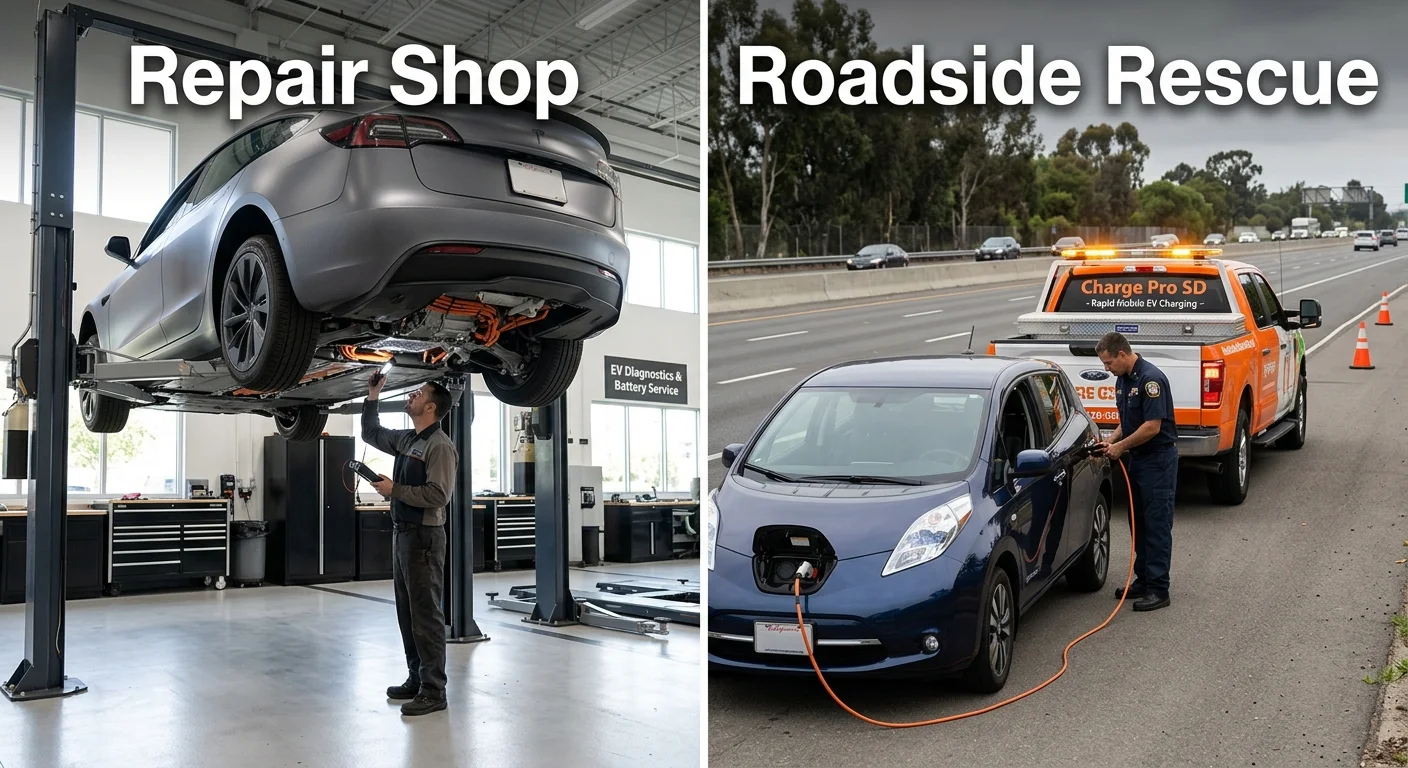
Two jobs hide under the same three words
EV service can mean a scheduled visit at a dealership. It can also mean getting a silent car to move again. Those aren’t the same trade. Mixing them up burns a day.
A shop visit is for a car you can still drive there. Rescue is for a car that won’t wake, roll, or take a plug. If you can book an appointment, you want a service center. If you can’t leave the garage, you want help to come to you.
Charge Pro MIA is a referral line. It matches stranded drivers with independent local operators. It doesn’t run a shop. It doesn’t own trucks or a parts counter. The operator quotes you before work starts, then bills you directly. The pros we connect you with are licensed and insured.
Why a week in airport parking fools almost everyone
The high-voltage pack is rarely the part that dies in long-term parking. The small 12-volt battery is. It keeps computers, locks, and alarms alive while you fly. Leave the car for a week or two and that 12-volt can drain flat. The dash stays black and the car won’t wake.
The pack usually isn’t empty. Miami International lists ChargePoint ports in the Ibis Garage. Park 6, the new long-term garage, opened in summer 2026 with charging on site. None of that restarts a 12-volt that already died in the heat. A dealer across the county can’t jump you from the North Terminal. A flatbed is a hard way to fix a battery you can jump in the stall.
Cruise parking at PortMiami and Port Everglades follows the same sit-and-drain pattern. Confirm what each garage actually offers before you assume a plug will wake a dead 12-volt. For MIA lots, motorist help runs through garage parking at (305) 876-7536. Fort Lauderdale-Hollywood International garage details couldn’t be confirmed from the airport site when this was written. Check fll.net before you plan around a plug there. The 12-volt drain after a trip still applies.
The same brick shows up at Miami Executive, Miami-Opa Locka Executive, Fort Lauderdale Executive, and North Perry. If you parked near MIA and live in Miami Springs, that loop is common. The City of Miami is one of 34 municipalities in Miami-Dade. Miami Beach is a separate city, reached only by causeway.
Heat is why the small battery fails here
South Florida is flat. Range here isn’t a hill problem. Miami-Dade’s Atlantic Coastal Ridge tops out around 23 to 24 feet. Broward’s Pine Island Ridge is about 29 feet. Heat, air conditioning, and time sitting are what wear the car.
NWS Miami normals put July and August highs at 91F. Battery University notes that every roughly 15F rise halves lead-acid life. At about 93F it ages twice as fast as it does at 77F. At about 111F it ages about four times as fast. That heat damage doesn’t reverse.
A week in MIA parking is a classic 12-volt death for that reason. A jump, or an on-site 12-volt swap, is what gets you moving. A service appointment can wait until the car can drive there. If the car looks bricked after a trip, start with Tesla 12V failure after parking. The same logic holds for non-Tesla EVs.
When the right call is a shop
Book a service center when the car still drives. Persistent warning lights belong in a bay. So do odd noises or a weak climate system. An onboard charger that won’t take power at home is shop work too. Pack diagnosis needs a lift and dealer tools. Software updates and recall campaigns live at the brand’s service lane, not on a garage ramp.
Routine items still matter on an EV. Tires, cabin filters, and brake-fluid checks are shop work. They aren’t roadside work. Census ACS 2019-2023 figures put pre-1980 housing at 5.5% in Doral and 7.0% in Weston, so a home Level 2 is often already in the garage. Miami Springs is 89.5% pre-1980. North Miami is 82.7%. A home plug may not even be possible in that older stock. That still doesn’t turn a rattle into a rescue call.
Don’t call a mobile operator for a noise you heard last Tuesday. They won’t open the pack. They won’t program modules. If the car can move, they’ll point you at the dealer.
When the right call is a rescue
Call for rescue when the car won’t start where it sits. An empty pack on a surface street is one version. A black screen after parking is the other. EV roadside assistance covers both.
If the traction pack is actually empty, the operator brings a 240-volt Level 2 source to the car. Teslas take a native NACS plug. Other brands use a CCS or J1772 adapter. A typical top-up adds about 10 to 20 miles in 15 to 30 minutes of charging time. That’s plug time, not a clock on arrival. It’s enough to roll to a charger you choose. That process is on mobile EV charging.
If the 12-volt is the dead part, you need a jump or a replacement on site. The pack can be full and the car still silent. That’s the airport pattern. It’s also the condo-garage pattern in Miami Beach, Sunny Isles Beach, and Surfside. Operators handle Tesla and every major EV brand. The small-battery path is Tesla 12V jump service.
Charge Pro MIA doesn’t perform that work. The independent operators we connect you with do.
Empty on a freeway is a different scene
A stall on I-95, the Palmetto, or the Airport Expressway isn’t a garage problem. Florida Statute 316.194 says to leave the main-traveled part when you can. A truly disabled vehicle that can’t move is exempt. Put the hazards on. Stay out of the travel lane if the car can roll to the shoulder.
Florida’s Road Ranger Service Patrol is free on those corridors. FDOT District 6 covers Miami-Dade on I-95, 95 Express, I-195, I-395, I-75, 75 Express, and SR-826. District 4 covers Broward’s I-95 from the county line north, plus stretches of I-595 and I-75. Dial *FHP (*347). Rangers jump-start vehicles and handle minor repairs and flats. They also tow a disabled car from the travel lanes to the nearest safe spot.
Their public materials don’t mention EV charging. They still jump a 12-volt, and they still clear a lane. A Level 2 charge to the pack is what a mobile operator adds after you’re out of traffic. Florida 511 at FL511.com is the state’s traffic feed in English and Spanish.
How to choose before you dial
If the car can roll under its own power, and something feels wrong, drive to a dealer. If it can’t, you’re in rescue territory.
If the dash is dark after the car sat for days, think 12-volt first. A jump is the test. If it dies again soon, the small battery is likely worn out. That can still start as roadside work. A dealer visit can follow once the car moves.
If the display shows zero miles, or range warnings stacked up in traffic, you need energy in the pack, not a diagnostic laptop. Walk that fork in charge, jump, or tow.
Towing a dead EV is its own mess. Many wreckers aren’t set up to pull an EV with no 12-volt. If a jump or a short charge will move the car, try that first. Why towing a dead EV gets messy is the longer version. Private-property tows sit under Florida Statute 715.07. Miami-Dade sets nonconsent tows in Code Section 30-476. Broward uses Code Section 20-176.22. Don’t guess the dollar figures. If a wrecker is hooking up on private property, appear before the car is fully removed. The statute says they must return it then. You pay no more than half the posted tow rate.
What a rescue won’t fix
Operators don’t replace a high-voltage pack on a garage floor. If you need that work, you need a shop.
A warning light you can drive with is a dealer problem. A dark dash after MIA parking is a 12-volt problem. Use the shop for the car you can drive. Use a mobile operator for the car that won’t wake.
If the car is silent in a garage or on a street, start with rescue, not a shop slot. Charge Pro MIA can connect you with a local operator for a 12-volt jump or a short Level 2 top-up. Call (786) 963-2995. The operator quotes you first.