You live in Lauderhill without a wall plug. The car is sitting empty after a weekday run. EV roadside assistance here is a local operator. That operator brings a 240V Level 2 source to the car. Charge Pro MIA is a referral line, not a shop with a yard. It doesn’t own trucks, employ technicians, or set a price. The operator quotes you before any cable goes in, then bills you directly.
Why so many Lauderhill EVs never plug in at home
About two-thirds of the housing here went up before 1980. Census ACS 2019-2023 puts that share at 67.3 percent. Older panels, rental buildings, and apartment lots are the usual mix. A Level 2 wall unit is often not something you can hang overnight.
Inverrary condos, the SR-7 corridor, and the Oakland Park Blvd stretch lean that way. You park in a shared lot and you don’t control the panel. The landlord never ran a 240-volt circuit to your stall. Florida Power and Light serves the city, including these older blocks. FPL EVolution Home is the utility’s residential Level 2 program. Both still need a building that can take the load. Many older buildings in Lauderhill never will.
That’s why EV roadside assistance in Lauderhill is a weekday tool. It’s not a rare event on these streets. Public charging may already be on your route. It may also be occupied or down when you actually need it. If you’re weighing a wall unit against a rescue, read 240-volt charging: your home plug versus a mobile rescue.
A large Caribbean community and a working-class apartment base shape that demand. The constraint is the panel behind the meter.
Heat and AC eat range on a flat commute
Lauderhill sits on flat Broward ground with no grade. The county’s highest natural point is Pine Island Ridge at about 29 feet. Range here is heat, air conditioning, and time in traffic.
NWS Miami 1991-2020 normals put July and August average highs at 91F. A normal year sees about 64 days at or above 90F. Recurrent Auto studied about 30,000 EVs in its fleet research. It found about 5 percent range loss at 90F. The loss is about 17 to 18 percent at 100F. Cooling a 95-degree cabin can take 3 to 5 kW at first. Holding that cool takes about 1 kW. AAA’s 2019 SAE-standard test put the drop near 17 percent. That test ran at 95F with the AC on.
Summer afternoons bring thunderstorms, roughly 2pm to 6pm. Low-lying streets flood on king tides and heavy rain.
The commute here is an ordinary inland loop. The spine is SR-7, also called US-441. Oakland Park Blvd, Commercial Blvd, and NW 19th St carry the rest. Florida’s Turnpike runs along the west edge. You’re inland in central Broward, not on the beach. You’re far from Miami International and Fort Lauderdale-Hollywood International. This isn’t an airport-parking stall after a trip. This is errands, work, and school runs in heat.
Neighbors are Lauderdale Lakes, Plantation, Sunrise, Tamarac, and North Lauderdale. A short hop into Plantation still counts as a weekday loop. The pack doesn’t care that the map looks small. Lauderhill is the inland ordinary-commuter market in this part of Broward.
After work, when the only plug is a public one
You meant to stop on the way home, but SR-7 traffic held you. The AC ran the whole way. You reached a lot and the session didn’t start. The stall may already be taken. You’re now in a Lauderhill apartment lot with no assigned 240-volt outlet. That’s the call.
Don’t try to stretch to Sunrise or Tamarac on a guess. Don’t sit through another loop of Commercial Blvd hoping the estimate was wrong. Recurrent Auto and AAA already measured the heat tax. Treat the number on the dash as optimistic in July and August.
If the car still wakes, move it to a safer stall. If it doesn’t wake, treat it as a 12-volt until proven otherwise. Sitting overnight without a plug is common here. So is a car that looks fine at 9pm. It won’t open at 7am.
What EV roadside assistance actually is
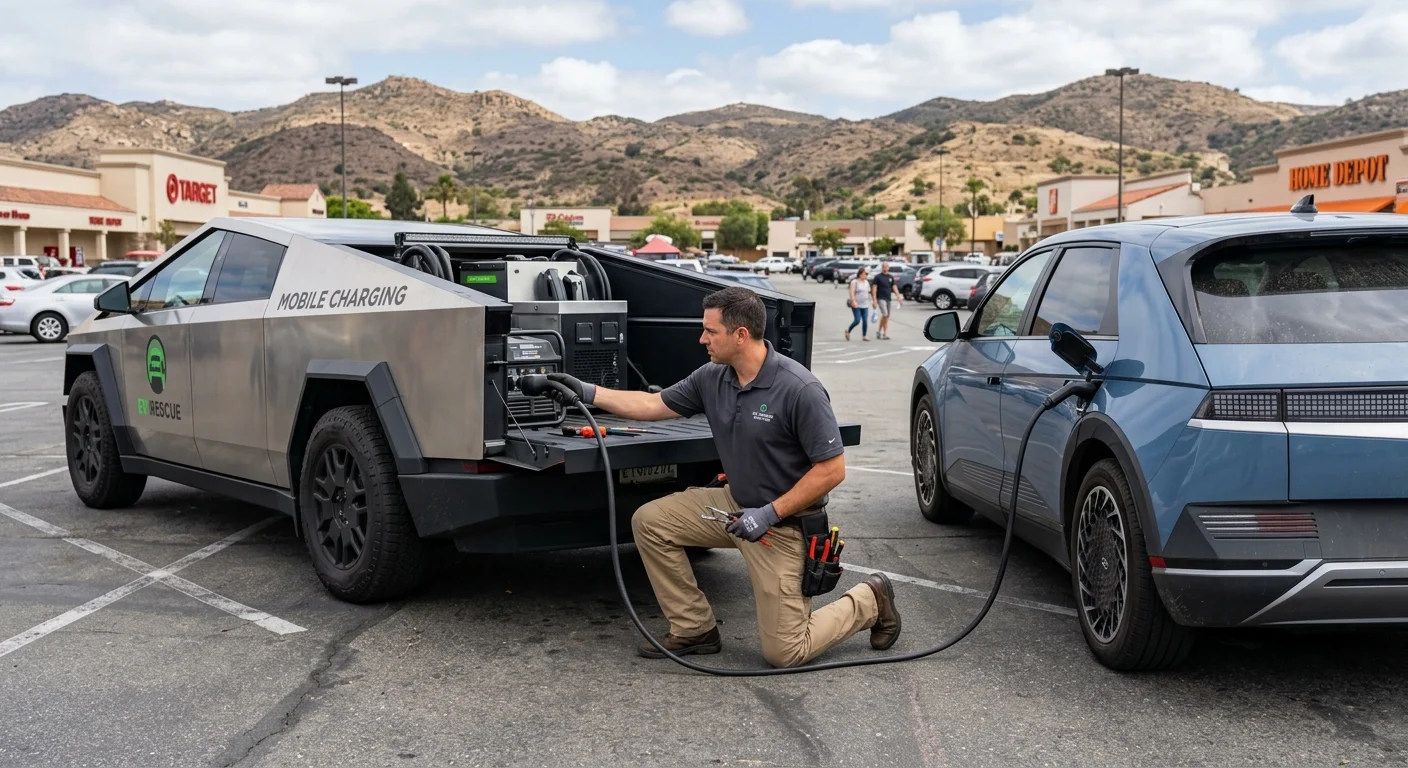
Charge Pro MIA matches stranded EV drivers with independent local mobile rescue operators. The brand holds no licence and performs no work. The operator who takes the job brings a 240V Level 2 source to the car.
Other EVs take CCS or J1772 through an adapter. Typical charging time is 15 to 30 minutes. That’s charging time, never an arrival time. That window usually adds 10 to 20 miles of range. That’s often enough to reach a public plug you already had in mind. It can also get you home if home can take a cord.
Operators also jump or replace a dead 12-volt battery on site. They handle Tesla and every major EV brand. A mobile EV charging stop is the empty-pack version of that same visit.
Road Rangers are a separate call. FDOT runs that free highway patrol. Dial *FHP, which is *347 on a mobile phone. District 4 covers Broward’s I-95 corridor, plus portions of I-595 and I-75. They jump-start, change a tire, and handle minor repairs. They also tow a disabled vehicle off the travel lanes to the nearest safe spot. Published Road Ranger material doesn’t mention EV charging. A Level 2 top-up isn’t what they bring. A 12-volt jump or a move off the travel lane still is.
If you’re on the Turnpike shoulder, start with Florida Statute 316.194. Leave the vehicle off the main-traveled part where you can. A genuinely disabled vehicle that can’t be moved is exempt. Put the hazards on and stay visible. Stay out of the travel lane if you can. Florida 511 at FL511.com is the state’s traffic feed, in English and Spanish.
Where drivers stall on ordinary days
Calls follow daily life, not rare trips. The Lauderhill Mall lot fills after a stop that ran long. Central Broward Park and the cricket stadium draw weekend traffic. A match or a long event can leave a pack thinner than you planned. The SR-7 corridor cuts through the middle of town. Oakland Park Blvd and Commercial Blvd see the same weekday stalls. Inverrary streets add overnight lots where the car sat on a shared stall.
The Turnpike is the west-side through-route for this city. If you go empty there, get off the travel lane first. Road Rangers can move you to a safer spot. They won’t fill the traction pack. An out-of-charge recovery is the Level 2 visit after you are out of harm’s way.
Census ACS 2019-2023 puts the population around 73,961. The 2024 estimate sits at 76,627. ZIPs 33311, 33312, 33313, 33319, and 33351 cover the city. The pattern is dense, older, and inland. It isn’t a beach stall and it isn’t an airport garage.
Don’t wait in a marked tow-away space hoping the car will wake up. Florida Statute 715.07 governs those private-property tows. Broward County Code Section 20-176.22 sets maximum nonconsent rates. Those dollar caps aren’t listed here because they change. If you appear before the car is fully removed, the tow must stop. The operator returns it on payment of no more than half the posted rate. In a county this size, storage must sit within a 10-mile radius. Confirm current rules with Broward Consumer Protection if a lot is already calling a wrecker.
Empty pack or a silent 12-volt
Two failures look the same from the sidewalk. The traction pack is empty, or the 12-volt battery is dead. The high-voltage pack can still hold plenty of energy. The 12-volt can still be gone. Then the car won’t unlock or wake. It won’t start a charge session either.
Salt-laden humid air is hard on a 12-volt battery. Heat makes that wear even worse. Battery University notes a hard heat rule. Every roughly 15F rise in temperature halves the life of a lead-acid battery. It ages about twice as fast at 93F versus 77F. It ages about four times as fast at 111F. Heat damage doesn’t reverse later. An EV that sat a week in Inverrary may not wake up. The same stall happens along SR-7 after a long sit. That can be true even if you had range when you parked.
A 12-volt jump on site is often the whole fix. The same pattern hits Tesla and every other brand. Walk through what happens when an EV’s 12-volt battery dies before you assume you need a flatbed.
A stuck charge port is a third call. Don’t yank the handle to force it. Forcing it can damage the latch and the port. The operator can often release it without a tow.
Charge on the spot, or wait on a tow
If the car is only empty, you need energy, not a hook. A mobile Level 2 visit leaves the car on its wheels. You drive it when the session is done. A tow loads the vehicle off that stall. On private property it can land under 715.07 storage rules. You still need a plug at the other end.
Towing a dead EV has extra handling so the drivetrain isn’t damaged. If you can take a charge where you sit, take the charge.
A tow still makes sense in a travel lane. It also makes sense in standing water, or when the car is mechanically broken. NHTSA warns that residual salt in a flooded lithium pack can short later. Don’t drive or charge a flood-exposed EV until it is inspected. If water reached the pack, that isn’t a roadside top-up.
What the operator brings, and who sets the price
The rig is a 240V Level 2 source. Teslas use a native NACS plug. CCS or J1772 adapters cover everyone else. Fifteen to thirty minutes of charging time is the usual on-site window. Ten to twenty miles of range is the usual result. That’s charging time, not a promise of when someone arrives.
Charge Pro MIA doesn’t set the price. The operator quotes you before starting and bills you directly. You can weigh that quote against a tow before anyone rolls.
City context lives on the Lauderhill EV charging page. Use it for the local layout.
When a call makes sense
Call when the traction pack is too low to reach a plug you can actually use. Call when the car is silent and you suspect the 12-volt. Call when the port won’t release. Don’t sit in a travel lane to save a few percent. Move off if you can, or dial *FHP. Then get a Level 2 source to the car. An operator still needs a legal, reachable parking spot to plug in. A live lane isn’t that spot.
The number for Charge Pro MIA is (786) 963-2995. That call connects you with a local operator. The operator quotes before any work starts.