EV roadside assistance in Miami Lakes is a charge at the car. Charge Pro MIA matches stranded drivers with independent local operators. The operator brings a 240V Level 2 source to where you stopped. Teslas use a native NACS plug. Other brands use a CCS or J1772 adapter. The operator quotes you before starting, then bills you directly.
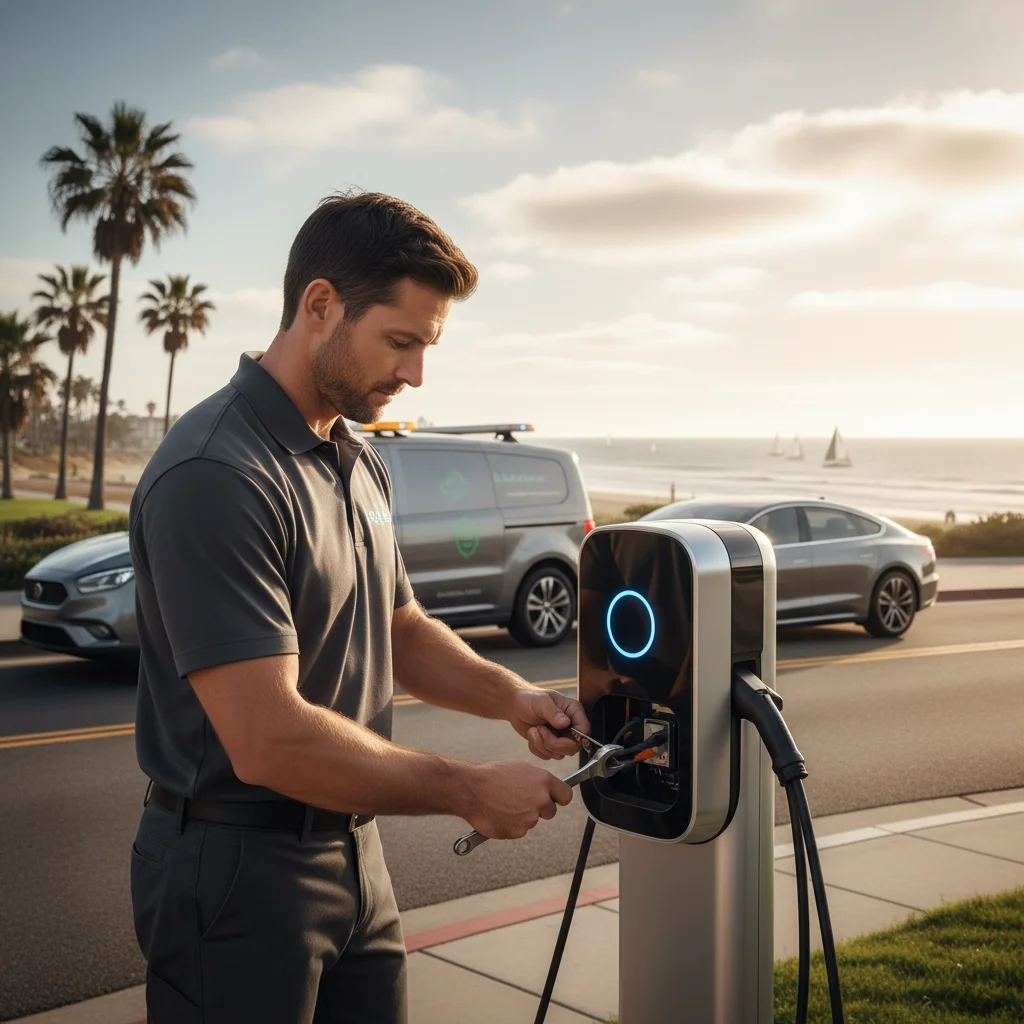
You left home with a comfortable buffer, then the suburban loop spent it. Miami Lakeway, NW 154th Street, and the Town Center keep stacking short trips. The Palmetto Expressway (SR-826) is often the exit that finishes the pack. EV roadside assistance is the call when those miles are gone.
A planned town of lakes and cul-de-sacs
Miami Lakes sits in north Miami-Dade on about 5.7 square miles. Census ACS 2019-2023 counts 30,731 people, with a 2024 estimate of 33,247. The town is named for the lakes around it. Cul-de-sacs in Loch Lomond, Royal Oaks, and West Lakes block a through-route. You loop the lakes instead of cutting across town. Main Street is the town center for those loops. The Don Shula golf resort is another pin drivers actually use. NW 67th Avenue, also called Ludlam Road, is a north-south spine. Miami Lakeway ties the residential pockets together. None of this is the City of Miami. It’s a self-contained Miami-Dade suburb beside Hialeah, Hialeah Gardens, Medley, and Miami Gardens.
A common stall starts after a full charge at home. You drop someone at Town Center first. Then you run a second errand on NW 154th Street. Afternoon heat has the AC working hard. Displayed range still looks fine from the driveway. Then you join the Palmetto and the buffer vanishes.
Hialeah next door is older housing stock. ACS 2019-2023 puts 60.1% of Hialeah homes before 1980. Miami Lakes sits at 32.4% pre-1980. That housing split matters for home plugs. More driveways here can support a Level 2 circuit. FPL serves the town. FPL EVolution Home is the utility’s residential install-and-maintain program. Confirm the current terms with FPL before you enroll. This referral line doesn’t sell panel work or wall units.
So the Miami Lakes call mix skews to the road. The car often charged overnight without drama. The empty pack happens on the Palmetto or Miami Lakeway. Sometimes it’s a cul-de-sac two turns from home. You’re away from the wall you usually use. That’s public-plug dependence in the suburban sense. You planned the day around chargers you could reach. The loop didn’t leave you enough miles to get there. Mobile EV charging puts range back at the bumper.
Don’t hunt a station while the car is already in limp mode. Open your charging app and note a reachable plug. If you can’t make that plug, stay put and call.
Heat spends range here, not hills
There’s no grade penalty on Miami Lakes streets. South Florida is flat coastal ground. Miami-Dade’s highest natural point is the Atlantic Coastal Ridge. That ridge sits at roughly 23 to 24 feet. Range here is heat, air conditioning, and time in traffic.
NWS Miami 1991-2020 normals put July and August average highs at 91F. A normal year has about 64 days at or above 90F. Recurrent Auto studied about 30,000 EVs for heat loss. That work found about 5% range loss at 90F. The loss is about 17 to 18% at 100F. AAA’s 2019 SAE-standard test ran EVs at 95F with the AC on. Range dropped about 17% in that test. Don’t blame a hill this town doesn’t have.
Cooling a 95-degree cabin can take 3 to 5 kW at first. Holding that cool takes about 1 kW. The expensive minutes are the first ones. Summer storms stack that cost on the same loop. NWS Miami notes afternoon thunderstorms run roughly 2 p.m. to 6 p.m. You idle in the rain with climate control on. Then you still have to finish the Miami Lakes loop.
King tides and heavy rain flood low-lying streets here. If salt water reached the pack, don’t drive and don’t charge. NHTSA warns residual salt can bridge and short a flooded lithium battery. Fires can start days to weeks later. Keep a flood-exposed EV at least 50 feet from a structure until it’s inspected. About 36 EVs flooded by Hurricane Ian in 2022 later caught fire.
Hurricane season runs June 1 to November 30. FPL tells EV owners to hold the pack between 50 and 80% in hurricane season. Unplug during the storm, and don’t charge a flood-exposed EV until it’s inspected. FPL also publishes an EV storm program with mobile charging trailers for planned outages and evacuations. That’s the utility’s program, not this referral line.
What shows up, and what this brand is
Charge Pro MIA is a referral line. It matches you with independent local mobile rescue operators. It performs no work and owns no trucks or equipment. It employs no technicians and sets no prices. It promises no arrival time and holds no trade license. The operator quotes you before starting, then bills you directly. The pros we connect you with are licensed and insured.
They bring a 240V Level 2 source to the car. Typical charging adds 10 to 20 miles of range in 15 to 30 minutes. That clock starts when the plug is live. It isn’t a travel estimate or a dispatch promise. Out-of-charge recovery is the empty traction pack. A silent car is often the 12-volt instead.
Salt-laden humid air here is hard on that small battery. A car that sat a week may not wake. Battery University notes every roughly 15F rise in temperature halves lead-acid life. It ages about twice as fast at 93F versus 77F. It ages about four times as fast at 111F. Heat damage doesn’t reverse on that chemistry.
A dead 12V means no unlock, no boot, and no charge handshake. Tesla 12V battery jump service is the first move on a brick. Non-Tesla EVs follow the same low-voltage logic. Jump or replace the 12V on site. Charge the pack only if you still need miles to move.
Palmetto stalls, Road Rangers, and tow rules
If you’re on SR-826, get out of the travel lane if you can. Florida Statute 316.194 says a vehicle should sit off the main-traveled part where practicable. Leave room for passing traffic, with a clear view from 200 feet each way. A genuinely disabled vehicle that can’t be moved is exempt under 316.194(2). Keep the hazards on, and keep people out of the lanes.
Then dial *FHP (*347) from your mobile phone. FDOT’s Road Ranger Service Patrol covers District 6, including Miami-Dade. Rangers patrol the Palmetto as part of that district. They jump-start vehicles, make minor repairs, and change flats. They also tow a disabled vehicle from the travel lanes to the nearest safe location. That highway help is free. Florida Highway Patrol takes disabled-motorist reports on the same short code.
Published Road Ranger material doesn’t mention electric vehicles or EV charging. A 12V jump or a lane-clearing tow is still in their kit. A Level 2 charge is what the mobile operator brings after you’re clear. Florida 511 at FL511.com is FDOT’s traffic system, in English and Spanish. Check it before you sit in a stacked Palmetto queue. The out-of-charge Palmetto Expressway post covers shoulder steps in more depth.
Private property is a different statute. Florida Statute 715.07 covers towing from private lots. If you appear before the car is fully removed, the tow must stop. You pay no more than half the posted tow rate for that return. The lot needs a permanent, reflective tow-away sign at each access. That sign must be posted at least 24 hours ahead, with listed exceptions. In Miami-Dade the car must be stored within a 10-mile radius. It must be released within one hour of request. Miami-Dade Code Section 30-476 sets maximum nonconsent towing and storage rates. The dollar caps weren’t confirmed from a loaded rate page. Read the posted schedule on site, and don’t use a number from memory.
Stadium days and the neighbor loop
Hialeah’s denser streets are a short loop away. EV roadside assistance in Hialeah is the sibling write-up if you crossed that line. Miami Gardens brings Hard Rock Stadium traffic onto north-county roads. The Dolphins, the Hurricanes, and the Miami Open use that campus. The F1 Miami Grand Prix uses it too. Those event days stretch a Miami Lakes return through Loch Lomond or Royal Oaks.
A car that sat through a week of humidity often looks totally dead. The traction pack can still be fine. Ask for a 12V jump first, then a top-up if you still need miles.
How to call from a cul-de-sac or Town Center
Stay with the car if it’s safe. Send a pin drop if you can. Name Main Street, Miami Lakeway, Ludlam, or the Don Shula golf resort. West Lakes and Town Center addresses are enough. Say the make, model, and whether the car unlocks. The operator confirms the port, then quotes you. You accept or you walk away. You’re not asking Charge Pro MIA to perform licensed work. You’re asking the line to connect you. Use the Miami Lakes charging hub on this site for the local overview.
Frequently asked questions
Does this line cover every Miami Lakes neighborhood?
Yes. Charge Pro MIA’s service area includes Miami Lakes and the rest of South Florida. Operators reach Loch Lomond, Royal Oaks, West Lakes, Town Center, and the Palmetto edge. The brand refers, and the operator on scene does the charging.
How much range does the mobile charge add?
Operators typically add 10 to 20 miles of range in 15 to 30 minutes of charging. That’s plug-in time, not a travel window. Use it to reach your home wall or a public plug you can confirm.
Why is the car dead after it sat for a week?
Heat and humidity here wear the 12-volt battery. A silent Tesla or other EV often needs a jump, not a traction charge. Tell the dispatcher it won’t wake. The operator can jump or replace that 12V on site.
If you’re stranded in Miami Lakes, call Charge Pro MIA at (786) 963-2995. You’ll be connected with a local operator who quotes the job before it starts.