Your EV died on Miramar Parkway, I-75, or a Silver Lakes cul-de-sac. You need EV roadside assistance in Miramar that comes to the car. Charge Pro MIA is a referral line. We match stranded drivers with independent local operators. The operator quotes you before any work starts, then bills you directly.
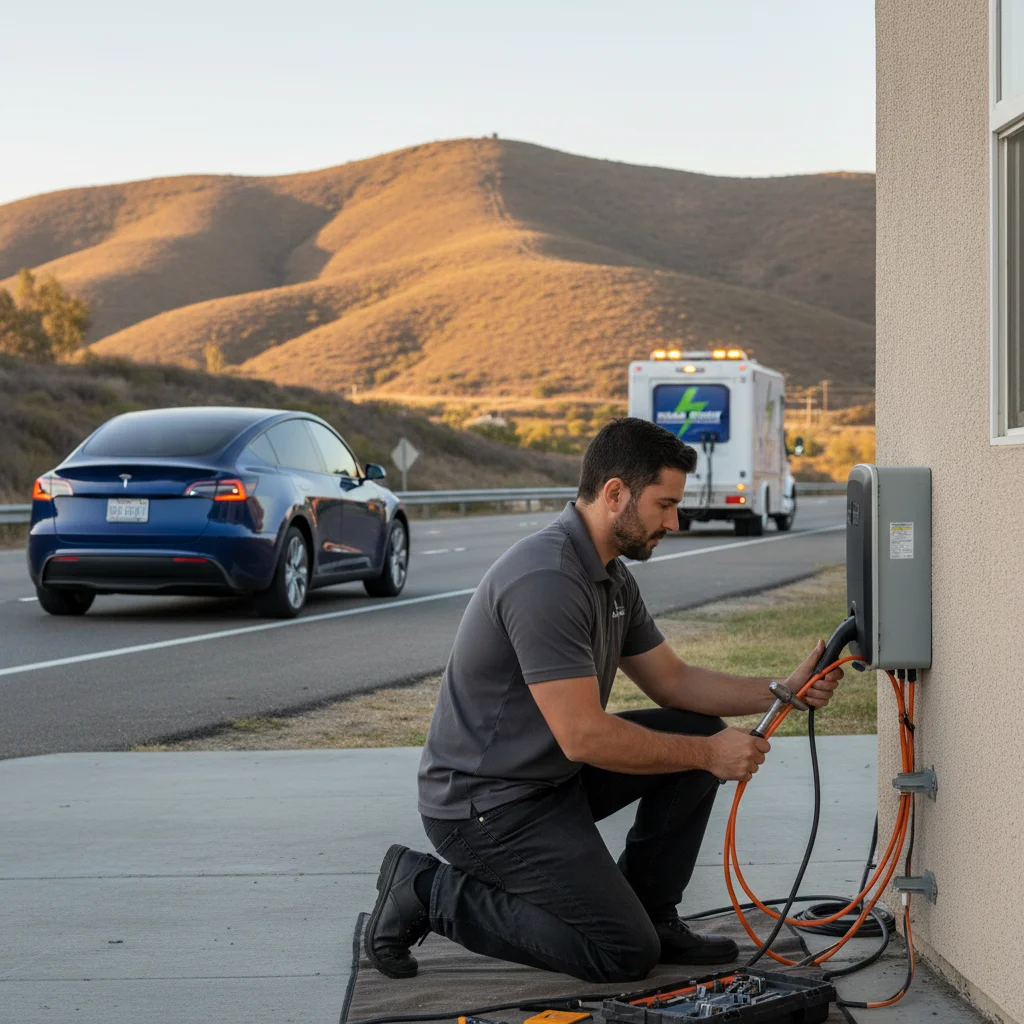
A large southwest Broward grid, not a hill climb
Miramar covers 28.853 square miles of Broward County. Census ACS 2019-2023 puts the city at 135,986 people. The 2024 estimate is 143,242. That’s a wide east-west grid on the Alligator Alley approach. There’s no hill that steals range here. Broward’s highest natural point is Pine Island Ridge at about 29 feet. Range in this city is heat, air conditioning, and sitting time.
The east-west split shows up in the housing. Historic Miramar and the older eastern tracts still carry pre-1980 stock. About 27.9% of Miramar homes were built before 1980. That’s a stand-in for panels and apartments that often can’t take a wall unit. West of that, Silver Lakes, Sunset Lakes, and Riviera Isles are newer master-plans. Drivers there usually plug in at home. The ones who stall are often crossing the city on a short errand.
Heat does the work a hill would do elsewhere
South Florida is flat across both counties. Recurrent Auto studied about 30,000 EVs. That work found about 5% range loss at 90F. Loss climbs to about 17 to 18% at 100F. AAA’s 2019 SAE-standard test ran EVs at 95F with the AC on. Range fell about 17% in that test. NWS Miami normals put July and August highs at 91F. A normal year sees about 64 days at or above 90F.
Your car’s computer estimated the errand on a cool morning. By midafternoon the cabin AC is pulling hard. Recurrent Auto notes 3 to 5 kW to cool a 95-degree cabin. Then it takes about 1 kW to hold it. The first minutes are the expensive ones. Summer storms roll through most afternoons, roughly 2pm to 6pm. Low-lying streets flood on king tides and heavy rain. You sit with the climate on while the water drops. The pack keeps falling while you wait.
Salt-laden humid air is hard on a 12-volt battery too. Every roughly 15F rise in temperature halves lead-acid life. Heat damage doesn’t reverse. An EV that sat a week in a corporate lot may not wake. The high-voltage pack can still hold range. The little battery that runs computers and latches is what died.
Miramar Parkway, Town Center, and the fleet mix
The city’s work spine is Miramar Parkway. Large corporate parks line that corridor. The Miramar Town Center sits in the same weekday pattern. You can leave the Miramar Regional Park amphitheater with less range than planned. People leave Teslas, Bolts, Mach-Es, and fleet vans in those lots. After a long stretch in the heat the car can look fully dead. Sometimes it needs a 12V jump. Sometimes the traction pack is actually empty.
Neighbors shape the commute. Pembroke Pines sits on the north edge. Weston sits west toward the Alley. Hollywood and West Park sit east. You can leave Historic Miramar for a job along the parkway. Then you merge west on I-75 with a thin buffer. AC on a hot afternoon burns that last slice. The same loop shows up in EV roadside assistance in Pembroke Pines.
ZIP codes here are 33023, 33025, 33027, and 33029. Florida Power and Light serves the city. FPL EVolution is the utility’s public charging brand. FPL EVolution Home is the residential Level 2 install-and-maintain program. Confirm current terms with FPL before you enroll. This page does not publish rates.
I-75, the Turnpike, and US-27 toward the Everglades edge
Major corridors through Miramar include I-75 and Florida’s Turnpike. You’ll also hit Miramar Parkway, Pembroke Road, Red Road, Flamingo Road, and US-27. I-75 here is the Alligator Alley approach. Once you commit west, towns thin fast. If you’re already low, get off before that stretch. Read the Alligator Alley empty-pack steps before you gamble on the next interchange.
Florida’s Turnpike Enterprise runs the Turnpike. It’s all-electronic, SunPass or toll-by-plate. There’s no cash booth to argue with. If you stall in a travel lane, move off it if you can. Florida Statute 316.194 says to leave the main-traveled part where practicable. A genuinely disabled vehicle that can’t practicably move off is exempt under 316.194(2). Put the hazards on. Stay out of the live lane if the car will still roll.
Florida Highway Patrol takes disabled-motorist reports at *FHP (*347). FDOT’s Road Ranger Service Patrol will jump-start a vehicle. Rangers also handle minor repairs and flat tires. They can tow a disabled vehicle from the travel lanes to the nearest safe spot. That patrol is free of charge. District 4 covers Broward. It patrols I-75 from the Miami-Dade line to mile marker 50. Road Ranger pages do not mention EV charging. A Ranger can still jump a 12V or pull you off the lanes. A Level 2 top-up is what mobile EV charging operators bring.
What the operator brings, and what the brand does not
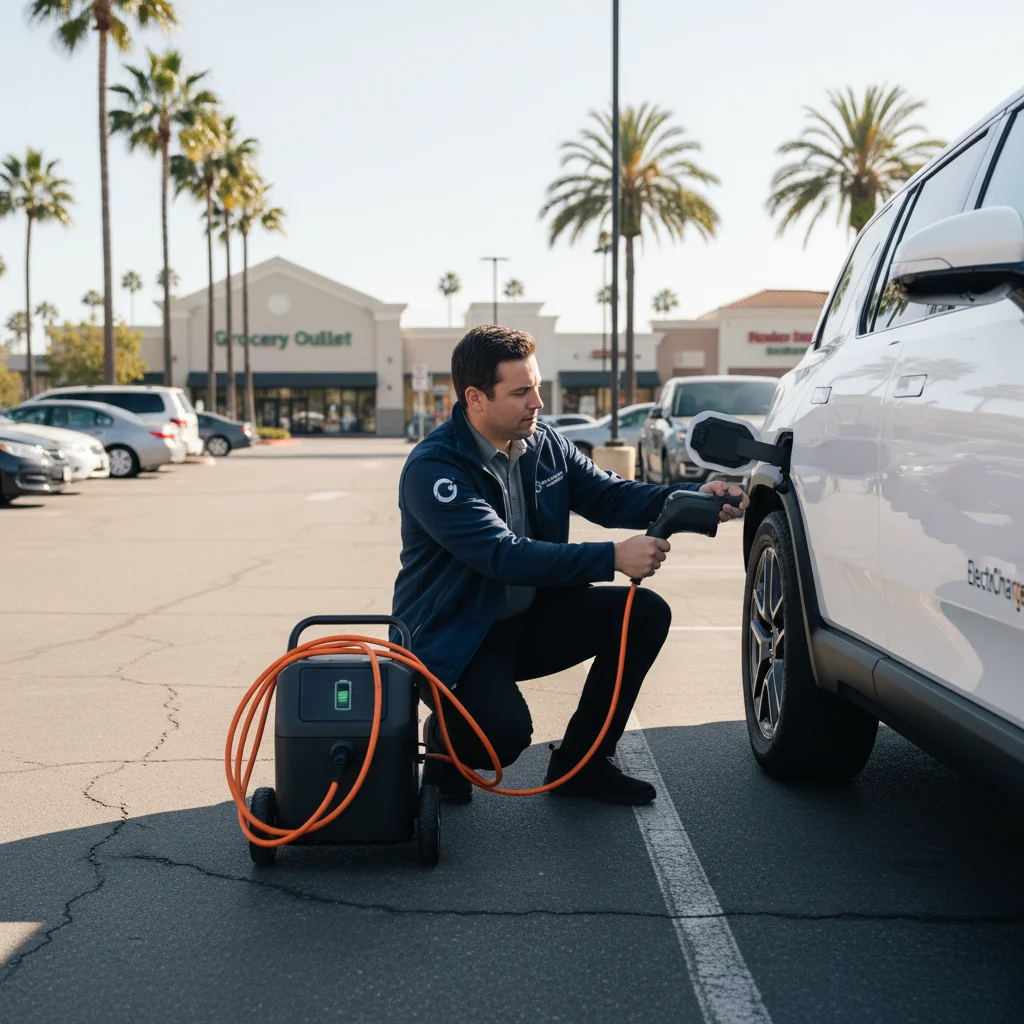
Charge Pro MIA does not own trucks, yards, or adapter stock. We don’t employ technicians, and we connect you with independent pros. Those operators bring a 240V Level 2 source to the car. Teslas get a native NACS plug. CCS or J1772 adapters cover non-Tesla EVs. Typical charging time adds 10 to 20 miles of range in 15 to 30 minutes. That’s plug time, not a promise of when someone arrives. Nobody on this line publishes an arrival window.
They also jump or replace a dead 12V on site. That covers Tesla and every major EV brand. The operator quotes before starting, and you pay that operator directly.
If the pack is empty, a jump will not move you. If the screens are black and the doors will not unlatch, start with the 12V. Heat after a week in a parkway garage is a classic 12V stall. A flood-exposed EV is a different problem. NHTSA warns residual salt in a flooded lithium pack can short later. Don’t drive or charge a flood-soaked EV until it’s inspected. Don’t park it within 50 feet of a structure.
Charge on site versus a Broward non-consent tow
A flatbed is the wrong first move for a pack that’s only empty. Loading an EV the safe way takes a flatbed, not a wheel-lift. Then you still need a plug at the other end. Broward County Code Section 20-176.22 sets maximum nonconsent tow rates. Don’t treat a lot tow as a rescue plan. Florida Statute 715.07 has a stop-and-return rule. If you appear before the car is fully removed, the operator must stop. You pay no more than one-half the posted tow rate in that case. Storage in Broward must sit within a 10-mile radius. Confirm the current posted schedule with the yard. This page does not invent a dollar cap.
Charge on site or tow is the real fork. If you’re on a shoulder, get a Level 2 top-up first. That can be enough to reach a safer lot. If the car will not wake, the 12V comes first. If water reached the pack, stop and get it inspected. Don’t keep cycling the starter.
Hurricane season runs June 1 to November 30. FPL tells EV owners to keep the pack between 50 and 80% through the season. Unplug during the storm, and don’t charge a flood-exposed car. The Florida Division of Emergency Management has deployed temporary EV chargers on I-75 for evacuations. That’s a storm tool, not a daily Miramar plan. On a normal weekday the help is an operator at the car. That might be a Town Center lot or a Silver Lakes driveway. It might be the I-75 shoulder after you’re out of the live lane.
If you need EV roadside assistance in Miramar, call (786) 963-2995. We’ll connect you with a local operator who quotes the job before they plug in.