Your EV stalled in North Miami Beach after a public plug. That’s the usual story on these older streets. Charge Pro MIA connects you with independent local operators. They bring a 240-volt charge to the car. They can jump a dead 12-volt on site. They can move the vehicle when the site isn’t safe to work.
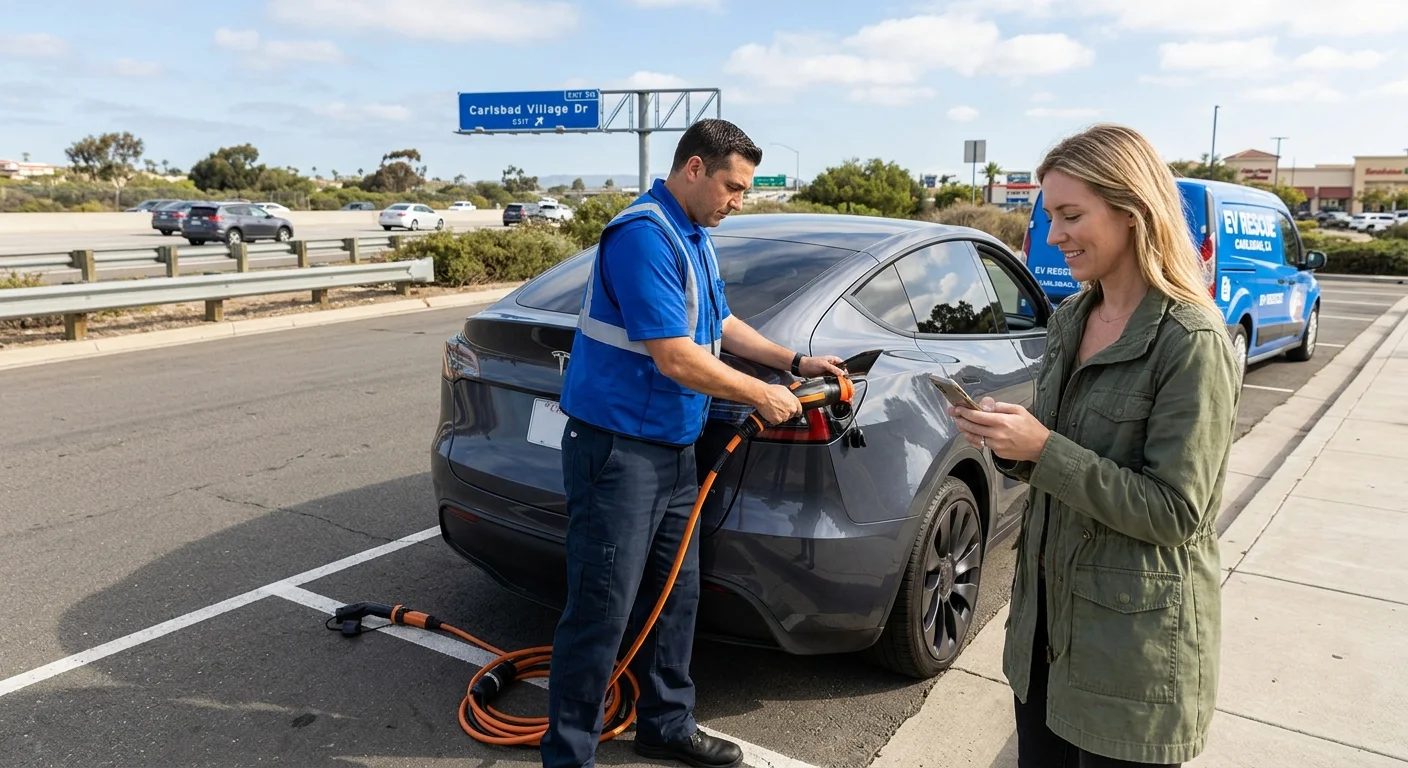
Public charging is how a lot of this city drives
Census ACS 2019-2023 data covers this city’s housing stock. 80.0% of it went up before 1980. Older panels and apartment stock follow from that. A wall charger is often not installable. Florida Power and Light serves the city. FPL EVolution is the utility’s public charging brand. Drivers in Uleta, Fulford, Eastern Shores, and Skylake live this pattern. They finish many days on public plugs, then try to get home.
North Miami Beach is mostly not on the beach. It’s dense housing along the Intracoastal that feeds the barrier islands by causeway. Aventura’s towers sit next door and work the same way. People plug at a garage or a street station. Then they roll US-1 or head east toward Sunny Isles Beach. When the pack is already thin, air conditioning spends the rest.
There’s no hill tax on range here. Miami-Dade’s highest natural point is the Atlantic Coastal Ridge. It sits around 23 to 24 feet. Range is heat, AC, and dwell. NWS Miami 1991-2020 normals put July and August average highs at 91F. A normal year sees about 64 days at or above 90F. Recurrent Auto studied about 30,000 EVs. It found about 5% range loss at 90F. The loss is about 17 to 18% at 100F.
Salt air is rough on a 12-volt battery. A car that sat a week by an Intracoastal marina may not wake. The same thing happens in an Eastern Shores lot. That’s not an empty pack. The operator needs to hear the difference.
Tell a dead pack from a dead 12-volt
Both failures look like a brick from the seat. They aren’t the same job.
A traction pack at zero still often shows a percentage. You may have seen a low-charge warning or limp power. Write down the last range you saw. A black screen, silent locks, and a car that will not wake point at the 12-volt. Battery University notes that every roughly 15F rise halves lead-acid life. South Florida holds that heat for months.
Say what still works. Note whether the main screen lights. Note whether the doors unlock. Note whether it goes into neutral. Note whether the charge port responds. Report what you can see. Don’t pull panels. Don’t poke high-voltage parts. Don’t keep tapping warnings you don’t understand. Photograph the message if it’s safe.
Out-of-charge recovery is the path when the main pack looks empty. A 12-volt jump is the other common call, including Tesla 12V battery jump for Tesla owners. The operator still confirms the car, the plug, and whether the site can take the work.
The U.S. Department of Energy publishes general charging background. It won’t diagnose this stall. Follow the automaker’s towing and roadside steps.
Pin the block, not the city name
North Miami Beach is too big to dispatch on. US-1, the causeways, NE 163rd Street, and West Dixie Highway are different approaches. Start with the corridor, the direction, and a cross street. Drop a map pin.
On Biscayne Boulevard, say northbound or southbound. Name the nearest plaza and the side of the road. Say whether you already left the through lanes. If you pulled into a lot, name the business and which entrance you used.
The William Lehman Causeway and the Sunny Isles Causeway are the east-west runs to the islands. A causeway stall is a traffic problem first. If the car still rolls, get out of a travel lane. Turn the hazards on. Then describe shoulder width, barriers, and the nearest place a truck can stand. Greynolds Park, the Intracoastal marinas, and the Ancient Spanish Monastery are usable landmarks.
NE 163rd Street is SR-826 as it runs east through this city. FDOT District 6 Road Rangers patrol SR-826, I-95, and 95 Express. They jump-start vehicles and do minor repairs. They also tow a disabled car from the travel lanes to the nearest safe spot. Dial *FHP (*347) if you’re in a live lane. Their published material does not mention EV charging. They can still jump a 12-volt or move you off the lanes. A Level 2 charge is what the matched operator brings, not the patrol.
Florida Statute 316.194 says leave the main-traveled part where practicable. 316.194(2) exempts a genuinely disabled vehicle that cannot be moved. Creep to a shoulder, a ramp, or a lot if you can.
Gated buildings change the job. Aventura’s towers sit on the north edge. If the EV is in a garage, share the level and the named entrance. Add clearance signs and how a service vehicle gets in. Don’t assume a gate opens for a rescue truck. On private property, Florida Statute 715.07 governs non-consent tows. Miami-Dade Code Section 30-476 caps those rates. The property needs a proper tow-away sign. If you appear before the car is fully removed, the tow operator must stop. They return it on payment of no more than half the posted rate. We don’t publish that dollar figure. Ask for the posted schedule.
West Dixie Highway and the Uleta grid are slower streets with older lots. A driveway, a strip plaza, and a marina parking strip are not the same working space. Describe the actual site.
What to have ready on the call
Make, model, year, and charge-port location. Say whether it’s a Tesla or another brand. Operators typically bring a 240-volt Level 2 source with a native NACS plug. They carry CCS or J1772 adapters for everyone else. That typically adds 10 to 20 miles of range in 15 to 30 minutes of charging. That number is charging time. It isn’t an arrival window. Confirm the connector on the call. Don’t assume your adapter matches theirs.
On a Fulford curb, say how the port faces the street. Do the same on a tight Eastern Shores drive. Surface lots, hotel drives, and enclosed garages need different trucks. Mention clearance bars, loading zones, and HOA gates.
Stay on the phone. A white SUV on Biscayne at dusk isn’t a meeting point. Plate description, a fixed sign, and a pin are.
Charge Pro MIA is a referral line. It matches stranded EV drivers with independent local mobile rescue operators. It performs no work, owns no trucks, and employs no technicians. It sets no prices and publishes no arrival time. The operator quotes you before starting and bills you directly.
For coverage beyond this stall, see EV roadside assistance and mobile EV charging. Local map context is on the North Miami Beach charging page.
Charge here, or move the car first
Mobile charging isn’t the default. It fits when the traction battery looks empty and the port works. A service vehicle also has to stand next to the car. If the 12-volt failed, a jump or an on-site replacement may be the whole job. If you’re in a travel lane or standing water, moving the car comes first. The same is true of a garage the truck can’t enter.
Low-lying streets flood on king tides and on heavy rain. Summer storms stack up from about 2pm to 6pm. If water is around the car, don’t plug in. NHTSA warns that residual salt in a flooded lithium pack can short days or weeks later. A flood-exposed EV shouldn’t be driven or charged until it’s inspected. It shouldn’t sit within 50 feet of a structure. Get people out of traffic. Then ask about a move, not a charge.
If a short top-up is on offer, ask what it’s for. The point is enough range to reach a safer lot. That can also mean a public plug you already had in mind. Read the display before you pull out.
We don’t publish a North Miami Beach price. Charge Pro MIA doesn’t set the operator’s rate. Ask for the current amount and the terms before you approve. Your insurer, automaker plan, or club membership may apply.
The same apartment-and-tower pattern shows up in North Miami and next door in Aventura. Each call still has to describe this car, this block, and this access.
When to call
Call when the EV has stopped in North Miami Beach. You need an operator to weigh a mobile charge, a 12-volt jump, or a move. Have the pin, the vehicle, the last battery reading, and the dashboard text ready. Call (786) 963-2995 and we’ll connect you with a local EV rescue operator.