The typical North Miami house went up before 1980. About 82.7 percent of the city’s housing did. That age is why a lot of EV owners here never get a wall charger at all. The panel is old. The building is an apartment. The landlord never signed off. So when the car dies on Biscayne Boulevard, you’re not rolling into a garage plug. You’re searching EV roadside assistance North Miami because the next move has to be a charge, not a flatbed.
That’s the search. Your EV is silent on an older street. You need to know what happens next.
Older housing is why the car dies on the street
North Miami is a real city in Miami-Dade County. It covers just over eight square miles. Census ACS 2019-2023 counts 59,429 residents. The 2024 estimate is 62,202. The city is dense and mixed. It has a large Haitian community, working families, and apartment blocks. Keystone Point and Sans Souci sit as named pockets inside that mix. The spine is US-1, Biscayne Boulevard. I-95 cuts the west side. NE 125th Street, NE 6th Avenue, and West Dixie Highway carry the daily errands.
The housing figure is the one that matters for EVs. ACS data puts 82.7 percent of North Miami’s stock as built before 1980. That’s one of the oldest shares in the county. A Level 2 home charger needs a spare 240-volt circuit. It also needs a panel that can take the load. A lot of these buildings never got that upgrade.
Florida Power and Light serves the city. FPL EVolution Home is the residential install-and-maintain program. It still can’t put a charger where the wiring won’t support one. So the pattern here isn’t a forgotten garage plug. A lot of people live on public plugs from day one. That leaves no overnight buffer. One extra loop, one afternoon of AC, and the estimate drops faster than you planned.
If you’re weighing a panel job against a rescue tonight, read home charger panel upgrade or roadside. Charge Pro MIA does not install chargers. Licensed electricians do that work. The operators we send handle the stranded car.
Two failures that look the same from the sidewalk
Drivers mix these up constantly.
The first is a traction pack that’s actually empty. You drove until the estimate hit zero. The car may still show a screen. It may have already limited speed. What you need then is a mobile Level 2 charge. That’s 240 volts brought to the car.
The second is a dead 12-volt battery. Every modern EV still has one. It runs the computers, the door latches, and the charge-port door. When it dies, the main pack can be fine. The car still looks like a brick. Heat makes this worse. Battery University notes that every roughly 15°F rise halves lead-acid life. South Florida sits in that heat for months. Salt-laden humid air around Biscayne Bay doesn’t help a 12-volt that sat a week.
Florida International University’s Biscayne Bay Campus produces this call. So does the Museum of Contemporary Art lot. So do the streets near Oleta River State Park. “It won’t wake up” is often the 12-volt, not range. The 12-volt failure guide walks through the signs.
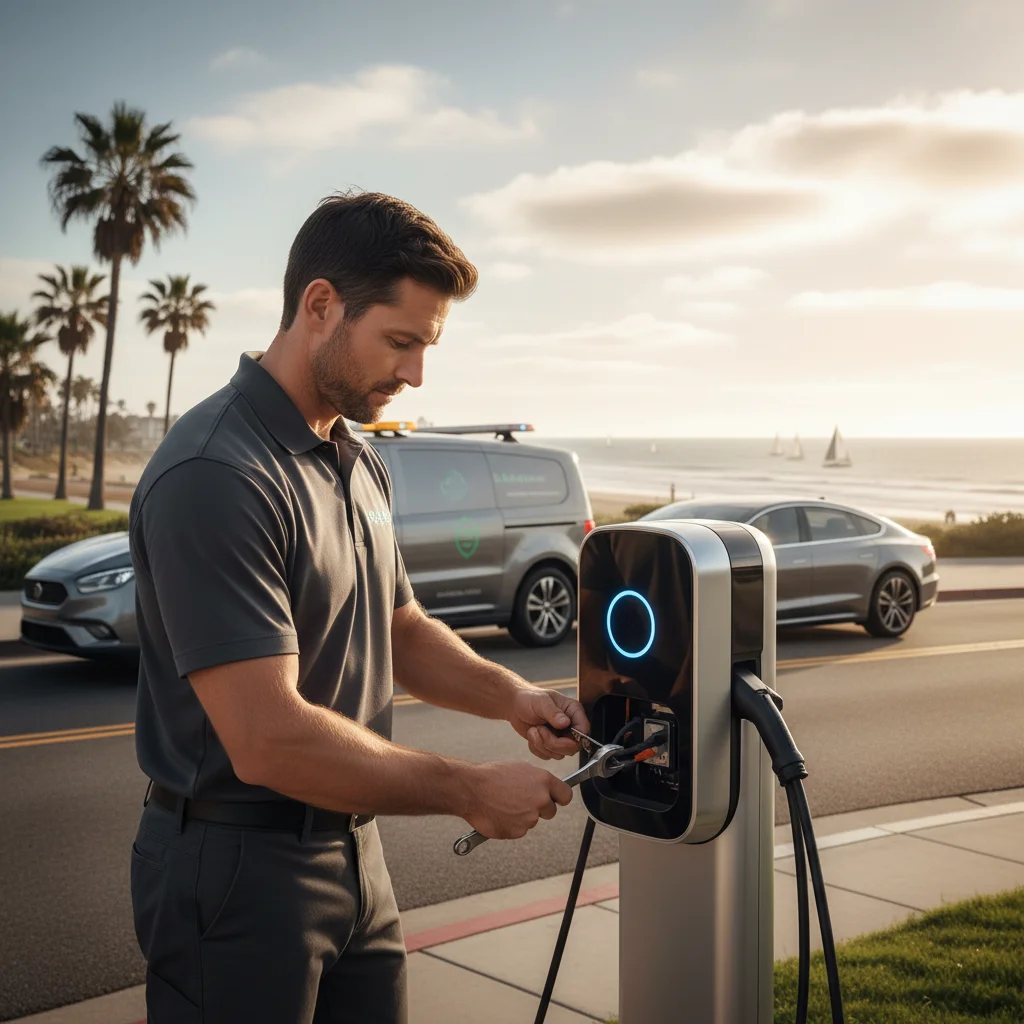
Operators we connect you with carry both tools. They bring a 240-volt Level 2 source with a native NACS plug. They also bring CCS or J1772 adapters for non-Tesla cars. They jump or replace a dead 12-volt on site. A typical charge adds 10 to 20 miles in 15 to 30 minutes of charging time. That’s plug time. It is not a promise of when anyone arrives. The operator quotes you before work starts and bills you directly.
Charge Pro MIA is a referral line. We match stranded drivers with independent local operators. We don’t own the truck.
Biscayne, 125th Street, and the I-95 edge
Biscayne Boulevard is the daily grind. School traffic and store runs crawl past NE 125th Street. That low-speed traffic eats range. Creeping with the AC on costs more than a highway cruise.
The ground is flat. Miami-Dade’s highest natural point is only about 23 to 24 feet. Range here is heat and air conditioning, not hills. NWS Miami 1991-2020 normals put July and August average highs at 91°F. A normal year sees about 64 days at or above 90°F. Recurrent Auto’s fleet study of about 30,000 EVs found about 5% range loss at 90°F. The same study found about 17 to 18% loss at 100°F. AAA’s 2019 SAE-standard test found about a 17% drop at 95°F with the AC on.
West Dixie Highway and NE 6th Avenue are slower and more residential. Sunkist Grove sits on those slower streets. Apartment blocks off NE 6th Avenue often sit between public charging sessions. If the car sat through a summer storm window, check the 12-volt first.
I-95 on the city’s west edge is a different problem. A dead EV in a travel lane is a hazard. Florida Statute 316.194 says you leave the vehicle off the main-traveled part where you can. A genuinely disabled vehicle that cannot practicably be moved is exempt. You still want out of the lane. Dial *FHP (*347) for Florida Highway Patrol and the Road Ranger Service Patrol. Road Rangers jump-start vehicles and handle minor repairs. They also tow a disabled car from the travel lanes to a safer spot, at no charge. Their public materials don’t mention EV charging. A Level 2 top-up is the job of a mobile operator. That’s why people also land on the North Miami EV charging and rescue page. For the freeway steps, read what to do when an EV dies on the freeway.
NE 125th Street feeds I-95 and the rest of north Miami-Dade. If you’re emptying out toward Miami Gardens or Aventura, don’t wait for zero on the on-ramp.
The north-county loop around North Miami
North Miami sits against North Miami Beach, Miami Shores, the City of Miami, Aventura, and Opa-locka. The same older-housing story shows up next door. About 80 percent of North Miami Beach’s housing also predates 1980. Hialeah, a short drive west, has 60.1 percent pre-1980 stock. Miami Gardens, to the northwest, is 72.0 percent pre-1980. Hard Rock Stadium days stack cars in lots for hours.
A typical loop here is not a long mountain drive. It’s Biscayne to a campus lot, then a mall run toward Aventura, then home. The car started the day already on a public plug. Afternoon thunderstorms, usually about 2 p.m. to 6 p.m., push the AC harder. Low-lying streets can flood on king tides and heavy rain. None of that is a hill. All of it drains the pack.
Aventura’s pattern is different. High-rises around Aventura Mall mean longer dwell times in a garage. North Miami is the other end of the same county. Older panels. Street parking. Public charging as the default, not a backup. That’s why the rescue call is often from a block that never had a wall unit. North Miami Beach has the same mix. That write-up is EV roadside assistance in North Miami Beach.
Hurricane season runs June 1 through November 30. When Miami-Dade orders an evacuation north, I-95 and Florida’s Turnpike are the launch. FPL tells EV owners to keep the pack between 50 and 80 percent through the season. Unplug during the storm. Don’t charge or drive a flood-exposed EV until it’s inspected. NHTSA warns that residual salt in a flooded lithium pack can short later. A flood-exposed EV should not sit within 50 feet of a structure.
What the operator does once they park
You describe the street, the car, and what the dash is doing, or not doing. Dispatch matches you with an independent operator who covers this part of Miami-Dade. The operator confirms the location and quotes the job before anything starts.
On site, the first question is 12-volt versus pack. If the car is silent with a healthy traction battery, a 12-volt jump can wake it. A 12-volt swap works the same way. If the pack is empty, the operator connects a 240-volt Level 2 source. Teslas take a native NACS plug. Other brands use CCS or a J1772 adapter. That covers Tesla, Hyundai, Kia, Ford, Chevy, and Rivian. BMW, Volkswagen, Audi, Mercedes, and most other EVs on these streets too.
Charging time is usually 15 to 30 minutes for about 10 to 20 miles. That’s enough to reach a place you can sit and finish a charge. It can also get you home if home is close. The operator does not need your garage. They work on the street or in a lot. A legal shoulder works once you’re out of a live lane.
Tesla’s own roadside program, in most markets, is built around tires, locks, and tows. Mobile charging is the piece local operators fill. Check the Tesla app for what your account includes. Then decide whether you still need a charge brought to the car.
For a charge-focused visit, see mobile EV charging. For an empty pack on the street, out-of-charge recovery is the matching service page.
FPL, public plugs, and the night you can’t charge at home
FPL is the utility. FPL EVolution is the public charging brand. FPL EVolution Home is the residential Level 2 program. FPL also publishes a Time-of-Use rate for home charging. None of those programs changes an 82.7 percent pre-1980 housing share overnight. If your building can’t take the circuit, you keep using public plugs. You also keep a rescue plan for the night the last session didn’t stick.
Don’t aim for zero. If the estimate is already thin, pick a safe lot. Call while the car still rolls on Biscayne or West Dixie. Waiting until the car is a silent shape on NE 6th Avenue just makes the job harder.
Private lots can tow under Florida Statute 715.07. If a wrecker starts a non-consent tow, you still have a window. Arrive before the car is fully removed, and the operator must stop and return it. You pay no more than half the posted tow rate. Miami-Dade caps non-consent rates under Code Section 30-476. Confirm the current posted rate with the yard.
Frequently asked questions
What should I do first if my EV dies on a North Miami street?
Get out of a travel lane if the car will still move. Hazards on. Then figure out whether it’s a 12-volt or an empty pack. No dash, no locks, no wake-up usually points at the 12-volt. A car that still talks to you but shows zero is a range problem. Call for a local operator either way. On I-95, start with *FHP (*347) so a Road Ranger can clear the lane.
Can older North Miami housing take a home charger?
Sometimes, if you own the place and the panel can take a 240-volt circuit. Often, it can’t. Apartments, older duplexes, and pre-1980 houses are the usual stop. Ask FPL about EVolution Home if you want an install path. Charge Pro MIA doesn’t do that work. We connect you with a mobile operator for the stranded car.
Who shows up when I call for a dead EV here?
An independent local operator, not a Charge Pro MIA truck. They bring a 240-volt Level 2 source, a NACS plug, and CCS or J1772 adapters, plus 12-volt jump gear. They quote you before they start. They bill you directly.
If you’re already stranded
Call (786) 963-2995 if the car is dead on Biscayne, West Dixie, or NE 125th Street.