Four percent on a Collins Avenue tower display is a stall, not a close call. In Sunny Isles Beach, many condo buildings never wired a resident wall plug. You can’t top up overnight the way a house can. EV roadside assistance here means a mobile Level 2 charge brought to the car. If the car is silent after sitting, it may be the 12-volt instead. Charge Pro MIA is a referral line. We match stranded EV drivers with independent local operators. The operator quotes you before any work starts.
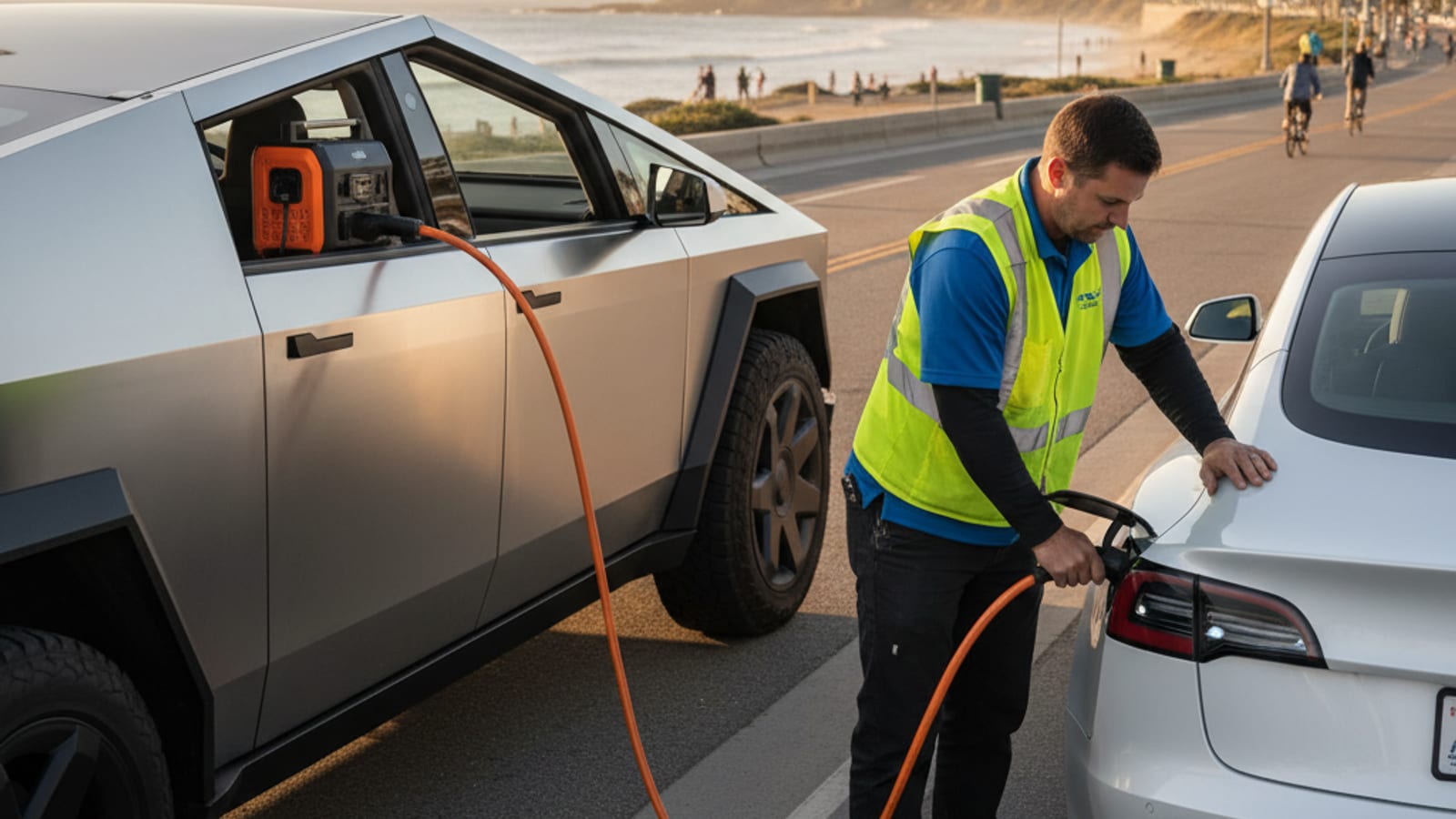
A one-square-mile city that’s almost all towers
Sunny Isles Beach sits on a Miami-Dade barrier island of about 1.011 square miles. Census ACS 2019-2023 counts 22,125 residents. The 2024 estimate is 22,903. That’s a small population packed into an oceanfront high-rise wall. ZIP code 33160 covers the city. Florida Power and Light serves it.
Collins Avenue, also signed A1A, is the north-south spine. The William Lehman Causeway, SR-856, is the run to the mainland. Aventura sits on the far side of that causeway. Bal Harbour, North Miami Beach, and Surfside sit along the same coastal strip. Haulover Park is just south. The Newport Fishing Pier is a named landmark on the water. Golden Shores and the Intracoastal side sit west of the Collins Avenue tower row.
This isn’t inland housing. Doral’s stock is only about 5.5% pre-1980, so a home plug is more often installable there. Sunny Isles Beach is different. About 48.5% of housing here was built before 1980, per ACS 2019-2023. That older share is a proxy for aging panels. Many apartments never planned a 240-volt resident circuit. Newer towers still park in shared structures. The association, not the driver, controls whether a stall gets a plug.
The city is also second-home-heavy, rental-heavy, and heavily international. Cars sit for a week while the owner is overseas. A visitor in a rented EV learns the heat on the first afternoon.
For city-level charging context, use the Sunny Isles Beach EV charging page. This article can’t publish a station-by-station map. Federal AFDC station data couldn’t be confirmed for this piece. Confirm any public post in the moment, before you spend the last miles toward it.
Heat eats the buffer, not the hills
South Florida is flat. There’s no grade penalty on range in Miami-Dade. The county’s highest natural point is the Atlantic Coastal Ridge at roughly 23 to 24 feet. Sunny Isles Beach is coastal ground with no climb. Range here is heat, air conditioning, and time parked.
NWS Miami 1991-2020 normals put July and August average highs at 91F. A normal year sees about 64 days at or above 90F. Summer afternoons bring daily thunderstorms, roughly 2pm to 6pm per NWS Miami. The AC runs most of the year on this coast.
Recurrent Auto’s fleet study of about 30,000 EVs finds about 5% range loss at 90F. The same study finds about 17 to 18% at 100F. Cooling a 95-degree cabin can take 3 to 5 kW in the first minutes. AAA’s 2019 SAE-standard test found about a 17% range drop at 95F with the AC on. Don’t treat those figures as a Tesla-specific number.
A Collins Avenue errand looks short on the map. The cabin still cools from a hot garage. Preconditioning while you wait downstairs uses energy you thought you’d keep. A four percent buffer that looked fine at the lobby can be empty at the gate. The same nibble happens on a crawl to Haulover Park.
You don’t need a highway to run down here. You need a thin buffer, a hot stall, and a building that never gave you a plug.
Four percent on the dash is an empty pack
If the screens still wake and show a few miles, the traction pack is low. You used the energy. Hunting another garage while you’re already that thin is a gamble. Out-of-charge recovery is the on-site path. An operator brings a 240-volt Level 2 source to the bumper. Tesla vehicles take a native NACS plug. Other brands use a CCS or J1772 adapter.
A typical top-up adds 10 to 20 miles of range in 15 to 30 minutes of charging. That’s charging time, never an arrival clock. Ten to twenty miles is usually enough to leave the garage. Use it to reach a plug you can verify. It isn’t a full fill. Ask how many miles you need before they start. The operator quotes you first and bills you directly.
Charge Pro MIA owns no trucks and employs no technicians. We set no prices and publish no hours. The pros we connect you with are licensed and insured. Distance and time of day move that quote. So does how much range you need, and whether you also need 12-volt service. Ask for the quote before they unroll a cable.
A roadside top-up is meant to make the car movable. It isn’t a substitute for overnight charging at a house you don’t have.
A silent car after a week is often the 12-volt
Many owners think an EV has one battery. It doesn’t. The high-voltage pack moves the car. A small 12-volt battery wakes the computers, latches, and screens. When that 12-volt dies, the car can look like a brick. The pack may still hold miles.
Salt-laden humid air along this coast is hard on that battery. Battery University notes that every roughly 15F rise halves the life of a lead-acid 12-volt. It ages about twice as fast at 93F versus 77F. It ages about four times as fast at 111F. That heat damage doesn’t reverse. A second-home Tesla that sat through a trip may not wake in the tower. The same pattern shows up after a week in a rental stall.
The operators we connect you with can jump or replace a 12-volt on site. Don’t order a flatbed until that check is done. A silent car and a four-percent car are different jobs. Say which one you have when you call.
A car that sat a week in a tower stall can come back silent for the same reason. The 12-volt drained keeping systems alive. Miami’s sustained heat makes the sit worse.
Condo living without a resident plug
A house west of the Palmetto can often add a wall charger. A Collins Avenue tower usually can’t, at least not on your own. You need the association, a reserved stall, and a path from the panel. Level 1 charging in a condo covers the slow overnight outlet some buildings still offer. Many stalls have no outlet at all.
FPL EVolution Home is the utility’s residential Level 2 install-and-maintain program. Confirm current terms with FPL. This page doesn’t publish program prices. For condos, FPL EVolution Make-Ready Credit is a multifamily program. Your association has to pursue it. Charge Pro MIA doesn’t install chargers. We don’t hold a trade license. The operators we connect you with recover a stranded car. They don’t wire your building.
FPL also offers a residential Time-of-Use rate for home charging. Confirm the current schedule with FPL. If you already can’t move, EV roadside assistance is the call, not a permit.
Daily life becomes a public plug and a thinner buffer. That’s why four percent in the garage is a common stall here. You left with just enough, and the AC took the rest. Nearby Aventura has the same tower pattern on the mainland side. If you died after crossing the causeway, EV roadside assistance in Aventura walks that mall-and-tower mix.
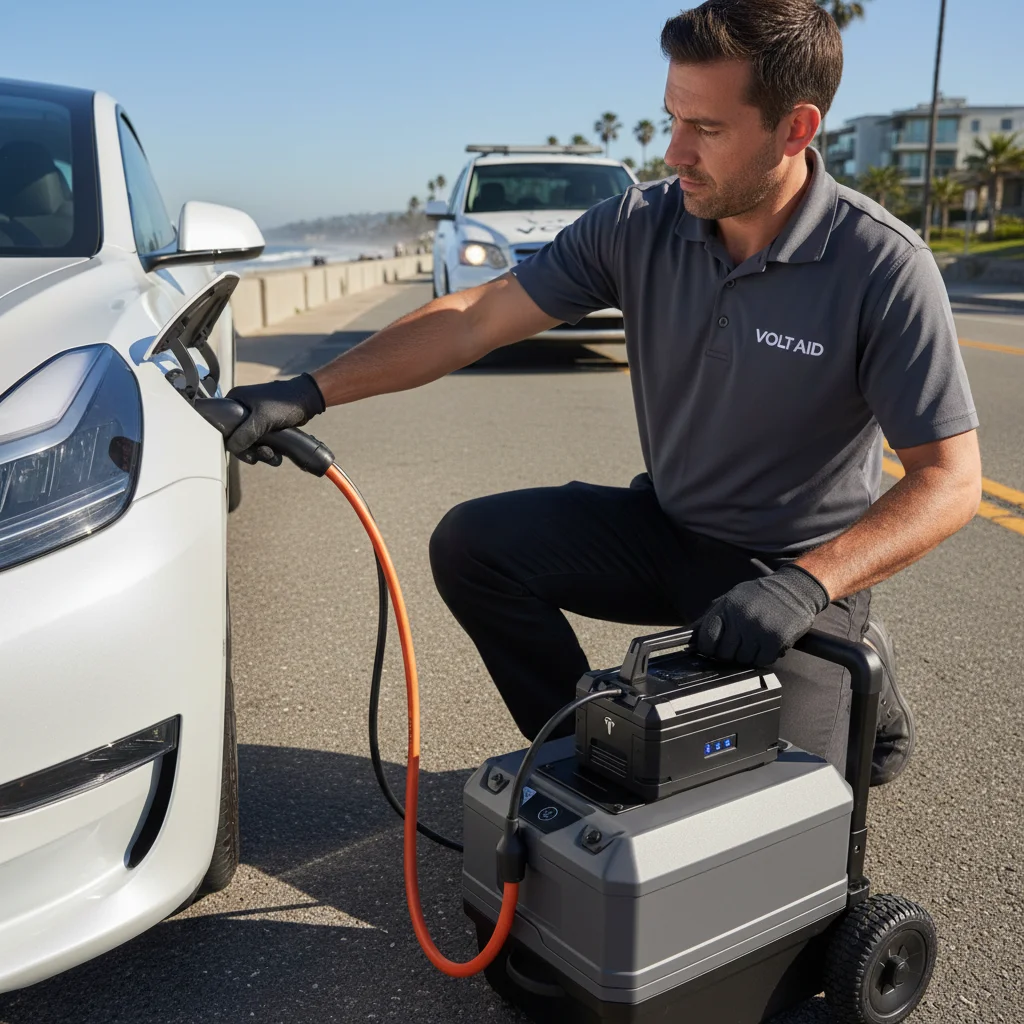
Collins Avenue, the causeway, and a car that stops
Named corridors here are Collins Avenue (A1A) and the William Lehman Causeway (SR-856). Collins is the tower row, the hotels, and the beach access. The causeway is the short link toward Aventura. Golden Shores sits on the west side. The Intracoastal side has its own garage pattern, still high-rise shared parking.
If the car dies on a limited-access highway, follow Florida Statute 316.194. Get off the main-traveled part where practicable. Leave room for passing traffic. Keep a clear view from 200 feet each way. A genuinely disabled vehicle that can’t be moved is exempt under 316.194(2). Florida Statute 316.1945 covers places where stopping is prohibited. Dial *FHP (*347) for Florida Highway Patrol and the Road Ranger Service Patrol.
Road Rangers jump-start vehicles and make minor repairs. They change flats and provide gas, diesel, and water. They can tow a disabled car from the travel lanes to the nearest safe spot. That patrol is free under FDOT. District 6 covers Miami-Dade. That includes I-95, 95 Express, I-195, I-395, I-75, 75 Express, and SR-826, the Palmetto. Road Ranger public pages don’t mention EV charging. They can still jump a 12-volt and move you off a lane. They don’t bring a Level 2 charge. A mobile operator handles that once you’re in a safe spot.
Florida 511 at FL511.com is FDOT’s traffic system, in English and Spanish. Use it for backups on the causeway before you commit the last miles.
A stall on Collins in front of a tower isn’t the same as a stall on I-95. Private pavement and a travel lane are different calls. If you’re blocking a lane, hazards on, and *FHP first. If you’re in a garage aisle, stay with the car and call for a mobile charge.
Surfside is the next beach city south, still a coastal strip. Hallandale Beach sits north across into Broward. Don’t assume the next city has a plug waiting in the building you parked.
King tides, salt water, and a flooded port
Low-lying streets here flood on king tides and heavy rain. King tides run mainly September through November. They last about three hours each. Miami-Dade publishes that window for coastal streets. Don’t sit in standing water with a live charge port.
NHTSA warns that residual salt in a flooded lithium pack can bridge and short. A flood-exposed EV shouldn’t be driven or charged until it’s inspected. It also shouldn’t be parked within 50 feet of a structure. About 36 EVs flooded by Hurricane Ian in 2022 later caught fire, per NHTSA. That’s an official warning, not a scare line.
Hurricane season runs June 1 through November 30. FPL tells EV owners to keep the pack between 50 and 80% through the season. Unplug during the storm. Don’t charge or drive a flood-exposed EV until it’s inspected. FPL also deploys mobile EV charging trailers before planned outages and during storms to aid evacuations. That’s FPL’s storm program, not this referral line.
If king-tide water reached the port, stop. Get the car to high pavement if you can still roll. Then get it inspected. A mobile Level 2 top-up is for a dry, empty pack, not a flooded one.
Private garages, wreckers, and Florida Statute 715.07
A stall in a tower garage is private property. Florida Statute 715.07 governs non-consent tows from private lots. Miami-Dade posts maximum non-consent rates in Code Section 30-476, effective 2022-10-16. This page doesn’t publish those caps, because posted tow prices go stale. Confirm the current schedule with Miami-Dade Consumer Protection.
If you appear before the car is fully removed, the wrecker must stop and return it. That’s subject to the statute’s payment terms. The property must carry a permanent, reflective, correctly sized tow-away zone sign at each access. It must be posted at least 24 hours ahead, with the statute’s listed exceptions. In a county of 500,000 or more, storage must sit within a 10-mile radius. The yard must release the car within one hour of request. Both Miami-Dade and Broward qualify. The operator must file its rate schedule with local law enforcement and post it at the storage site.
If a wrecker is already wrapping the tires, get to the car before it leaves the garage. A mobile charge can’t help a car that’s already on a wrecker bed across the causeway. Tower security may also want the aisle cleared.
Charge on site, or tow the car out
A mobile EV charging call keeps the car where it is. That’s the point in a tower garage with height bars, tight ramps, and a security desk. All-wheel-drive EVs should ride a flatbed if they must be towed. Wheels on the ground can damage the motors. If the pack only needs miles, charge it where it sits.
Walk that choice in when you need a charge, not a tow. A tow still leaves you needing a plug at the far end. A Level 2 top-up leaves you able to roll. FPL EVolution is FPL’s public charging network brand. It’s one place to look once you have enough range to move. Confirm the plug is actually metering before you spend the last miles.
Tesla roadside assistance is a separate channel. Tesla directs owners to request help through the Tesla app. Out-of-range help may be available, and Tesla says it isn’t financially covered. Availability can be restricted case by case. A local operator is the backup when you need a Level 2 source at the bumper. Charge Pro MIA doesn’t speak for Tesla. Ask Tesla in the app for what they’ll send. Ask the local operator for a quote on a charge or a 12-volt jump.
Non-Tesla brands are in the same garage. Rivian, Ford, Hyundai, Kia, Chevy, BMW, and Mercedes sit in the same garages. They still need a CCS or J1772 path for a Level 2 rescue. The operators we connect you with handle Tesla and every major EV brand. Confirm your port type when you call. Don’t assume the adapter is obvious from the logo on the liftgate.
What to do when you’re already at four percent
Stay with the car if you’re in a garage or a legal stall. Hazards on if you’re on Collins and traffic is moving around you. If you’re in a travel lane on a limited-access road, *FHP first.
Note the building name, the garage level, and the stall number. Collins Avenue towers look alike from the street. The operator needs a door, a level, and a bay, not just Sunny Isles. Say whether the dash is alive. Say the make and the port. Say whether you sat a week or you just ran the pack down.
We connect stranded EV drivers with independent local mobile rescue operators across South Florida. We don’t perform the work. Tell the operator you’re in a Sunny Isles Beach tower garage. Say if you’re on Collins, the Intracoastal side, or the Lehman Causeway. The quote comes before the cable.
Frequently asked questions
What does EV roadside assistance cover in a Sunny Isles Beach tower?
A mobile operator can bring a 240-volt Level 2 charge to the car. That’s the usual fix when the pack is at four percent. They can also jump or replace a dead 12-volt on site. They don’t wire your building. Charge Pro MIA matches you with that operator. The operator quotes you before starting and bills you directly.
How many miles does a mobile charge add?
A typical session adds 10 to 20 miles of range in 15 to 30 minutes of charging. That window is charging time, not a clock on arrival. Actual miles depend on the car, the heat, and the starting percent. The goal is enough range to leave the garage and reach a plug you confirm. Ask for the quote and the planned miles before they start.
What if the car won’t unlock after sitting in the garage?
Think 12-volt first. Salt air and heat age that battery fast on this coast. A jump or an on-site 12-volt replacement often wakes the car. A flatbed is the last move, not the first. Tell the operator the car is silent, not empty, so they bring the right gear.
Call (786) 963-2995 to reach Charge Pro MIA. The operator quotes the job before anything starts.