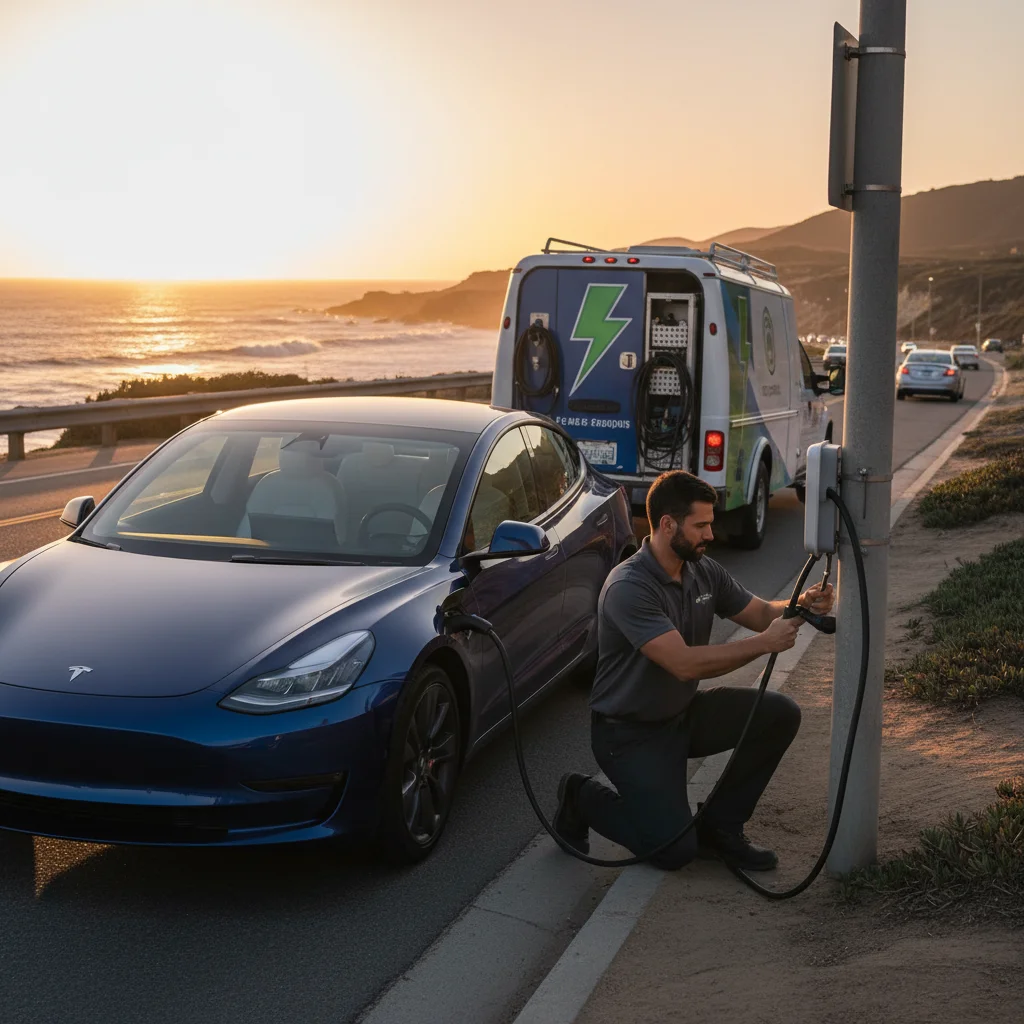
You’re on Collins Avenue with an empty pack. The oceanfront condo garage has no plug you can use. The car won’t roll to Harding Avenue on leftover hope. That’s the Surfside stall. It’s a small barrier-island town of oceanfront buildings. The street already used the last miles. Charge Pro MIA connects you with independent local operators. They bring a 240V Level 2 source to the car. They don’t work for us. They quote you before they start, and they bill you directly.
Surfside is small, and the causeway still costs range
Surfside covers 0.557 square miles in Miami-Dade County. Census ACS 2019-2023 puts the population at 5,566. The 2024 estimate is 5,719. You can walk a lot of it. You still need charge to leave the island. Neighbors sit tight against the town line. Miami Beach is south. Bal Harbour and Bay Harbor Islands sit beside it. Sunny Isles Beach is a short run north. Bal Harbour Shops sits just north of that line.
The corridors that matter are Collins Avenue (A1A) and Harding Avenue. The 96th Street approach is the other one. The town center, the oceanfront, and those streets share the same thin grid. ZIP 33154 is the whole place. When the pack hits empty here, you’re not on a long inland grid. You’re on a barrier island reached by causeway. Circling for a guest space burns more.
Florida Power and Light serves Surfside. FPL EVolution is the utility’s public charging brand. FPL EVolution Home is the residential Level 2 program. They don’t send a truck to a stall on Harding. If you need power where the car sits, that’s a different job. The Surfside city page is the local hub for that call.
Condo lots and pre-1980 buildings
People search ev roadside assistance surfside for a reason. A beach street or a tower lot left them stuck. About 61.5 percent of Surfside housing was built before 1980, per ACS 2019-2023. Older panels and apartment stock make a dedicated home charger hard to install. Many oceanfront condos still park cars in older garages. Those stalls were never wired for Level 2. That’s the angle of this town. You live in the building, or you parked as a guest. The stall often has no plug.
A visitor who shopped at Bal Harbour Shops can drift south on Collins. They can finish the evening on Harding with nothing left. A resident who ran errands across the 96th Street approach can come home drained. The Surfside community center is a real landmark. It won’t charge the car. If you can’t move, don’t sit there hoping a public stall opens. A mobile EV charging operator brings 240V to the bumper.
Tesla cars take a native NACS plug. Other brands use a CCS or J1772 adapter. A typical top-up adds 10 to 20 miles. That takes 15 to 30 minutes of charging. That’s charging time, not a promise of when someone arrives. Operators we connect you with handle Tesla and every major EV brand. There’s a sibling note on mobile EV charging in Surfside. Use it if the pack is empty and the car still wakes.
Heat and AC, not hills, take the last bars
South Florida is flat. There’s no grade penalty on range in Miami-Dade. The county’s highest natural ground is the Atlantic Coastal Ridge. It sits at roughly 23 to 24 feet. Surfside’s streets don’t climb. Range here is heat, air conditioning, and dwell. NWS Miami 1991-2020 normals put the July and August average high at 91F. A normal year sees about 64 days at or above 90F.
Recurrent Auto studied about 30,000 EVs. The fleet work found about 5 percent range loss at 90F. It found about 17 to 18 percent at 100F. Cooling a 95-degree cabin is expensive at first. It can take 3 to 5 kW in those minutes. Holding it cool takes about 1 kW. AAA’s 2019 SAE-standard test put a 17 percent range drop at 95F. That figure includes the AC. Summer afternoons bring thunderstorms, roughly 2pm to 6pm. The AC runs most of the year.
That’s why a short Collins Avenue hop can still leave you empty. You cooled the cabin. You sat in A1A traffic. You hunted a space on a crowded oceanfront block.
A silent car is often the 12-volt, not the pack
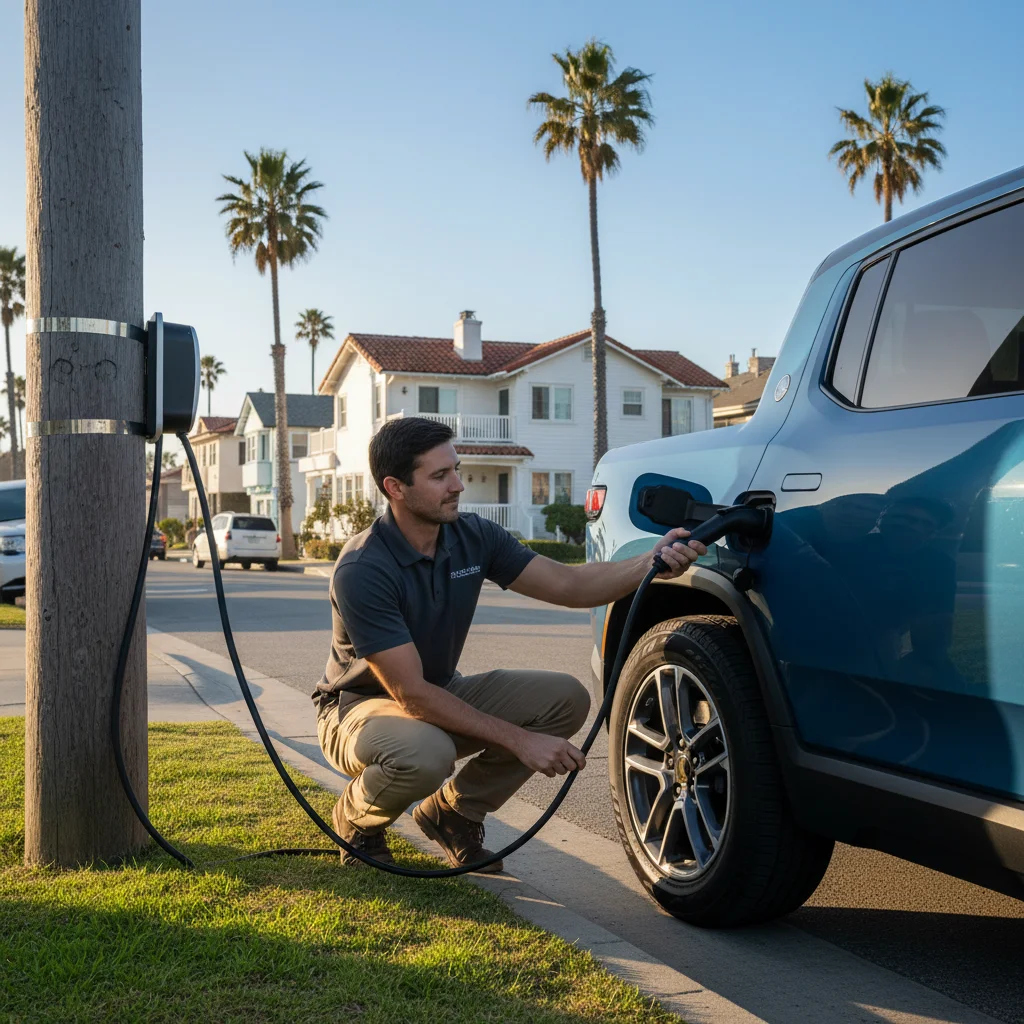
A dark dash isn’t always an empty high-voltage pack. Salt-laden humid air is hard on a 12-volt battery. A car that sat a week in a condo garage may not wake. South Florida heat makes that worse. Battery University notes that every roughly 15F rise halves lead-acid life. It ages about twice as fast at 93F versus 77F. It ages about four times as fast at 111F. Heat damage doesn’t reverse.
The 12-volt kept modules alive while the car sat. The traction pack may still have range. If the dash is dark and the handles won’t play, start with the 12-volt. Operators we connect you with can jump or replace a dead 12V on site. Read the Tesla 12V jump path if the car looks totally dead. Non-Tesla EVs fail the same way in this climate.
King tides and sunny-day flooding run mainly September through November. They hit low coastal streets on this strip. Miami-Dade publishes that pattern. If saltwater reached the charge port or the floor, don’t plug in. NHTSA warns that residual salt in a flooded lithium pack can short. Fires can follow days or weeks later. A flood-exposed EV shouldn’t sit within 50 feet of a structure. It shouldn’t be driven or charged until it’s inspected. After a king tide, dry the port and wait. Our note on water in the charge port covers the first steps.
Hurricane season is June 1 to November 30. FPL tells EV owners to keep the pack between 50 and 80 percent. Hold that band through the season. Unplug during the storm. Don’t charge a flood-exposed car until it’s inspected. That’s utility guidance, not a rescue promise.
Highway help, town streets, and the tow rules
Florida’s Road Ranger Service Patrol is FDOT’s free highway service patrol. Crews jump-start vehicles and change flats. They also tow a disabled car from travel lanes to a safe spot. Dial *FHP (*347) from a mobile phone. District 6 covers Miami-Dade, including I-95, I-195, I-395, I-75, and SR-826, the Palmetto. Road Ranger material doesn’t mention electric vehicles or EV charging. Don’t read that as them refusing an EV. A dead EV can still need a 12-volt jump. It can also need a move off a travel lane. A Level 2 charge isn’t something they provide.
Surfside’s beach streets aren’t those highways. If you’re already in a condo garage or on Harding, Road Rangers aren’t the tool.
Florida Statute 316.194 covers stopping on a highway outside a municipality. Leave the vehicle off the main-traveled part where practicable. Leave room for passing traffic. Keep a clear view from 200 feet each way. 316.194(2) exempts a genuinely disabled vehicle that can’t practicably be moved. On a town street, still get out of the travel lane if you can. Keep hazards on and people first.
A private-property tow follows Florida Statute 715.07. If you appear before the car is fully removed, the operator must stop. They must return the vehicle. You pay no more than half the posted tow rate. Miami-Dade Code Section 30-476 sets maximum nonconsent rates. Those dollar caps weren’t confirmed on a page that loaded. Don’t guess them. Confirm the posted schedule if a garage is already calling a wrecker.
Mobile charge versus a flatbed on these streets
For an empty pack on a Surfside street, a mobile charge usually beats a flatbed. A wrecker still has to thread Collins and a condo ramp. An EV that can roll after a top-up doesn’t need that extra handling. The operator delivers enough energy to reach a plug you already trust. You can also use it to get home. You drive out under your own power.
A tow can still be the honest answer. Mechanical damage can force a tow. Flood exposure can too. So can a stall the truck can’t reach. The operator on scene quotes before starting. Charge Pro MIA holds no trucks, employs no technicians, and sets no prices. It doesn’t promise an arrival window. Compare the next town’s playbook in Miami Beach EV roadside help. Use it if you crossed the city line on Collins.
If the car still wakes, the pack may be the only problem. Ask for EV roadside assistance that includes a Level 2 top-up. If the car is silent, say so up front. That’s a 12-volt job until proven otherwise.
When the stall started in the next town
A lot of Surfside calls start somewhere else. You came north on Collins from Miami Beach. You dropped south from Sunny Isles Beach after a tower garage. Bal Harbour and Bay Harbor Islands sit in the same strip. The 96th Street approach is how many trips enter town. Florida had about 450,400 registered EVs in 2025, per DOE AFDC state registration data. There’s no confirmed county split in that file. The buildings didn’t all grow plugs to match.
If you can still creep a few blocks, stay on a known path. Don’t aim at a mystery charger on a map. The station-level inventory for this metro couldn’t be confirmed. The AFDC station API host didn’t resolve when this research was pulled on 2026-09-18. Named site lists and distances aren’t on this page for that reason. Drive toward a plug you already know, or stay put and request help.
Stay with the vehicle if the street is safe. If a king tide is in the lane, get to higher ground, then call. Tell the operator the make, the connector, and whether the car wakes. Empty pack and dead 12-volt are different jobs. Harding Avenue, Collins Avenue, and a numbered oceanfront garage are all usable pins.
Charge Pro MIA is a referral line. It matches stranded EV drivers with independent local mobile rescue operators. Call (786) 963-2995 when you need that match. The operator quotes before work starts and bills you directly.