The valet ticket is still in your pocket. The car sat under a South Beach hotel for hours. Now the dash is dark. Or the range is too thin to trust a bridge. Miami Beach is a barrier island in Miami-Dade County. You do not roll onto the next block and leave. You take the MacArthur, the Julia Tuttle, or the Venetian. That is the whole trap. EV roadside assistance in Miami Beach is for that moment. The way out is a causeway. The car has to be able to take it.
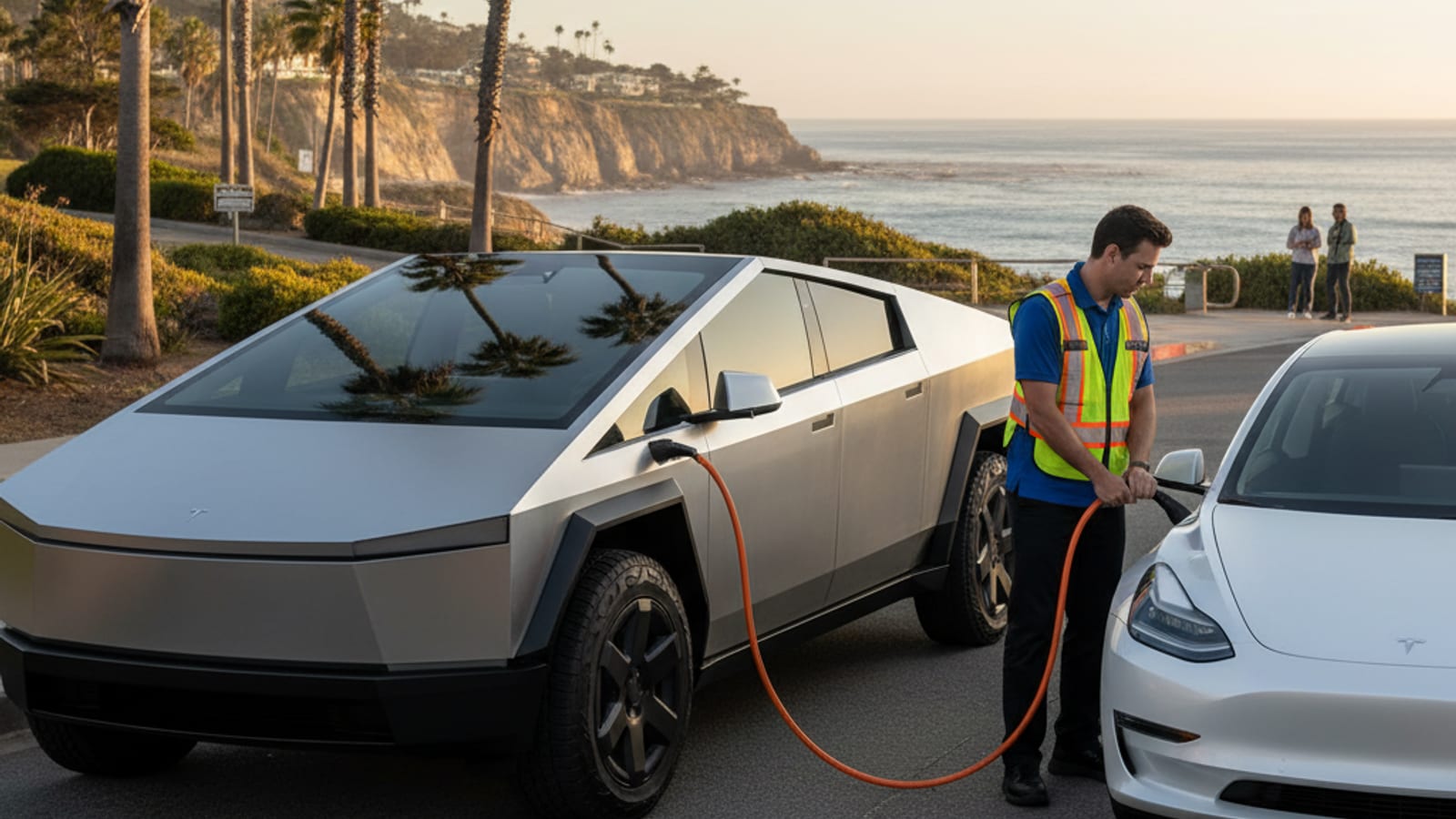
You are not in Miami. You are on an island.
People mix the names constantly. Miami Beach is its own city. South Beach is a neighborhood of Miami Beach. It is not a separate city. The City of Miami sits across Biscayne Bay. Neighbors include Surfside, Bal Harbour, Key Biscayne, and North Bay Village. Do not confuse this island with North Miami Beach. That is a different city. Despite the name, it is mostly not on the beach.
The island covers about 7.693 square miles. Census ACS 2019-2023 puts the population at 81,319. The 2024 estimate is 83,251. ZIP codes here are 33109, 33139, 33140, and 33141. Daily driving hugs Collins Avenue, Ocean Drive, Alton Road, and Washington Avenue. Lincoln Road, the Art Deco district, and the Miami Beach Convention Center pull visitors into the same dense blocks. The New World Symphony sits in that South Beach cluster.
Valet lines and event garages keep cars awake for hours. Sentry mode still watches the lot. Cabin climate still fights the heat. The phone still pings the car. All of that nibbles at the 12-volt system. The high-voltage pack may still have range. The car still will not wake.
There is no hill to blame. Miami-Dade’s highest natural ground is the Atlantic Coastal Ridge. It sits about 23 to 24 feet. Range here is heat, air conditioning, and time sitting still. Salt air is the other tax. It is hard on a 12-volt battery.
Why a low battery here feels like a locked gate
On the mainland, a thin range number can still mean a few more streets. On this island, the next useful move is often a bridge. The MacArthur, Julia Tuttle, and Venetian causeways are the exits. If the pack is too low to trust that crossing, you are stuck in place. You are not choosing a different neighborhood. You are waiting for power, or for a wrecker.
Hotel and condo towers add a second problem. About 68.4 percent of Miami Beach housing was built before 1980. That figure is ACS 2019-2023. Older apartment stock is a proxy for panels never meant for a dedicated stall charger. Plenty of residents and guests park without a plug of their own in the building. Florida Power and Light serves the city. FPL EVolution is the utility’s public charging brand. EVolution Home is the residential Level 2 program. FPL also publishes a residential Time-of-Use rate for home charging. Confirm those program details on fpl.com. None of that helps in the hour a valet ticket will not start the car.
Convention weeks make the same pattern louder. The Miami Beach Convention Center fills Mid-Beach garages. South Beach restaurants and Ocean Drive nights keep cars in stacked lots. A car that sat through a long event is a classic 12-volt failure. It is often not an empty pack.
The same story shows up after a cruise. PortMiami parking pages list northside garages A, AA, B, C, D, F, and G. They list southside J and K, plus surface Lot E. Those pages do not list EV charging at any PortMiami facility. You come back to a silent car. You assume the pack is dead. Often it is the small battery that kept the electronics alive in the heat.
Heat does the range work that hills do elsewhere
NWS Miami 1991-2020 normals put July and August average highs at 91F. A normal year has about 64 days at or above 90F. Recurrent Auto studied about 30,000 EVs. That fleet work finds about 5 percent range loss at 90F. It finds about 17 to 18 percent at 100F. Cooling a 95-degree cabin can take 3 to 5 kW at first. Holding it cool takes about 1 kW. AAA’s 2019 SAE-standard test found about a 17 percent range drop at 95F with the AC on. That is the Miami Beach math. The AC runs most of the year. There is no grade to recover on the way home.
King tides run mainly September through November. They last about three hours. They hit these low coastal streets. Miami-Dade publishes that pattern for Miami Beach. If saltwater reached the charge port or the floor, stop. NHTSA warns that residual salt in a flooded lithium pack can short later. Fires can start days to weeks after. A flood-exposed EV should not sit within 50 feet of a structure. It should not be driven or charged until it is inspected. Hurricane Ian in 2022 left about 36 flooded EVs that later caught fire. FPL tells owners to keep the pack between 50 and 80 percent through hurricane season. Unplug during the storm. Skip charging a flood-exposed car until it is checked. Miami Beach sits in Storm Surge Planning Zone B.
Hurricane season runs June 1 to November 30. That is NOAA and the National Hurricane Center. If you are leaving on an evacuation order, you need range you can trust. Do not wait until a causeway is the only road left in your plan. Evacuation routes north include I-95, Florida’s Turnpike, and I-75.
Empty pack, dead 12V, or a car that should not move
Three different failures look identical from the sidewalk.
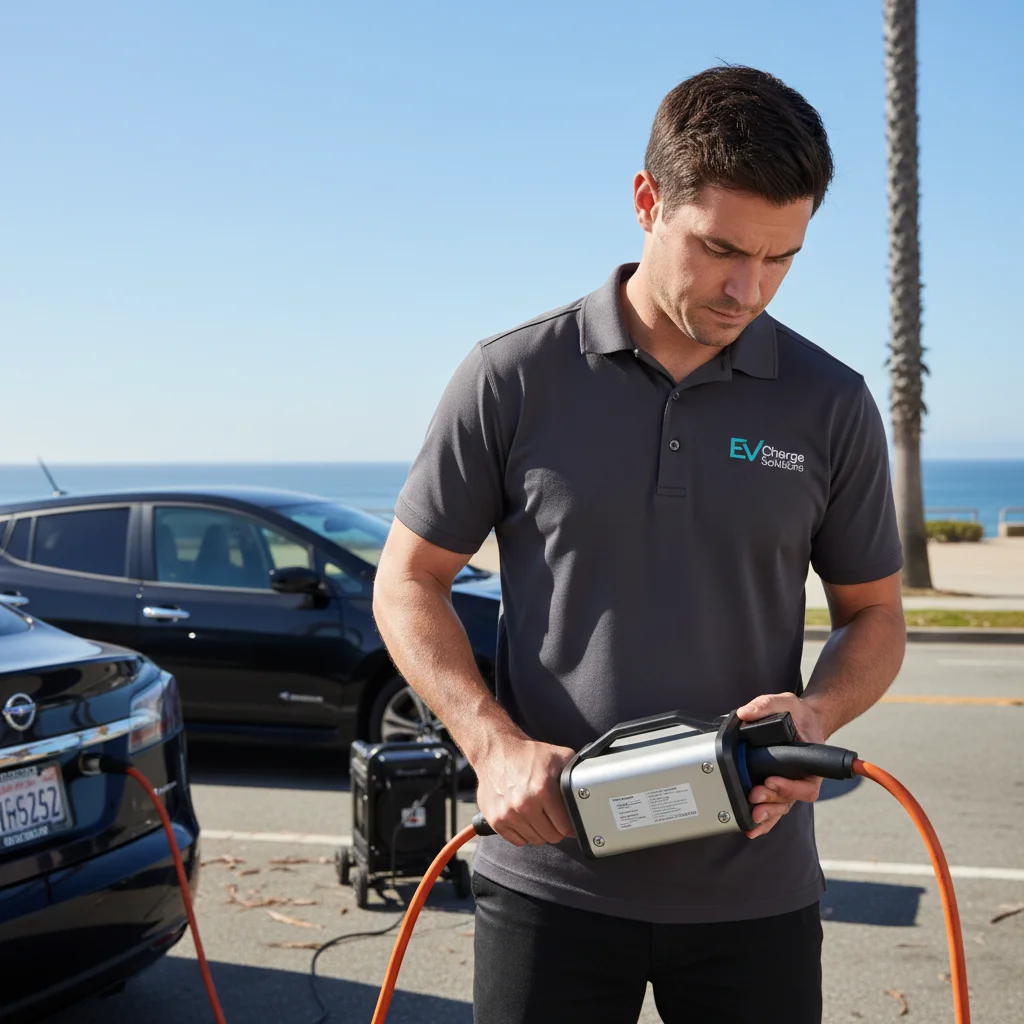
An empty high-voltage pack is the simple one. The car is on. The display talks. Range is zero, or close to it. You cannot risk the Julia Tuttle or the MacArthur. Mobile EV charging is built for that. Operators bring a 240V Level 2 source to the car. Teslas take a native NACS plug. Other EVs take CCS or a J1772 adapter. The point is not a full pack. It is typically 10 to 20 miles of range. That takes 15 to 30 minutes of charging. That is charging time. It is not a promise about when someone arrives. Then you drive off the island toward the plug you meant to use.
A dead 12-volt is the silent one. Doors may not wake. The screen stays black. The pack can still be half full. Open the app if you can. See whether it still reports a pack percentage. A healthy pack with a dead 12-volt is a jump job. A pack at zero is a charge job. If the app is dark and the car is dark, treat it as a 12-volt until an operator says otherwise. Heat halves lead-acid life about every 15F, per Battery University. It ages about twice as fast at 93F versus 77F. It ages about four times as fast at 111F. Salt air on a barrier island does not help. A Tesla 12V jump on site is often the whole job. The same 12-volt failure hits other brands. The operators we connect you with handle Tesla and every major EV.
Water in the port is the third case. After a king tide on Collins, or a garage that took on water, do not force a charge. Get the car inspected first. A rescue that plugs into a wet port is the wrong call.
Charge Pro MIA is a referral line. We match stranded drivers with independent local mobile rescue operators. We do not own trucks. We do not employ technicians. We do not hold a trade license. We do not set prices. We do not publish hours. We do not promise an arrival window. The operator quotes you before starting. The operator bills you directly. The pros we connect you with are licensed and insured.
What this rescue is not
A mobile stop is not a home charger. It is not a full pack. FPL EVolution Home is the utility program for a stall install. That is a different job, on a different calendar. Tonight is range to leave the island. Or it is a 12-volt that lets the car wake.
A mobile stop is also not FPL’s storm trailers. FPL deploys mobile EV charging trailers before planned outages and during storms to aid evacuations. The Florida Division of Emergency Management has deployed temporary EV chargers along the I-75 evacuation corridor. Those are emergency-management tools. They are not a private rescue on Ocean Drive after dinner.
A wrecker is a third path, and it is a last one for many EVs. Lots of electric drivetrains should not be flat-towed. A charge or a jump on the island often keeps the car off a hook.
What to do if you are already in a travel lane
If you stalled on a causeway or a highway approach, Florida Statute 316.194 is the rule. A vehicle must sit off the main-traveled part where practicable. Leave room for passing traffic. Keep a clear view from 200 feet each way. Statute 316.194(2) exempts a genuinely disabled vehicle. That exemption applies when it cannot practicably be moved off the road. Statute 316.1945 lists other places you must not stop.
Dial *FHP (*347) from your phone. That reaches Florida Highway Patrol. It also reaches the Road Ranger Service Patrol. Road Rangers are FDOT’s free highway service patrol. They jump-start vehicles. They make minor repairs. They change flats. They provide gas, diesel, and water. They tow a disabled vehicle from the travel lanes to the nearest safe location. District 6 covers Miami-Dade. It patrols I-95, 95 Express, I-195, I-395, I-75, 75 Express, and SR-826, the Palmetto. No Road Ranger material we read on 2026-09-18 mentions electric vehicles or EV charging. They still jump a 12-volt. They still move you off a live lane. They do not bring a Level 2 charge. That is why people call for EV roadside assistance after the shoulder is safe.
Florida 511 at FL511.com is FDOT’s traffic feed. It runs in English and Spanish. Check it before you assume a causeway is moving.
Do not stand in a travel lane to wait for a quote. Get the car and yourself out of traffic first. Then talk to an operator about a charge or a 12-volt jump.
A garage tow is not a small errand
South Beach valet lots and hotel garages post tow-away rules. Florida Statute 715.07 governs towing from private property. A tow operator must stop and return the vehicle if you appear before it is fully removed. You then pay no more than one-half the posted tow rate. The property needs a permanent, reflective, correctly sized tow-away sign at each access. That sign must be posted at least 24 hours ahead. Exceptions exist for a single-family home, or when personal notice is given. In a county over 500,000 people, the car must be stored within a 10-mile radius. Miami-Dade qualifies. The operator must release it within one hour of request. The operator must file its rate schedule with local law enforcement. It must post that schedule at the storage site.
Miami-Dade caps nonconsent tow rates in Code Section 30-476. We could not load a current rate table from the county page on 2026-09-18. We will not guess a number. Confirm the posted rate at the lot. Confirm it with Miami-Dade Consumer Protection before you pay. A charge on site can keep you out of that process. For why a wrecker on a dead EV gets messy, read why towing a dead EV in South Florida gets messy. Many EVs should not be flat-towed. A mobile charge or a 12-volt jump often avoids the hook.
The operator quotes you, not the referral line
Distance moves the price. Time of day moves the price. How much range you need moves the price. An island call can mean crossing a causeway in traffic. A Convention Center garage is a different setup than a street stall on Ocean Drive. A 12-volt jump is not the same job as a Level 2 top-up. Charge Pro MIA does not publish a price. The operator who comes to you quotes before work starts. If the quote is not a fit, you can decline. Florida is an all-party consent state under Statute 934.03(2)(d). The phone line’s recorded-line notice is there for that reason.
Do not wait for a number you saw on a blog. Confirm it with the person doing the work.
Collins, Alton, and the rest of the island
South Beach is the dense end. Ocean Drive and Washington Avenue stack hotels, clubs, and Art Deco blocks. Alton Road runs the west side. Collins Avenue is the spine through Mid-Beach and North Beach. Sunset Harbour sits on the bay side. North Beach runs toward Surfside. Each pocket has the same causeway math. You still leave on a bridge.
A weeknight on Lincoln Road is not a trip across inland Miami-Dade. You are already on the island. If the pack is thin late, you do not have a grid of inland streets to coast through. You have water on both sides.
Mid-Beach is Convention Center traffic. North Beach is the run toward Surfside. Sunset Harbour is quieter bay-side streets. The water still rings all three. A low pack in North Beach does not let you head inland without a bridge. If you are going to Bal Harbour, you are still on the barrier strip. Surfside sits between you and that border. Key Biscayne is a different causeway, south of the City of Miami. Do not treat those islands as one place.
If you are comparing notes with the next barrier island, stuck on Key Biscayne with a dead EV walks that crossing. A related Miami Beach night is out of charge on Miami Beach with no building plug.
We serve every city in the county, and the rest of South Florida. Operators handle Tesla roadside rescue, out-of-charge recovery, and non-Tesla EV rescue. They do not promise a clock. They tell you what they can do once they have your pin.
How the call actually goes
You share a pin, a garage level, or a causeway shoulder. You name the make and model. You say whether the car is silent or showing zero miles. That split decides a jump versus a charge. An independent operator calls you with a quote. If you accept, they bring the 240V source or the 12-volt gear. They add enough range to leave the island, or they wake the car. Then they bill you. That is the whole loop.
Keep hazards on if you are near moving traffic. Stay behind a barrier if you have one. Do not stand between the car and a travel lane.
If the car still will not take a charge after a jump, stop. A repeated 12-volt fail can mean the small battery is done. It can also mean a deeper electrical fault. That is a shop job, not another roadside top-up.
Frequently asked questions
Can they help a Tesla and a non-Tesla on Miami Beach?
Yes. Operators bring a native NACS plug for Tesla. They carry CCS or J1772 adapters for other EVs. Ford, Chevy, Hyundai, Kia, Rivian, Porsche, and the rest are in scope. Tell them the model when you call so they roll with the right adapter.
What if I stalled on the MacArthur or the Julia Tuttle?
Get out of the travel lane if you can. Dial *FHP so Road Rangers can move you to a safe spot. Then call for a mobile charge or a 12-volt jump. Road Rangers do not publish an EV charging service. A Level 2 top-up is the operator’s job once you are clear of live traffic.
Who sets the price for a mobile charge here?
The operator does. Charge Pro MIA does not. Distance, hour, and how much range you need all move the quote. You hear the number before work starts. Confirm it, then decide.
If you need EV roadside assistance on Miami Beach, call (786) 963-2995. We connect you with a local operator. They quote you. They do the work. You leave the island when the car can take a causeway again.