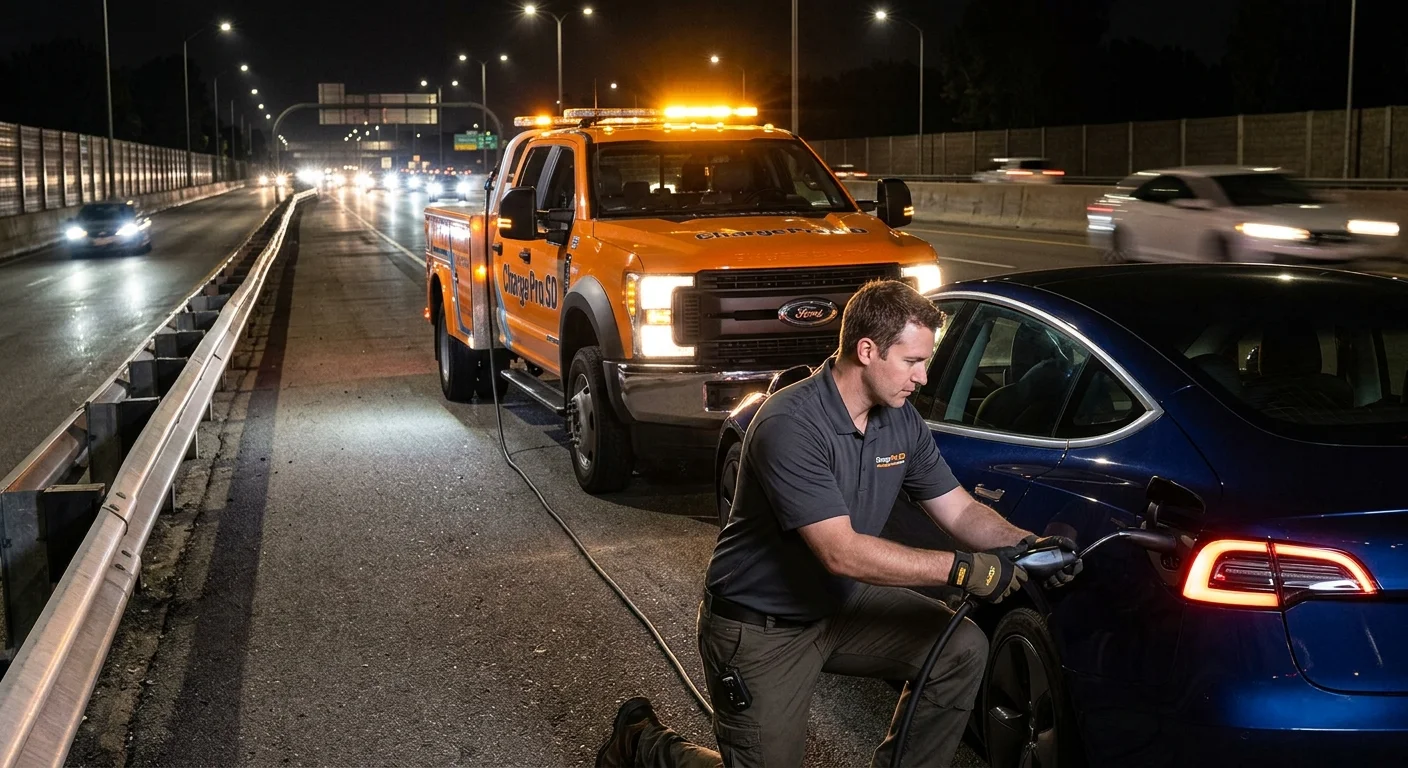
An empty EV on Miami Beach is stuck on a barrier island. Every way out is a causeway, not the next block. Emergency EV charging Miami Beach is a truck that comes to the car. Many condo and hotel buildings have no plug you can use tonight.
Why a low car gets pinned on this island
Miami Beach sits in Miami-Dade County on a thin barrier island. You reach it only by the MacArthur, the Julia Tuttle, or the Venetian causeways. Collins Avenue, Ocean Drive, Alton Road, and Washington Avenue never leave that sand. If the pack is already low, those bridges are the whole problem.
South Beach is a neighborhood, not its own city. Miami Beach is also not the City of Miami. Neighbors include Surfside, Bal Harbour, North Bay Village, and Key Biscayne. Each one still needs a causeway if you’re trying to leave. The Miami Beach charging page covers the same island geography.
About 68.4% of Miami Beach housing was built before 1980, per Census ACS 2019-2023. Older condo and apartment stock often can’t take a home charger. FPL serves the island. FPL EVolution Home is the utility’s residential Level 2 program. That program doesn’t help you in a valet stall tonight. Your building may still have no assigned plug. Start with what a Level 1 charger is in a condo.
South Beach packs valet, hotel, and event garages. They cluster around Lincoln Road, Ocean Drive, and the Art Deco district. A car can sit awake for hours at the Miami Beach Convention Center. The same thing happens near the New World Symphony. That idle draw is how a low pack becomes a car that won’t roll.
Low pack, empty pack, or a 12V that won’t wake
A low pack and a dead car aren’t the same job. Many EVs drop into limp or turtle mode while some range remains. Dash warnings stack. Some cars still crawl on a small reserve after the gauge reads zero. Use those miles to reach a safe curb. Don’t invent a new route mid-block. Our low-battery checklist is for that window.
Zero on the high-voltage pack is a different mess. The car may not shift, unlock, or hold hazards for long. A separate 12V battery runs lights, locks, and computers. Salt air and heat on this island are hard on that small battery. A car that sat in Mid-Beach for a week may be a 12V failure. North Beach and Sunset Harbour see the same sit-and-die pattern. It may not be an empty pack.
If the doors won’t open, treat it as a 12V problem first. The operator can jump or replace a dead 12V on site. They handle Tesla and every major EV brand. Don’t assume you need a flatbed because the screens are black.
Get off the travel lane before you shop for a plug
If you still have motion, coast to a shoulder or a legal pull-off. Hit the hazards. Stay belted inside if traffic is close. The cabin is safer than standing in a lane.
Don’t try to push the car. The pack makes an EV much heavier than a similar gas model. If you’re on a highway or causeway, Florida Statute 316.194 applies. Leave the main-traveled part where practicable. 316.194(2) exempts a genuinely disabled vehicle that can’t be moved off the road.
If you’re blocking a lane, call 911 so police can hold the scene. You can also dial *FHP (*347) for Florida Highway Patrol. FDOT’s Road Ranger Service Patrol is free. Crews jump-start vehicles, make minor repairs, and change flats. They also tow a disabled car from the travel lanes to the nearest safe spot. District 6 covers Miami-Dade. It patrols I-95, 95 Express, I-195, I-395, I-75, 75 Express, and SR-826. I-195 is the Julia Tuttle. Road Ranger materials don’t mention EV charging. They can still jump a 12V or move you off a lane. A Level 2 charge is the piece they don’t bring. What to do on a freeway when the pack hits empty covers the same first moves.
A mobile Level 2 plug versus a wrecker
A wrecker isn’t always the next move. If the 12V is dead, the car may not go into neutral. A bad hook can damage a motor. A flatbed is the safer tow. It still leaves you needing a charge after the drop.
Charge Pro MIA is a referral line. It matches you with an independent local operator. The brand owns no trucks and does no work itself. The operator quotes you before starting, then bills you directly. For an empty pack, ask for out-of-charge recovery or mobile EV charging.
If a garage starts a non-consent tow, Florida Statute 715.07 has rules that matter. The tow operator must stop and return the car if you appear before it’s fully removed. You then pay no more than half the posted tow rate. Miami-Dade Code Section 30-476 caps those non-consent rates. Confirm the current posted figure with the yard before you pay. In this county the car must be stored within a 10-mile radius. It must be released within one hour of request.
What the operator brings, and how much range you get
Give the dispatcher your street or garage name, the make and model, and a callback number. The operator covering that stretch of the island quotes the job first. No cable goes in before that quote.
The truck brings a 240V Level 2 source to the car. Teslas take a native NACS plug. Other EVs use a CCS or J1772 adapter. Charging time is typically 15 to 30 minutes. That’s time on the plug, never a promise of when the truck arrives. Most jobs add about 10 to 20 miles of range. That’s usually enough to get you rolling again. You pick the next stop with the operator. Name a charger you already use, a friend’s building, or home if you have a plug. This page isn’t a station map. A live site inventory couldn’t be confirmed from public feeds.
Heat, salt, and water on the same streets
There’s no hill penalty on range in Miami-Dade. The county’s highest natural point is the Atlantic Coastal Ridge, about 23 to 24 feet. Range here is heat, air conditioning, and time sitting still. NWS Miami 1991-2020 normals put July and August average highs at 91F. A normal year sees about 64 days at or above 90F.
Recurrent Auto’s fleet study of about 30,000 EVs finds about 5% range loss at 90F. The same study finds about 17 to 18% loss at 100F. Cooling a hot cabin can take 3 to 5 kW in the first minutes. Holding it cool takes about 1 kW. AAA’s 2019 SAE-standard test found about a 17% range drop at 95F with the AC on. AC runs most of the year on this island.
King tides hit Miami Beach mainly from September through November. Each pulse lasts about three hours. Low streets and garages can take water on those days. If the car sat in saltwater, stop. NHTSA warns residual salt in a flooded lithium pack can short later. That can happen days or weeks on. Don’t drive or charge a flood-exposed EV until it’s inspected. Keep it at least 50 feet from a structure.
Miami-Dade Storm Surge Planning Zone B includes Miami Beach. FPL tells EV owners to keep the pack between 50 and 80% through hurricane season. Unplug during the storm. Don’t charge or drive a flood-exposed car until it’s inspected.
Every roughly 15F rise in temperature halves the life of a lead-acid 12V. Heat damage doesn’t reverse. A car that sat through a hot week in a Collins Avenue garage may not wake. That can happen even with miles still on the pack.
Condo towers, valets, and a building with no plug
Sunset Harbour, Mid-Beach, and North Beach repeat the same housing pattern. Towers and older walk-ups weren’t built around a 240V stall per unit. You may live above a garage with no assigned EV plug. A dead car at home is still a roadside job on this island.
A valet garage isn’t your driveway. You usually can’t drop a household cord across that floor. Event nights at the Convention Center keep cars sitting for hours. Systems stay awake. You come back to a brick. For the local rescue path, see EV roadside assistance in Miami Beach.
When to call, and what we won’t promise
If the pack is empty, or the car won’t wake, make the call. Reach Charge Pro MIA at (786) 963-2995. We connect you with a local independent operator. They quote before they start. They don’t publish arrival times, and neither do we.